A uPVC door that drops, catches on the frame or needs a shoulder to lock is very often a hinge problem, not a lock problem. Most hinges can be adjusted in three directions, but a worn, cracked or loose hinge needs repair or replacement, and the sooner it is dealt with the less strain the lock, seals and frame take. At Cloudy2Clear Windows we repair door hinges, locks and handles for homes, businesses and housing associations, so this guide shows you how to tell the faults apart and what a proper repair involves.
How to recognise a hinge problem
A uPVC door hangs on three or more hinges, which carry the whole weight of the door and keep it square in the frame. When one of them loosens or wears, the door sags a little. You rarely see the sag. You notice what it causes:
- The door catches or rubs on the frame, usually at the bottom corner on the lock side.
- The handle lifts but the key or latch only turns with extra force.
- The door needs a pull or a push, or a lift, to engage the locking points.
- A gap appears along the top or the hinge side, while the opposite side looks tight.
- You can see daylight at the threshold, or feel a draught around the closed door.
- A hinge looks loose, a screw is missing, or the cover cap has come off.
The pattern matters. A door that is tight in one corner only, and tight all year, points to alignment. A door that sticks in warm weather and eases in winter has a different cause, which we cover below.
Why uPVC door hinges fail
The causes are usually a mix of the following.
Weight and daily use
A modern door with a double glazed unit is heavy. Every opening and closing puts the same load through the same few screws. Over years, fixings work loose and the hinge pins and bearing surfaces wear. Doors that are slammed, leaned on or used by many people, such as communal entrances in housing association blocks and shop back doors, wear faster.
Loose or stripped screws
A uPVC frame is a hollow plastic profile with thin walls. A screw that passes through one thin wall has little to grip, and each use widens the hole a little more until the screw simply spins. That is why a hinge can look fine and still let the door drop.
Building movement and weather
Settlement, a shifting threshold or a door that has been knocked against the brickwork can all change how the door sits in its frame. Replacement doors and windows should be fitted with the correct movement gap around the perimeter, as the Glass and Glazing Federation’s good practice guide sets out, so a door that was fitted tightly in the first place is more likely to bind later.
Heat expansion
Plastic expands in sun and contracts in the cold. A door that only sticks in summer may be swelling, not dropping. Our guide on why uPVC doors stick in UK homes explains how to tell the difference.
Hinge fault or lock fault? A simple check
This is the step people skip, and it is where the wrong repair gets chosen. A stiff lock is not always a lock fault. When a door has dropped, the keeps (the metal plates the bolts and hooks engage with) no longer line up with the locking points. Pushing the key or handle against that misalignment wears the latch and strains the multipoint lock gearbox.
Try this:
- With the door open, lift the handle and turn the key. Do this a few times and note how it feels.
- Close the door and repeat.
- If the lock works smoothly when the door is open but becomes stiff once it is closed, the door is probably out of alignment.
- If the lock is stiff or gritty in both positions, the fault is more likely inside the cylinder, latch or gearbox.
- Look at the bolts and hooks as the door closes. If they land to one side of, or above or below, the keeps, the hinges are the place to start.
The symptom alone does not tell you which part has failed, and changing a lock when the real cause is a sagging door will not cure the problem. If the second test points to the lock itself, our guide to uPVC door lock problems covers the checks and repairs.
How hinge adjustment works
Most modern uPVC door hinges, often called flag hinges, are adjustable in three directions:
- Height: raises or lowers the door in the frame.
- Lateral (side to side): moves the door towards or away from the hinge side, changing the gaps either side.
- Compression: moves the door closer to or further from the frame, changing how firmly it presses on the seals.
The ranges are small, and they depend on the hinge model. One manufacturer’s trade adjustment sheet for a Liniar hinge lists a 5 mm Allen key, about 4 mm of height adjustment, about 4 mm either way laterally and about 1 mm of compression. Those limits are for that hinge. Other makes differ, which is why a door that has dropped further than a few millimetres cannot be brought back by adjustment alone.
The basic sequence
- Open the door and remove the cover caps. They pull or clip off the hinge. Keep them safe, as they are easy to lose and they hide the adjusting screws.
- Check every hinge for tightness first. Tighten any loose fixing screws before adjusting anything. Adjusting a hinge that is loose in the frame gives a false result.
- Support the door. The weight should be carried evenly across all hinges. Overstressing one hinge while the others hang loose is a common way to damage it.
- Adjust height first. Small turns of the Allen key on the hinge, then check the gap at the top and the bottom.
- Adjust lateral position. Aim for an even gap down the hinge side and the lock side.
- Adjust compression last. Close the door and check the seal contact. Too tight and the door is hard to close; too loose and it lets in draughts.
- Tighten the grub screws and refit the cover caps. Grub screws are the small locking screws that hold the setting.
- Test the lock. Close the door, lift the handle and turn the key. It should work without force or lifting.
Where it goes wrong
- Turning one hinge a long way instead of making small changes across all of them.
- Adjusting before tightening loose fixings, so the setting does not hold.
- Forgetting that lateral and height changes affect each other, so the door looks right at the top and wrong at the bottom.
- Skipping the lock test. A door can look square and still not engage the locking points properly.
- Running out of adjustment and forcing the screw further, which can crack the hinge.
If a door has dropped repeatedly, or you reach the end of the adjustment range, stop there. That is the point where the problem is no longer a setting.
When adjustment is not enough
Adjusting is the right first move when the door catches or is stiff to lock and the hinges look sound. It is the wrong one in these cases:
- A cracked, bent or rusted hinge. The metal has failed and will not hold a setting. Replace it and check the others, as they have been carrying the same load.
- A worn pin. The door rocks or clunks when you lift and lower it.
- Screws that turn but never tighten. The hole in the plastic is worn out. A thicker repair screw in the same hole, often around 25 mm, can bite into fresh material. Wood screws should not be used, because their coarse thread splits uPVC.
- A door that still drops after the hinges reach their limit. On a glazed or panelled door this often means the sash has gone out of square, and the glass is packed in the wrong places. That needs the glazing packers repositioned, not more hinge work.
- A missing screw. One missing screw puts extra load on the rest. The door will keep dropping until it is replaced correctly.
A fully dropped door is a more serious version of the same fault. Our guide to a dropped uPVC door explains how to judge when a repair is needed, and if the door will not shut at all, this guide to doors that will not close lists the other causes.
Hinge problems that look like something else
A hinge fault can imitate several other faults, which is why accurate diagnosis saves repeat visits.
| What you notice | Hinge cause | Other possible cause |
|---|---|---|
| Key stiff when the door is closed | Door dropped, keeps out of line | Worn cylinder or gearbox |
| Draught at the threshold | Door sagging, compression lost | Worn or flattened seals |
| Handle loose or floppy | Door movement loosening fixings | Handle screws or spindle worn |
| Door sticks in summer only | Hinges at their limit | Heat expansion of the frame |
If the handle is the main complaint, see our guide to a loose uPVC door handle. If the problem is a draught, replacing seals and keeping trickle vents open may be part of the answer.
Door hinge repairs across England and Scotland
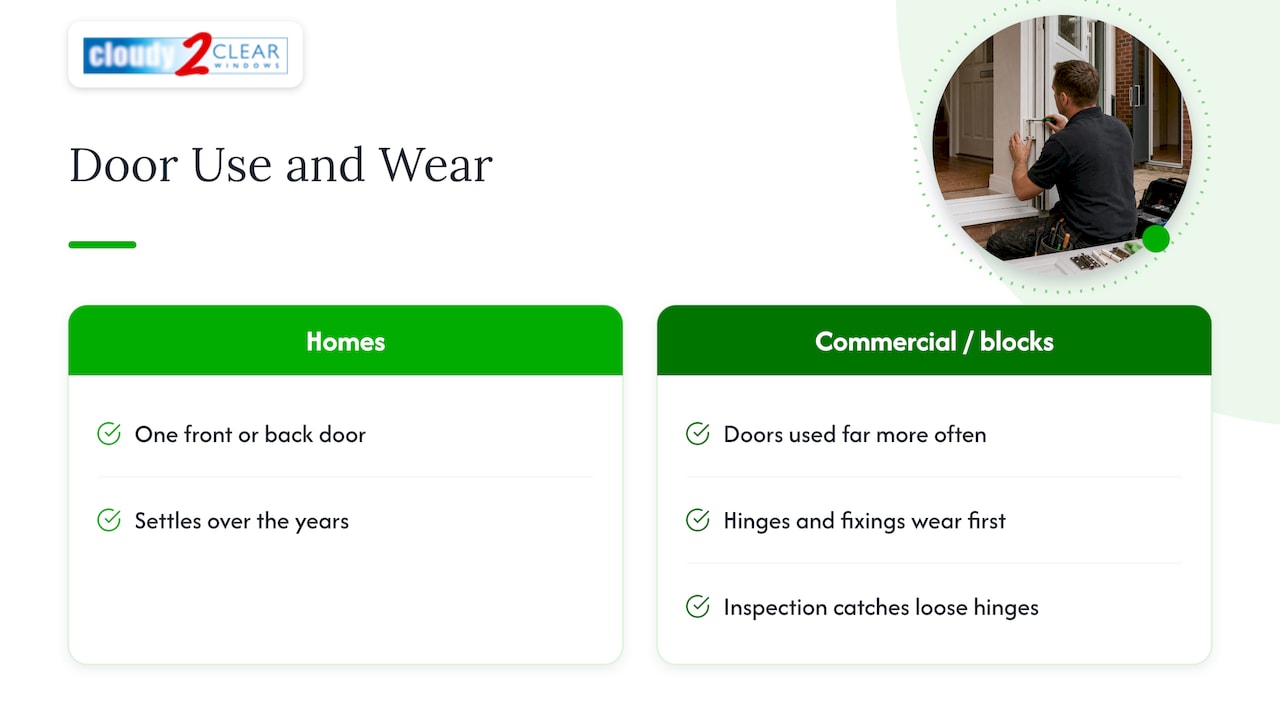
We work with home owners, business owners and housing associations, and the faults are much the same in each. Homes tend to have a single front or back door that has settled over the years. Commercial premises and housing association blocks have doors that are used far more often, so hinges and fixings are the first parts to wear. For communal and commercial doors, regular inspection means a loose hinge is found before the door drops and damages the lock or the frame. Our commercial fenestration and inspection service is set up for exactly that kind of property.
Our coverage is nationwide, and we have local branch pages where you can find your area. For example, if you are looking for door hinge repairs in Stockport, you will find our Stockport branch page. We also have branches covering Wigan, Coventry, Milton Keynes, Norwich and Oxford, among others.
What a professional hinge repair involves
With a door that has gone beyond a simple adjustment, the question is the cause, not only the symptom. A professional repair works through the same chain you have seen above: check the fixings, check the hinges, check the alignment of the door in its frame, then check the lock and keeps once the door is square. The result is a door that closes without force, locks with a light turn and sits evenly against its seals.
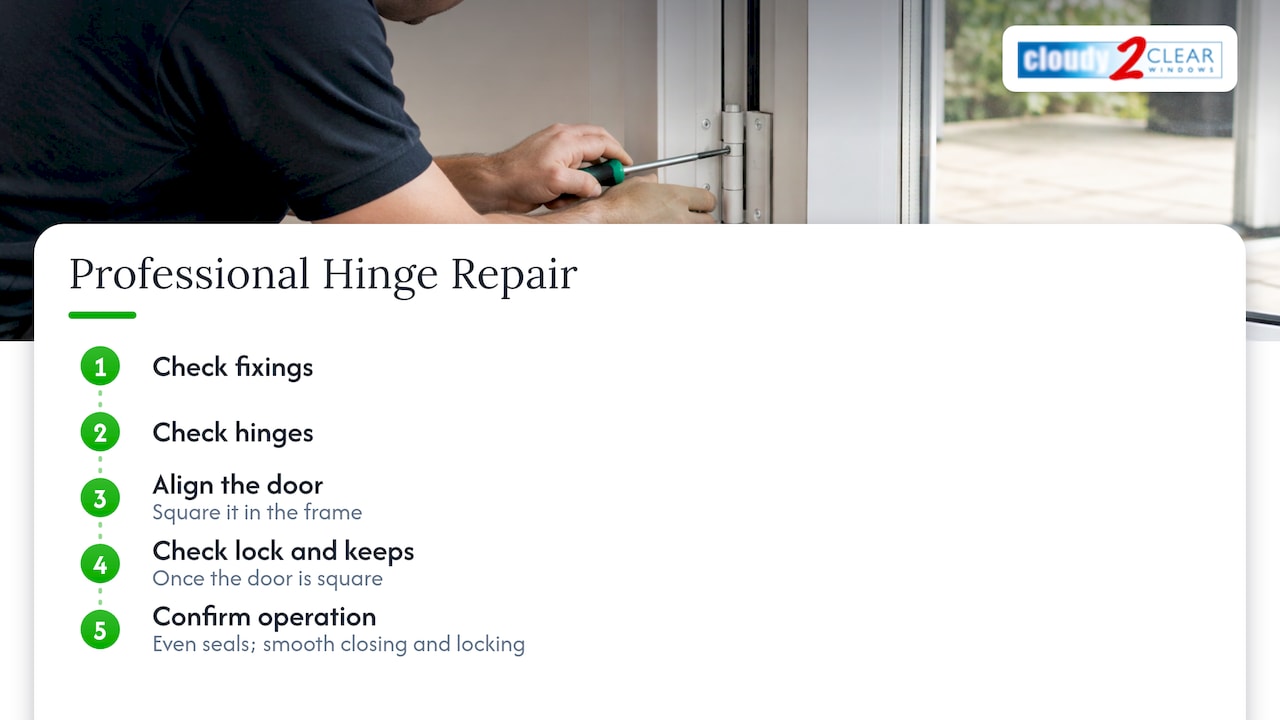
That order matters. Replacing a lock first, when the door is simply hanging low, means the new lock is soon put under the same strain as the old one. Starting with the hinges and the door position protects whatever you fit afterwards.
We repair double glazed door glass, locks, handles and hinges, so one visit can look at the whole door rather than a single part. You can read more on our lock, hinge and handle repairs page, and our double glazed door repairs page covers the door glass itself.
Book a hinge repair with Cloudy2Clear Windows
If your door is dropping, catching or hard to lock, we can look at the hinges, the door position and the lock together. We have been installing, replacing and repairing double glazed windows and doors for homes and businesses since 2005, and our team handles hinge, lock and handle repairs as part of the same service.

You can call us 24 hours a day, 7 days a week to book a quote. Our operational hours are 8.30am to 6.30pm. Start with our locks, handles and hinges repairs page, or visit the Cloudy2Clear Windows home page to find the right service.
Our view on hinge problems
We see a hinge problem as the start of a chain. The hinge loosens, the door drops a few millimetres, the keeps stop lining up, and then the lock, the seals and the handle all start to suffer. That is why we look at the whole door when we are asked to repair one part of it.
Our approach at Cloudy2Clear Windows is repair first. Many door faults come from a worn fixing or a small misalignment, and a repair puts the door back in working order without replacing more than needs replacing. The same thinking runs through our glass-only work: we replace what has failed and leave what is sound.
For landlords, housing associations and business owners, we would encourage regular checks over reacting to a failure. A hinge that is tightened or replaced early protects the lock and the frame, and keeps the door secure.
Frequently asked questions
Can I adjust uPVC door hinges myself?
Most modern flag hinges have adjusting screws for height, side to side and compression, and they are set with an Allen key. Tighten loose fixings first, adjust in small steps across all hinges, then test the lock. If the door has dropped beyond the adjustment range, or a hinge is damaged, a repair is the better route, and we can help with that.
Why does my uPVC door keep dropping after I adjust it?
The usual reasons are worn screw holes that will not hold a fixing, a hinge with a worn pin, or a sash that has gone out of square. In each case the setting will not hold, because the underlying part has failed. A proper repair deals with the cause, not just the position of the door.
Is a stiff lock always a lock fault?
No. A dropped or shifted door forces the lock out of line with its keeps, which makes the key and handle hard to use. Test the lock with the door open and then closed. If it is smooth open and stiff closed, alignment is the likely cause.
Do you cover both England and Scotland?
Our coverage is nationwide, and we work with home owners, business owners and housing associations. Call us at any time, day or night, to book a quote.