Mould around windows is almost always a moisture problem, and the fix depends on where the moisture comes from. Warm indoor air meets a cold surface and condenses, a seal or frame lets water in, or a failed glass unit stops insulating. A small patch on a hard frame can be cleaned safely in minutes, but cleaning only treats the symptom. If the glass itself has failed, replacing the glass unit is what removes the cause. At Cloudy2Clear Windows we replace only the glass and keep your existing frame, which means less disruption and a faster job than replacing the whole window.
This guide explains why mould appears on frames and sills, how to tell condensation from a leak, how to remove black mould safely, and how to keep it from returning. It also covers what landlords and housing associations need to know about the latest damp and mould rules.
Why mould grows around window frames and sills
Mould needs moisture, something organic to feed on and a reasonable temperature. Window frames and sills give it all three, particularly in winter. Dust, silicone sealant, paint and timber all give it something to grow on.
The moisture usually comes from condensation. The UK Government’s damp and mould guidance explains that condensation forms when moisture in indoor air meets cold surfaces, which is why window frames and sills are such common places to find it. Cooking, showering, drying washing indoors and even breathing all add water vapour to the air. Glass and frames are often the coldest surfaces in a room, so that vapour lands there first.
That explains why the black speckling tends to collect in the bottom corners of the glass, along the sealant line and on the sill. These are the spots where water pools and stays damp longest.
What mould on windows looks like
Mould on windows usually appears as black, green, white or orange spots or fuzzy patches on the frame, sill or corners. Black mould on silicone sealant is particularly common, because the sealant stays damp and holds a little dirt. Mould on painted timber sills may show as dark patches that return soon after cleaning.
Condensation or a leak: how to tell the difference
This is the most useful question to answer before you reach for a cleaning spray, because the two problems need different repairs.
| Sign | Points to condensation | Points to a leak or water ingress |
|---|---|---|
| Where it appears | Glass, frames and sills, often in cold weather | Around the frame edges, reveals or below the window |
| Marks left behind | Usually no tidemark | Often a tidemark or stain |
| Pattern | Worse on cold mornings, better when the room is warm and aired | Appears after rain, whatever the indoor conditions |
| Where the moisture sits | On the room-facing side of the glass | Inside walls, around the frame or between the panes |
North Devon Council says condensation often appears near windows and in poorly ventilated areas, especially in cold weather, and does not usually leave a tidemark. The same council lists leaking pipes, rain getting in around window frames, roof defects and blocked gutters as non-condensation causes, which often leave a tidemark and need the moisture source repaired.
More than one cause can exist at once. The UK Government guidance notes that surface cleaning alone will not prevent recurrence when the underlying cause is still there. If you want a deeper explanation of the distinction, our guide to condensation versus damp walks through it.
When the glass unit itself is the problem
A double glazed unit is two panes sealed with a gap between them. When that seal fails, the unit stops insulating properly. You may see a cloudy film or droplets between the panes that you cannot wipe away, and the inner pane can feel colder than it should. A colder surface means more condensation on the room side, and more condensation means more mould on the frame and sill beside it.
In that situation, wiping the frame will only give you a few clean days. The lasting answer is a new sealed glass unit in the frame you already have. This is exactly the job we do: double glazing replacement of misted, cracked or failed panes, with the frame left in place.
How to remove black mould from window frames safely
For a small amount of mould on a hard surface such as a uPVC frame, the UK Government guidance says to use an appropriate mould and mildew cleaner and follow the label. Here is a sensible routine based on that advice and on the RICS consumer guide to damp and mould, which treats removal itself as a possible exposure risk.
- Photograph it first. The UK Government guidance recommends documenting and photographing mould before removal because it helps identify the source. Tenants will also want these pictures for their landlord.
- Protect yourself. Wear gloves, a mask and goggles.
- Contain the spores. Keep the room door shut so spores do not spread to other rooms, and open the window for ventilation.
- Apply the cleaner as the label directs. Use a product made for mould and mildew on hard surfaces, and do not mix products.
- Wipe, do not scrub dry. Use a damp cloth rather than brushing or dry-wiping, which can throw spores into the air.
- Dry the surface completely. Moisture left behind invites the mould straight back.
- Dispose of the cloths carefully. Bag them and put them in the bin rather than rinsing them in the sink.
The same guidance says larger areas should be handled by qualified professionals, and that absorbent materials such as soft furnishings or plasterboard that cannot be fully cleaned or dried may need to be thrown away. If you or someone in your home has asthma, a lung condition, a weakened immune system or is very young or elderly, speak to your GP about any symptoms and ask a professional to deal with anything beyond a small patch.
If mould keeps coming back along the sealant line, the sealant itself may have reached the end of its life. A failed seal on a glass unit, or a gap where the unit meets the frame, is something we can look at as part of a glass repair.
Why wiping and spraying are not enough
Surface cleaners remove what you can see. They do not change the temperature of the glass, the humidity of the room, or the route water takes into the frame. This is why a patch can return within weeks.
Treat the cleaning step as stage one. Stage two is working out why the surface was damp. That means checking the glass, the seals, the ventilation and the heating pattern, in that order.
How to stop mould around windows coming back
Prevention works on four fronts: ventilation, moisture control, steady warmth and window condition.
Ventilate without losing all your heat
The UK Government advises keeping trickle vents, the small slots at the top of many window frames, open and unblocked. RICS suggests opening windows for short periods, about five minutes for each hour spent in a room, or using trickle vents so you are not leaving windows open all day.
Use your kitchen and bathroom extractor fans while cooking and showering, and keep them clean. The UK Government’s existing home ventilation guide recommends regularly cleaning extractor fans and maintaining whole-house ventilation filters according to the manufacturer’s instructions.
We have more practical ideas in our guide to improving ventilation in your home.
Wipe away condensation early
Plymouth City Council advises wiping window frames and other wet surfaces dry, and new frames should include trickle ventilators when units are replaced. A microfibre cloth on cold mornings takes a minute and stops moisture sitting on the sealant.
Keep a steady background warmth
Somerset Council recommends consistent background heat, kitchen and bathroom extraction, open window vents and some airflow around furniture. Short bursts of high heat followed by long cold spells allow moisture to condense on the coldest surfaces. A lower, steadier temperature is kinder to your windows.
Keep moisture sources in check
- Cover pans while cooking.
- Close the bathroom door when showering and run the fan afterwards.
- Dry washing outdoors where you can, or in a room with a window open.
- Leave a gap between large furniture and external walls so air can move.
Our step-by-step workflow to prevent window condensation and our condensation prevention tips for double glazing go through these habits in more detail.
Fix the window itself
The UK Government guidance says frames and gutters should be maintained so water cannot penetrate. Look for these signs:
- Misting or moisture between the panes.
- Cracked or chipped glass.
- Gaps, cracked sealant or crumbling putty around the glazing.
- Handles, hinges or locks that no longer pull the sash tight, leaving the window slightly open to the weather.
Each of these lets in cold air or water. Our guide to fixing window leaks explains how to trace a leak, and we repair locks, handles and hinges when a window no longer closes properly.
A note on new windows and ventilation
Old, leaky windows let in a lot of incidental air. The government’s ventilation guide explains that replacing them can remove that airflow, so replacement windows may need trickle vents to restore background ventilation. Keep your vents open after any glazing work.
Why replacing only the glass often makes sense
When the cause is a failed or damaged glass unit, you have two broad routes: replace the whole window, or replace the glass. Replacing only the glass keeps the frame you already have, which means less disruption in your home or premises and a quicker visit. It also lets you upgrade at the same time to energy-efficient insulating glass, which is designed to reduce heat loss through the pane, or to soundproofing glass if noise is a concern.
This suits several situations:
- Misted units with a sound frame. The glass has failed, but the frame is still doing its job.
- Cracked or broken panes. See our broken window repairs.
- Conservatories. Large glazed areas are prone to condensation, and our conservatory window repair service covers them.
- Roof windows. We carry out Velux window repair.
- Doors with glazed panels. See double glazed door repairs.
Double glazing repairs near you: Coventry, Norwich, Stockport and beyond
We have been installing, replacing and repairing double glazed windows since 2005, for homes and businesses, and we cover the whole of the UK. Local branch pages show the areas we work in, including Coventry, Norwich, Stockport, Milton Keynes, Oxford and East Lancashire.
Housing associations and landlords: the current duties
Mould around windows is now a regulatory matter for social landlords, not only a maintenance one.
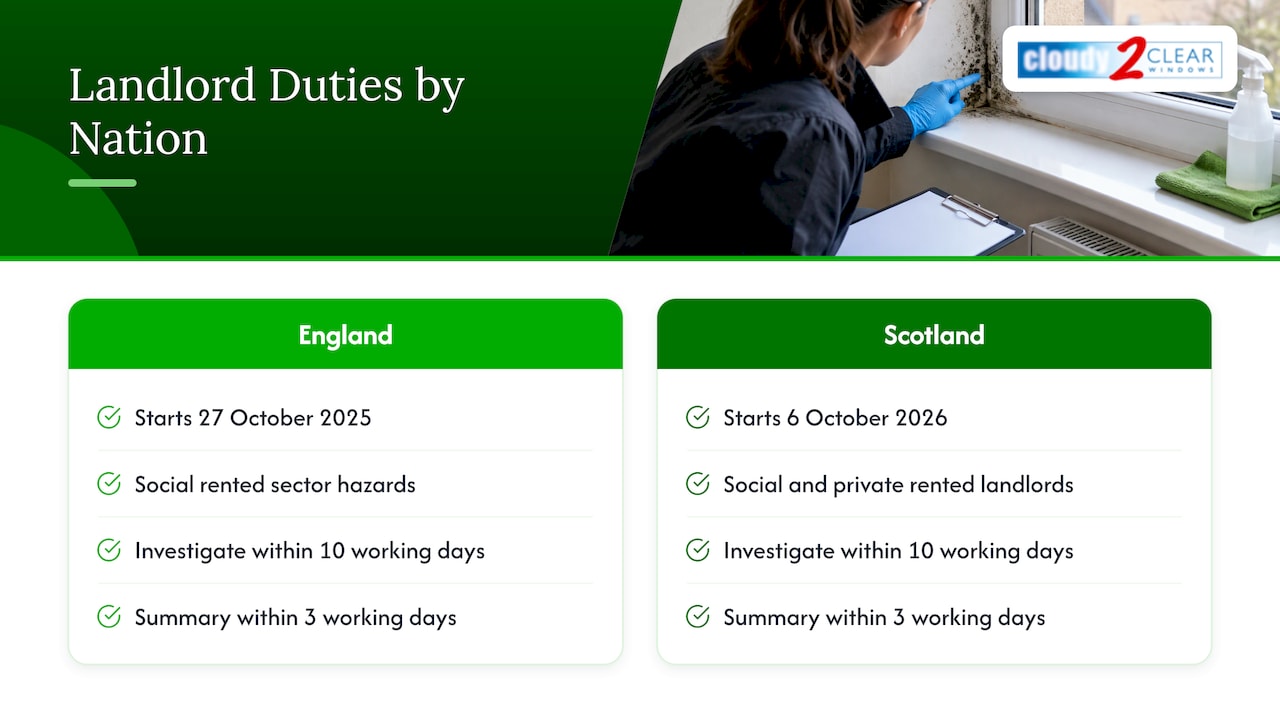
In England, the government’s Awaab’s Law guidance says the rules apply from 27 October 2025 to emergency hazards and to damp and mould hazards that pose a significant risk of harm in the social rented sector. Social landlords must investigate potential significant hazards within 10 working days and provide a written summary of findings within three working days after the investigation concludes.
In Scotland, the Scottish Parliament information service reported that new duties take effect on 6 October 2026. They require investigation within 10 working days, a written summary within three working days of completion, and repair work to begin within five working days when needed. The regulations apply to social and private rented landlords.
For window-related causes, that timetable leaves little room for delay. A clear record of each inspection and repair helps. We provide an inspection service and full replacements for commercial and housing association properties, and our guide to landlord glazing responsibilities explains who fixes windows and when.
What we do about mould-causing window faults
If your windows are misted, cracked or no longer sealing, we replace the glass and leave the frame in place. We also repair locks, handles and hinges, and work on conservatories, Velux windows, caravans and commercial premises. Our work comes with a 25-year guarantee, and our insulated glass options are designed to help restore clarity and energy efficiency.
You can call us 24 hours a day, 7 days a week to book a quote. Our operational hours are 8.30am to 6.30pm. See all our window repair services or get in touch through our homepage.

If you manage several properties, we can discuss a programme of inspections and repairs across your housing stock.
Our view: treat the window, not only the stain
Over the years we have repaired double glazing for homeowners, businesses and housing associations, and the pattern is familiar. Someone cleans the black mould from a sill, it comes back, and they clean it again. Meanwhile the glass unit beside it has quietly failed.
We believe the sensible order is to find the cause first. Check the ventilation, check the heating habits, then look closely at the glass, the seals and the hardware. If the unit has failed, a new sealed glass unit in your existing frame is a tidy answer. We replace only the glass, so you keep the frame, we make less mess, and the job is quicker than a full window replacement.
Our work carries a 25-year guarantee, and we can fit insulating or soundproofing glass at the same time if you want those benefits. Whether you live in a house in Norwich or manage a block in Stockport, we are happy to talk through what you can see on your windows.
FAQ
Is black mould around windows harmful?
Mould can irritate the airways and skin, and people with asthma, allergies, lung conditions or weakened immunity are more at risk. If anyone in your home has symptoms, speak to your GP. Photograph the mould, deal with small patches carefully, and have larger areas handled by qualified professionals, as the UK Government guidance advises.
Does having the heating on stop mould?
Steady background warmth helps, because warmer surfaces attract less condensation. Somerset Council recommends consistent background heat alongside extraction and open window vents. Heating on its own does not remove moisture, so combine it with ventilation.
Why does mould come back after I clean it?
Cleaning removes the visible growth, but the damp that fed it is still there. The cause may be condensation, a leak, a failed seal or misted glass. Find and fix that cause, otherwise the mould will return.
Can misted double glazing cause mould on the frame?
A failed sealed unit loses its insulating performance, which can leave the inner surface colder and more prone to condensation. That moisture can then collect on the frame and sill. Replacing the glass unit addresses the failed part while keeping your frame.
Can I call to book a quote outside office hours?
Yes. You can call us 24 hours a day, 7 days a week to book a quote. Our operational hours are 8.30am to 6.30pm.
Sources
- Understanding and addressing the health risks of damp and mould in the home, GOV.UK
- Existing home ventilation guide, GOV.UK
- Awaab’s Law guidance for social landlords, GOV.UK
- Condensation, damp and mould, North Devon Council
- Damp and mould, Somerset Council
- Keeping homes free from damp and mould, Plymouth City Council
- Damp and mould, RICS consumer guide
- Dampness and mould in rented housing, Scottish Parliament information service