School glazing is safe when glass in the places where pupils can hit it either breaks harmlessly, resists the impact or is protected, and when large clear panes are marked so nobody walks into them. To prove that, a school needs a documented risk assessment of every window and glazed door, followed by repair or replacement where the glass is not up to standard. Cloudy2Clear Windows repairs and replaces glass in commercial and housing association properties, and offers an inspection service for compliance. You can call us 24 hours a day, 7 days a week to book a quote, and our operational hours are 8.30am to 6.30pm.
This guide is for school premises managers, business managers, governors and housing associations responsible for buildings that children use. It explains the rules in plain terms, where the risk areas sit, and what to do when glass fails the check.
Who is responsible for glazing safety in a school
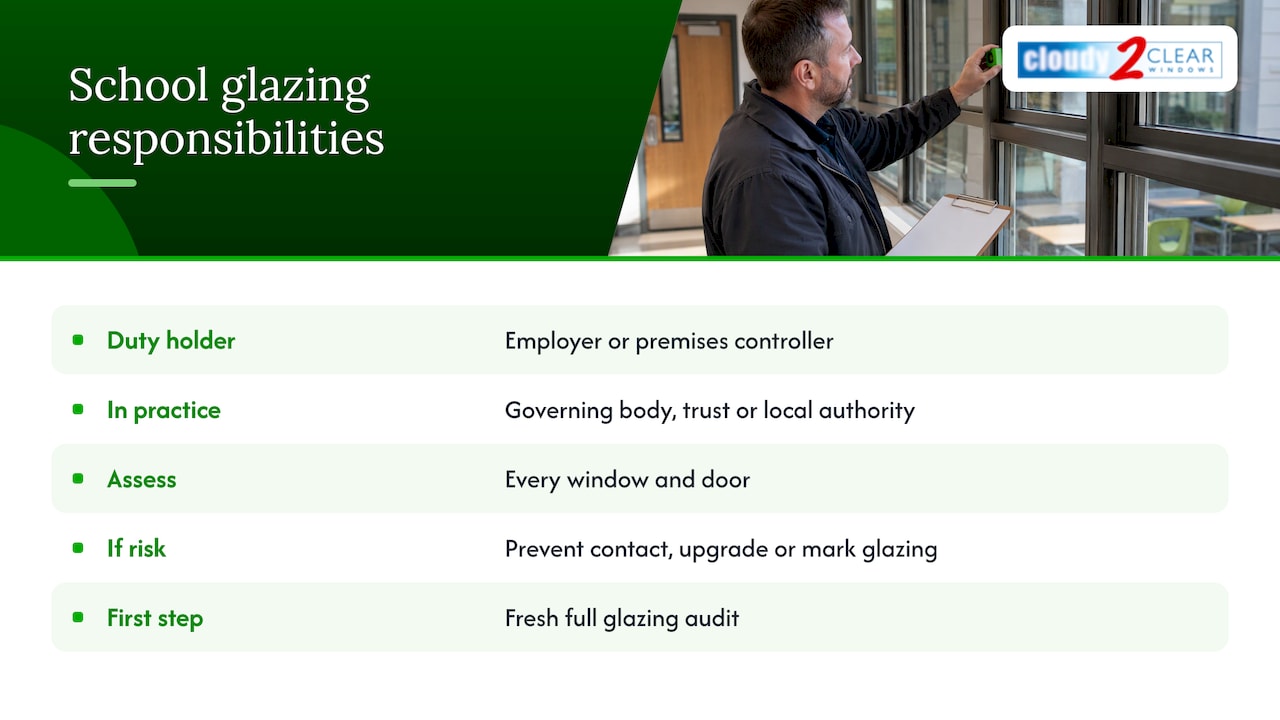
The duty normally falls on the employer or whoever controls the premises, according to CIPFA’s school premises compliance guidance. In practice that means the governing body, academy trust or local authority, with day-to-day management passed to a site manager or business manager.
The same guidance says every window and door must be assessed to establish whether anyone could be hurt. Where there is a risk, the school must prevent contact, upgrade the glazing so it breaks safely, or mark large expanses so people can see them.
The Glass and Glazing Federation has warned that many schools and public buildings have not acted on earlier risk assessments, and that ignoring the Regulations could lead to prosecution. It recommends a fresh full glazing audit as the first step.
The rules that apply in England, Wales and Scotland
Three pieces of legislation matter most.
Regulation 14 of the Workplace Regulations
The Workplace (Health, Safety and Welfare) Regulations 1992 apply across Great Britain, including schools as workplaces. Regulation 14 says that where necessary for health and safety, every window or other transparent surface in a wall or partition, and every transparent surface in a door or gate, must be made of safety material or protected against breakage. It must also be appropriately marked or have features that make it apparent.
Building Regulations Part K in England
Requirement K4 of the Building Regulations 2010 says glazing people are likely to come into contact with must, if broken by impact, break in a way unlikely to cause injury, or resist impact without breaking, or be shielded. K5 adds that transparent glazing must have features that make it apparent, and that there must be provision to prevent collision with open windows, skylights and ventilators.
Scotland
In Scotland, Standard 4.8 of the Building (Scotland) Regulations 2004 requires that people are protected from injury by fixed glazing, that fixed glazing is not vulnerable to breakage where impact is possible, and that both faces of windows and rooflights can be cleaned without a risk of a fall causing severe injury. Scottish owners can read more in our window safety regulations guide for Scotland.
What safety glass is and where schools need it
“Safety glass” is a term from a British Standard. The HSE’s Approved Code of Practice L24 explains that materials meeting it, such as laminated or toughened glass, break in a way that does not leave large, sharp pieces.
L24 directs particular attention to:
- Doors, gates and their side panels where any part of the glass is at shoulder level or below.
- Windows, walls and partitions where any part is at waist level or below.
Glasshouses are excepted, as are narrow panes up to 250 mm wide measured between glazing beads.
Approved Document K for England says glazing in these critical locations is suitable if it meets Class 3 of BS EN 12600 or Class C of BS 6206. For door panes wider than 900 mm, Class 2 or Class B is enough. It also notes that children are especially vulnerable to impact with low-level glazing in walls and partitions, and that a first impact can be followed by a fall through the glass, causing further injury to face and body.
We cover the topic in more depth in our guide to critical locations in glazing.
Risk codes used by glaziers
The Glass and Glazing Federation’s guidance uses the BS 6262 Part 4 risk codes to describe critical locations:
| Risk code | Location |
|---|---|
| 1 | Door panels, and panels within 300 mm of doors up to 1,500 mm from the floor |
| 2 | Low-level panels within 800 mm of the floor |
| 3 | Balustrade glazing |
| 4 | Wet areas |
| 5 | Areas of special risk, such as indoor sports facilities |
For risk code 5, a higher classification and extra safeguards such as screens or marking should be considered.
Where the risk sits in a school building
School glazing is a particular concern because pupils run, play and push through doors. A school glazing policy from the Abbey Federation lists three risk types: impact with glazing, collision with open windows, and access to windows for opening, closing and cleaning. It asks schools to consider planned and unplanned activities, including unauthorised running and PE near glazing.
Southampton City Council’s school advice note (June 2025) lists the places to check:
- Glazed doors, and side panels that could be mistaken for doors.
- Low-level glazing within 800 mm of floor level.
- Glazing between 800 mm and 1,500 mm where there is a special risk.
- Balustrades.
- High-level glass next to playgrounds and sports fields.
A hall used for sport is a higher-risk location than a quiet corridor. CIPFA’s guidance says the assessment must weigh location, activities, pedestrian traffic and previous incidents, because Regulation 14 only requires action where necessary for health or safety.
Marking large panes
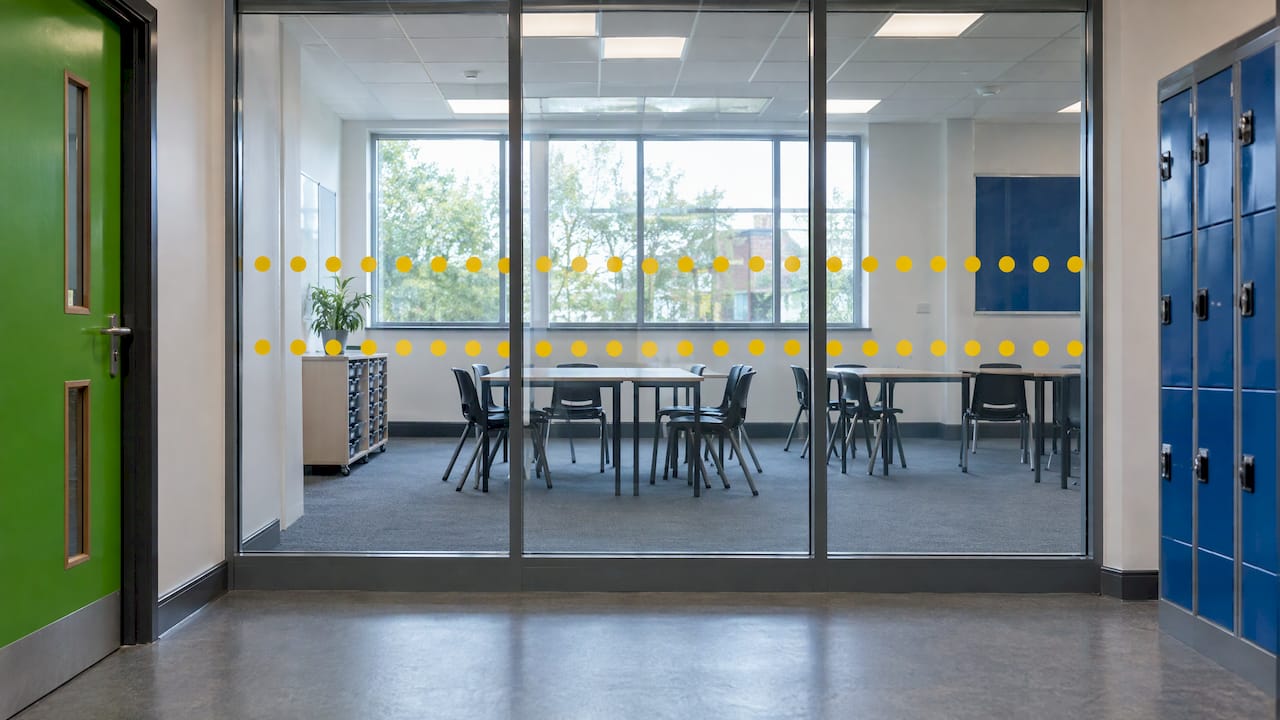
The HSE explains that collision risk is greatest with large, uninterrupted transparent surfaces where the floor is at a similar level on both sides, so people may think they can walk straight through. That is why marking is a core control alongside safety materials. The Abbey Federation policy puts markings between 600 and 1,500 mm above floor level where needed.
Glass balustrades
Balustrades deserve their own check. A December 2019 alert from the Standing Committee on Structural Safety reported glass balustrade failures in schools, including a March 2019 failure at a Manchester school where a pupil fell through the gap onto concrete and suffered minor injuries. It recommends laminated glass so the barrier stays in place after fracture, and regular visual inspection for chips, slippage, corrosion and loose or missing fixings.
How to assess your school glazing
- Survey every pane. Warwickshire’s Standards for Schools ask for an up-to-date survey of all internal and external glazing by a competent contractor. The standard says it must take the form of a risk assessment and not just a certificate of compliance.
- Record the glass type and safety rating in each critical location. Look for the standard marking, usually etched in a corner of the pane.
- Note activities and traffic. Corridors, halls, sports areas and playground edges carry different levels of risk.
- Decide the remedy for each failing location.
- Document the work and review it regularly.
Our five-step Regulation 14 glazing assessment walks through the same process for facilities managers, and our compliance checklist is useful for a regular review. Our inspection service for commercial and housing association properties covers this stage, and it sits on our commercial fenestration page.
What to do when glass is unsafe
Southampton’s advice note gives four options:
- Replace the glass with another material.
- Fix a barrier in front of it.
- Replace it with safety glass.
- Apply anti-shatter film to BS 6206.
The same note puts the lifespan of safety film at around 10 to 15 years. Replacing the glass itself with toughened or laminated safety glass deals with the cause directly, and it is the option we recommend for panes in doors, side panels and low-level windows.
SCOSS warns that the greatest balustrade risk comes from systems chosen on lowest cost without a proper risk assessment, and that the assessment must be done early by a competent person rather than passed down the supply chain. The point applies to all school glazing: assess first, then specify.
Glazing changes the Department for Education expects
In May 2019 the Department for Education revised its output specification for school barriers. As reported by SCOSS, glass must follow BS 6180:2011 and Approved Document K, designs must be certified by chartered structural engineers or a BSI Kitemark registered manufacturer, and installers must be qualified and accredited.
Planning the work around the school day
School glazing work needs to cause as little disruption as possible. We replace only the glass, not the frame, which means less disruption and faster work than a full window replacement. That suits a site where classrooms and corridors must be back in use quickly.
We also supply insulating glass and soundproofing units, so a safety upgrade can be combined with energy efficiency or noise reduction in the same visit. See our soundproofing and noise reduction page for more.
Our view on school glazing safety
Most glazing problems we are asked about are not dramatic. They are an old pane in a door side panel, a low window beside a corridor, or a misted unit nobody has looked at in years. The safest approach is to treat glass as part of the regular building checks, not as a one-off job.
We replace only the glass and keep the existing frame, so the work is quicker and less disruptive for a busy site. Our glass replacements carry a 25-year guarantee, and we have been installing, replacing and repairing double glazing for homes and businesses since 2005.
For schools and housing associations, the best result comes from pairing an inspection with a repair plan, so every pane that fails is dealt with in the same programme of work.
Arrange an inspection or glass replacement
If your survey has found panes that need attention, Cloudy2Clear Windows can inspect, repair and replace them. Our commercial window repair service covers non-domestic premises, and our double glazing replacement service replaces failed glass units. You can call us 24 hours a day, 7 days a week to book a quote.
We also repair glazed doors, locks, handles and hinges, so a single visit can cover the whole door. See our double glazed door repairs page for details, or our guide to toughened glass door requirements.
FAQ
Does every window in a school need safety glass?
No. Safety glass is needed where the risk is, mainly in doors, door side panels and low-level windows. The HSE says to look at doors and side panels with glass at shoulder level or below, and windows and partitions with glass at waist level or below. A risk assessment confirms which panes qualify.
How can I tell whether existing glass is safety glass?
Safety glass is normally marked with a standard such as BS 6206 or BS EN 12600, often etched in a corner. If the mark is missing or unreadable, a glazing survey can establish the glass type. Our inspection service is available for commercial and housing association properties.
What is the difference between safety glass and safety film?
Safety glass is made to break safely, for example toughened or laminated glass. Film is applied to existing glass to hold fragments together, and Southampton’s advice note gives it a lifespan of around 10 to 15 years. Replacing the glass is the lasting fix.
Who is responsible for school glazing safety?
The employer or the person in control of the premises, according to CIPFA’s guidance. In practice that is the governing body, trust or local authority, usually acting through the site manager.
Sources
- The Workplace (Health, Safety and Welfare) Regulations 1992
- The Building Regulations 2010, Schedule 1
- The Building (Scotland) Regulations 2004, Schedule 5
- HSE Approved Code of Practice L24
- Approved Document K
- GGF guidance on Regulation 14
- Southampton City Council school glazing advice note
- Abbey Federation glazing policy
- SCOSS structural safety of glass in balustrades
- CIPFA compliance monitoring for school premises
- Warwickshire Standards for Schools