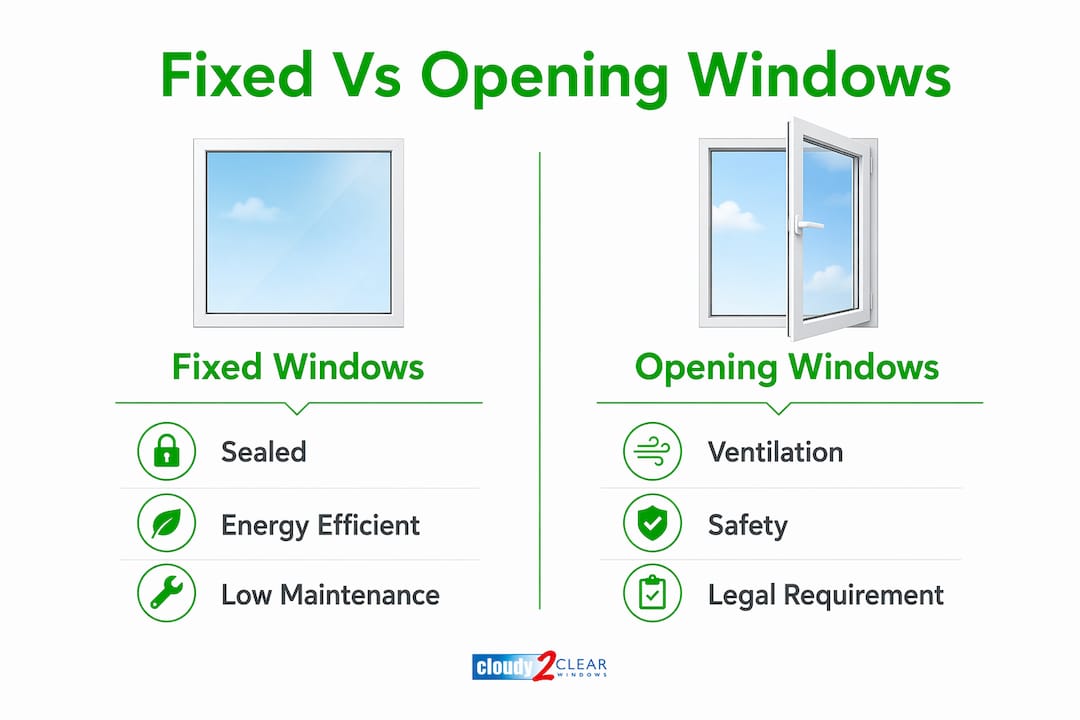
Fixed windows are permanently sealed glazing units that offer superior airtightness and insulation, while opening windows, also called operable windows, provide the ventilation and fire egress that UK building regulations require. Choosing between the two is not a simple either/or decision. Most homes in England and Scotland need both types working together to meet the 2026 building regulations, control energy costs, and maintain comfortable indoor air quality. This guide breaks down exactly how each type performs, what the law demands, and how to combine them effectively.
How do fixed windows improve energy efficiency and aesthetics?
Fixed windows deliver measurably better thermal performance than operable windows. Because they have no hinges, locks, or clearance gaps, they seal completely against the frame. Fixed windows provide up to 20% better insulation than operable equivalents. That matters significantly when you consider that windows account for 25–30% of a home’s total heat loss.
The 2026 building regulations in England set a maximum U-value of 1.2 W/m²K for new-build windows and 1.4 W/m²K for replacements. A U-value measures how quickly heat passes through a material. The lower the number, the better the insulation. Fixed units consistently achieve lower U-values than operable ones because there are no moving parts to create air leakage paths. For homeowners in Scotland, Scottish building standards apply slightly stricter requirements, so checking local compliance is essential before specifying any glazing.
Fixed windows also offer a clear aesthetic advantage. Slimmer frame profiles are possible because there is no hardware to accommodate. That produces a higher glass-to-frame ratio, which means more natural light and cleaner sightlines. A large fixed pane framing a garden view or a stairwell window flooding a hallway with daylight are both classic applications where fixed glazing excels.
Key benefits of fixed windows at a glance:
- Superior airtightness with no draught paths from seals or hinges
- Lower U-values, supporting compliance with 2026 building regulations
- 40% less maintenance than operable units due to no moving parts
- Larger glass area for maximum natural light
- Reduced long-term repair costs with no hardware to replace
Pro Tip: Pair triple-glazed fixed panes with well-placed casement or tilt-and-turn openers to get the best of both worlds. You gain the thermal performance of a sealed unit where it counts most, without sacrificing ventilation where you need it.
What role do opening windows play in ventilation and safety?

Opening windows are not optional in habitable rooms. They are a legal requirement. Approved Document F of the UK building regulations mandates background ventilation throughout a dwelling, and opening windows are the primary means of delivering it in most homes.
The minimum openable window area for a habitable room is 1/20th of the floor area. That figure exists for two reasons: air quality and fire safety. Adequate airflow removes moisture, carbon dioxide, and pollutants. An openable window also provides an emergency escape route, which is a non-negotiable requirement in bedrooms and certain other rooms under Part B of the building regulations.
Trickle vents provide background ventilation when windows are closed. Since june 2022, trickle vents are required on all replacement windows in England unless a mechanical ventilation system meeting background airflow rates is already installed. Omitting them risks condensation, poor air quality, and a formal compliance failure. Retrofitting them after the fact costs £80–£150 per window, which adds up quickly across a full property.
The table below compares natural and mechanical ventilation approaches for homes where fixed windows form a significant part of the fenestration:
| Ventilation method | Typical cost | Compliance route | Best suited for |
|---|---|---|---|
| Trickle vents on operable windows | £20–£60 per vent | Approved Document F | Most residential properties |
| MVHR (mechanical ventilation with heat recovery) | £1,500–£4,500 | Approved Document F alternative | New builds and deep retrofits |
| Natural cross-ventilation via opening windows | No additional cost | Standard compliance | Properties with good window placement |
A fixed-only approach cannot satisfy ventilation or fire egress requirements in habitable rooms. Fixed panes work well in stairwells, corridors, and utility areas where ventilation rules are less prescriptive, but bedrooms, living rooms, and kitchens all need operable sections.
How to balance fixed and opening windows in home design
The most effective window schemes combine a large central fixed pane with operable sections on either side. This configuration, common in bay windows and modern extensions, delivers the thermal and visual benefits of fixed glazing while meeting ventilation and egress requirements through the flanking openers.
Room function should drive your window specification:
- Bedrooms require an openable section large enough for emergency egress. The minimum clear opening is typically 0.33 m² with no dimension less than 450mm. A fixed pane can occupy the majority of the frame, but the operable section must meet this threshold.
- Living rooms benefit from a large fixed pane for views and light, with a casement or tilt-and-turn opener to one side for summer ventilation and compliance with the 1/20th floor area rule.
- Kitchens need extract ventilation. An opening window above the worktop or sink handles background airflow, while a fixed pane elsewhere in the room adds light without creating a draught near cooking areas.
- Stairwells and hallways are ideal locations for purely fixed glazing. There is no habitable room requirement here, so a large fixed pane can flood the space with light without any regulatory conflict.
- Bathrooms and wet rooms require extract rates of 13–30 l/s under Approved Document F. An opening window or mechanical extract fan satisfies this. A fixed pane can fill the rest of the frame.
Cleaning fixed windows, particularly on upper floors, requires planning. External access for cleaning is a genuine practical consideration. Tilt-and-turn openers on upper floors solve this problem neatly because they allow the outer face to be cleaned from inside. If you specify fixed glazing above ground floor level, factor in the cost of periodic professional window cleaning or water-fed pole access.
Pro Tip: If you are replacing windows in a property with existing trickle vents, the replacement units must also include trickle vents. Skipping this step is one of the most common compliance errors Cloudy2Clear Windows encounters during surveys.
For homeowners focused on increasing natural light without sacrificing airflow, a well-planned mix of fixed and operable glazing consistently outperforms either type used alone.
What are the costs and long-term benefits of each window type?
Cost is a practical factor in every window decision. Double glazing currently costs £250–£400 per m², while triple glazing runs £350–£550 per m². Fixed units tend to sit at the lower end of these ranges because they require less hardware and simpler installation. That initial saving compounds over time through lower maintenance costs.
Fixed windows require approximately 40% less maintenance than operable units. There are no hinges to oil, no handles to replace, and no friction stays to adjust. Over a 20-year lifespan, this difference is meaningful, particularly for larger properties with many windows. Operable windows, by contrast, need periodic hardware checks, seal replacements, and frame adjustments to maintain their performance.
The energy savings from better-insulated fixed glazing also accumulate. Reducing heat loss through windows directly lowers heating bills. The energy efficiency gains from airtight fixed glazing are most pronounced in north-facing rooms and exposed elevations where wind-driven infiltration is highest.
Where fixed windows add long-term value:
- Lower repair bills with no moving parts to wear out
- Consistent thermal performance that does not degrade as seals compress over time
- Cleaner aesthetics that tend to appeal to buyers, supporting resale value
- Compliance with 2026 U-value targets without the complexity of hardware-heavy operable frames
Where opening windows justify their cost:
- Legal compliance in habitable rooms for ventilation and fire egress
- Practical summer cooling without relying on air conditioning
- Flexibility for future layout changes or room repurposing
Understanding building regulations for windows before you specify either type protects you from costly retrofits later. Non-compliance with trickle vent requirements, for example, can trigger enforcement action and retrospective installation costs of £80–£150 per window.
The honest truth about fixed versus opening windows
After nearly two decades working with homeowners and developers across England and Scotland, Cloudy2Clear Windows has seen the same mistake repeated: people choose one type of window and treat it as the complete solution. Fixed windows look beautiful and perform brilliantly on paper, but a home glazed entirely with fixed panes will fail a building regulations inspection and become stuffy and damp within months.
The opposite error is equally common. Specifying operable windows throughout a property, because “you can always open them,” ignores the thermal penalty. Every operable frame introduces potential air leakage paths, and over a full property, that adds up to a measurable increase in heating costs year on year.
The approach that consistently works is treating fixed and opening windows as a system, not a competition. Large fixed panes where views, light, and insulation matter most. Operable sections precisely where ventilation, egress, and cleaning access are needed. Trickle vents on every replacement window unless a professional ventilation assessment confirms an alternative mechanical system is in place.
One thing I would caution against is making these decisions based on aesthetics alone. A window that looks perfect but fails to meet Part F ventilation requirements or Part B egress standards is a liability, not an asset. Always get a professional assessment before finalising your specification.
— Cloudy2Clear
Window replacement and repair across England and Scotland
Cloudy2Clear Windows has been installing and replacing double glazed windows since 2005, working across both residential and commercial properties throughout England and Scotland.

Whether you need a double glazing replacement that meets 2026 U-value targets, or you want expert advice on combining fixed and operable glazing for your specific property, the Cloudy2Clear Windows team can help. Regional branches cover Milton Keynes, Oxford, Leicester, and many more areas. Contact your local branch for a survey and quote tailored to your property and compliance requirements.
FAQ
What is the difference between fixed and opening windows?
Fixed windows are permanently sealed and cannot be opened, offering superior insulation and airtightness. Opening windows, also called operable windows, can be opened for ventilation and fire egress, which building regulations require in habitable rooms.
Can I use only fixed windows in my home?
No. Building regulations in England and Scotland require openable windows in habitable rooms to provide ventilation and emergency egress. Fixed windows can be used in stairwells, corridors, and other non-habitable spaces, but must be combined with operable sections in bedrooms and living rooms.
Do replacement windows need trickle vents?
Yes, in most cases. Since june 2022, replacement windows in England must include trickle vents unless a mechanical ventilation system meeting background airflow requirements is already installed. Omitting them risks condensation and compliance failure.
Are fixed windows cheaper than opening windows?
Fixed windows generally cost less to buy and install because they require no hardware. They also need around 40% less maintenance over their lifetime. However, you will still need operable windows in habitable rooms, so the two types work alongside each other rather than as direct substitutes.
What U-value do windows need to meet in 2026?
New-build windows in England must achieve a maximum U-value of 1.2 W/m²K. Replacement windows must meet 1.4 W/m²K. Fixed windows typically achieve lower U-values than operable units because they have no moving parts creating air leakage.