Window U-value is defined as the rate at which heat passes through a complete window unit, measured in watts per square metre kelvin (W/m²K). The lower the number, the better the window insulates your home. Under 2026 UK Building Regulations, replacement windows must meet a whole-window U-value of 1.4 W/m²K or lower, while new-build dwellings face a stricter 1.2 W/m²K target. Understanding this figure is not just a technical exercise. It directly affects your energy bills, your comfort, and your ability to sell or remortgage your property.
What is window U-value and how is it calculated?
U-value measures thermal transmittance across the entire window assembly, not just the glass. The industry term for this is the whole-window U-value, written as Uw. It accounts for the glazing, the frame material, and the spacer bars that sit between panes. Each of these components conducts heat differently, and the combined result is your Uw figure.
The centre-pane U-value (Ug) only measures heat loss through the glass itself. It is always a better number than the whole-window figure. Whole-window values are typically 0.2 to 0.5 W/m²K higher than centre-pane values. A window advertised with a centre-pane value of 1.0 W/m²K could easily have a whole-window value of 1.3–1.5 W/m²K, which may fail Building Regulations.

What affects the whole-window U-value?
Several factors shift the final Uw figure:
- Frame material: uPVC frames insulate better than aluminium. Thermally broken aluminium frames close the gap but still perform differently from uPVC.
- Spacer bars: warm-edge spacers made from polymer or stainless steel reduce heat loss at the glass edge. Standard aluminium spacers conduct more heat.
- Glass specification: low-emissivity (low-e) coatings and argon or krypton gas fills between panes reduce the Ug significantly.
- Window size and frame ratio: larger windows have a higher glass-to-frame ratio, which can improve the overall Uw. Smaller windows have proportionally more frame, which raises it.
- Number of panes: double glazing and triple glazing perform very differently, as covered in the next section.
Testing must follow BS EN ISO 10077-1, the calculation standard now mandated for compliance. Physical “hotbox” testing is being phased out. The British Fenestration Rating Council (BFRC) certifies products against these standards, and their label is the most reliable indicator of a verified Uw figure.
Pro Tip: Always ask your supplier for the BFRC-certified whole-window U-value, not the centre-pane figure. If they cannot provide it, treat the product with caution.
What are the UK Building Regulations for window U-values in 2026?
UK Building Regulations set two types of U-value targets: limiting values and notional values. Understanding the difference matters if you are replacing windows or building new.
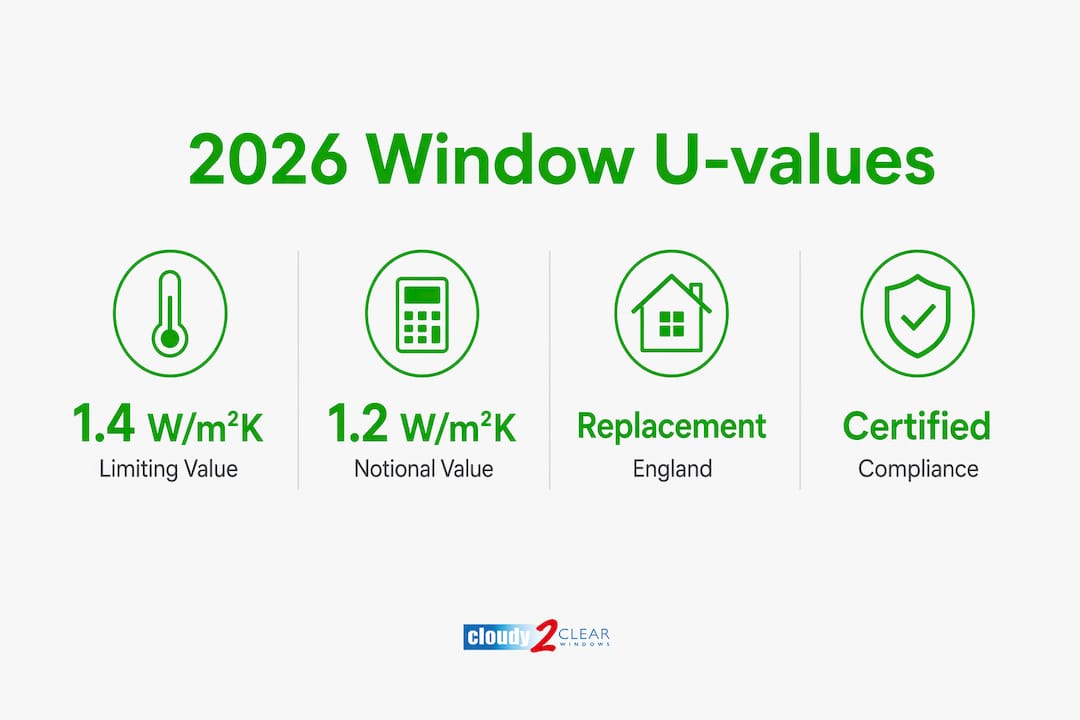
| Scenario | Limiting U-value | Notional U-value |
|---|---|---|
| Replacement windows (England) | 1.4 W/m²K | 1.2 W/m²K |
| New-build dwellings (England) | 1.4 W/m²K | 1.2 W/m²K |
| Scotland (replacement) | 1.4 W/m²K | 1.2 W/m²K |
| Wales (replacement) | 1.4 W/m²K | 1.2 W/m²K |
The limiting value is a hard cap. No installed window may exceed it. The notional value is a design target used in SAP (Standard Assessment Procedure) energy calculations. Meeting the notional value helps the overall building pass its energy performance assessment without requiring compensatory improvements elsewhere.
From 2026, regulations require that U-values are calculated using actual window dimensions and configurations, not generic declared values. A window that passes on paper using a standard reference size may fail when calculated for your specific opening. This change makes it harder to hit 1.2 W/m²K with double glazing alone, and triple glazing is increasingly necessary for new-build compliance.
Compliance also requires paperwork. CPS certificates or building regulations completion certificates must accompany every installation. Without them, you may face difficulties when selling your property or applying for a remortgage. Lenders and solicitors routinely request this documentation.
Pro Tip: Keep your compliance certificate in a safe place alongside your property deeds. Replacing lost certificates is time-consuming and can delay a property sale.
Why does a lower U-value matter for energy bills and comfort?
A lower U-value means less heat escapes through your windows. That directly reduces the energy your boiler uses to maintain a comfortable temperature. The difference between glazing types is substantial.
| Glazing type | Typical U-value range |
|---|---|
| Single glazing | 5.0–5.8 W/m²K |
| Standard double glazing | 1.2–1.4 W/m²K |
| Triple glazing | 0.7–1.0 W/m²K |
Upgrading from single glazing to a 1.2 W/m²K unit can reduce heat loss through the window by approximately 75%. That is a significant reduction in wasted energy, and it shows up on your energy bills over time.
Beyond bills, lower U-values improve thermal comfort. Cold surfaces near windows cause draughts and discomfort even when the room temperature is adequate. A window with a Uw of 1.2 W/m²K has a warmer internal surface than one at 1.4 W/m²K, which reduces the cold-radiation effect. This also lowers the risk of condensation forming on the glass, which can lead to mould growth on surrounding frames and walls.
For property investors, window energy efficiency directly affects the Energy Performance Certificate (EPC) rating. A higher EPC rating increases rental appeal and property value. Tenants and buyers increasingly factor energy costs into their decisions, and windows with strong U-values contribute to a better SAP score. Understanding the role of building fabric in overall energy performance helps investors make better specification decisions.
How should you assess and choose windows based on U-values?
Choosing the right window requires more than picking a number from a brochure. Follow these steps to make a well-informed decision.
- Request the whole-window U-value. Ask for the Uw figure, not the Ug. Confirm it is BFRC-certified and calculated to BS EN ISO 10077-1.
- Check it against your specific window size. Under 2026 rules, the U-value must be calculated for your actual opening dimensions. A generic figure is not sufficient for compliance.
- Consider your frame material. uPVC and timber frames generally outperform standard aluminium on U-value. If you prefer aluminium, specify a thermally broken profile.
- Evaluate double versus triple glazing. Triple glazing achieves 0.7–1.0 W/m²K, which comfortably meets new-build targets. Double glazing at 1.2–1.4 W/m²K meets replacement window limits but may require compensatory measures in new builds.
- Verify the paperwork. Confirm your installer will provide a CPS certificate or building regulations completion certificate on completion. Do not accept verbal assurances.
Pro Tip: If you are a property investor replacing windows across multiple units, ask your supplier to calculate U-values for each window size individually. A blanket figure across different openings is a compliance risk under 2026 regulations.
The window installation standards applied during fitting also affect thermal performance. Even a well-specified window loses efficiency if it is poorly installed, with gaps around the frame or inadequate sealing.
Common misconceptions about window U-values
Several misunderstandings regularly lead homeowners and investors into compliance problems or poor purchasing decisions.
- Confusing centre-pane with whole-window values. This is the most common error. A supplier quoting a Ug of 1.0 W/m²K is not quoting a compliant whole-window figure. Always confirm which value you are being given.
- Assuming one U-value fits all sizes. Windows with identical glazing but different frame styles and sizes have different U-values due to changing frame-to-glass ratios. Specifying by a generic figure creates compliance risk.
- Ignoring the G-value. The G-value measures solar heat gain through the glass. A window with a very low U-value but also a very low G-value may block useful winter sun, increasing heating demand. Balancing U-value and G-value is part of good window specification.
- Overlooking airtightness. A window with an excellent U-value still loses heat through air leakage if the installation is poor. Airtightness in window design is a separate but equally important performance measure.
- Skipping the compliance certificate. Many homeowners assume the installer handles all paperwork automatically. Confirm this in writing before work begins.
What Cloudy2Clear Windows has learnt from two decades of glazing
After nearly 20 years working across residential and commercial glazing, one pattern stands out clearly. Homeowners consistently underestimate how much the frame and spacer contribute to the final U-value. They focus on the glass specification and assume the rest is standard. It rarely is.
The 2026 regulatory changes have made this gap more consequential. Generic declared values no longer satisfy compliance requirements. Every window now needs a calculated U-value based on its actual size and configuration. That sounds straightforward, but it catches out even experienced developers who rely on a single figure from a product brochure.
My honest advice is this: treat the U-value conversation as a negotiation, not a box-tick. Ask your supplier to show their working. If they cannot produce a BS EN ISO 10077-1 calculation for your specific window dimensions, that is a warning sign. The same applies to certification. A CPS certificate is not optional paperwork. It is the document that protects your investment when you come to sell or refinance.
The G-value point is also worth taking seriously. We see properties where triple glazing has been fitted on south-facing elevations with a very low G-value, and the owners then wonder why their heating bills have not dropped as expected. The window is performing exactly as specified. The specification was simply incomplete.
How Cloudy2Clear Windows can help with your window U-values
Cloudy2Clear Windows has been installing and replacing double glazed windows since 2005, across both residential and commercial properties throughout the UK.

Whether you need a double glazing replacement that meets current U-value regulations, or a repair to restore the thermal performance of an existing unit, Cloudy2Clear Windows can help. Every installation comes with the correct compliance documentation, so your property records stay clean and your investment stays protected. If you are based in the Milton Keynes area, our local team offers double glazing repairs in Milton Keynes with full compliance support. Contact Cloudy2Clear Windows for an assessment or quote.
FAQ
What is window U-value in simple terms?
Window U-value measures how quickly heat passes through a window, expressed in W/m²K. A lower number means better insulation and less heat loss.
What U-value do replacement windows need in the UK?
Replacement windows in England must meet a limiting U-value of 1.4 W/m²K, with a notional target of 1.2 W/m²K used in SAP energy calculations.
What is the difference between Uw and Ug?
Uw is the whole-window U-value including frame, glass, and spacers. Ug is the centre-pane value for glass only. Building Regulations require the Uw figure, which is always higher than Ug.
Does triple glazing always have a better U-value than double glazing?
Yes. Triple glazing typically achieves 0.7–1.0 W/m²K compared to 1.2–1.4 W/m²K for standard double glazing, though it costs more and adds weight to the frame.
Do I need a certificate when replacing windows?
Yes. A CPS certificate or building regulations completion certificate is mandatory for compliance and protects you during future property sales or remortgaging.