Self-cleaning glass is a factory-coated glazing product that uses a two-stage process, photocatalysis followed by hydrophilic water sheeting, to break down organic dirt and rinse it away with rainfall. It genuinely reduces how often you need to clean certain windows, but it is not maintenance-free: it needs regular exposure to UV light and rain to work, and it will not touch limescale or mineral deposits. Products such as Pilkington Activ and SGG BIOCLEAN (Saint-Gobain) are the most widely available options in the UK market.
How does self-cleaning glass work?
The coating does two distinct jobs in sequence, and understanding both helps you judge whether it will work for your glazing.
Stage one: photocatalysis. The outer surface of the glass carries a thin layer of titanium dioxide (TiO2). When UV light from the sun hits this layer, it triggers a chemical reaction that breaks down organic deposits on the surface, things like pollen, algae, and general atmospheric grime. The dirt does not disappear instantly; it is loosened and degraded at a molecular level.
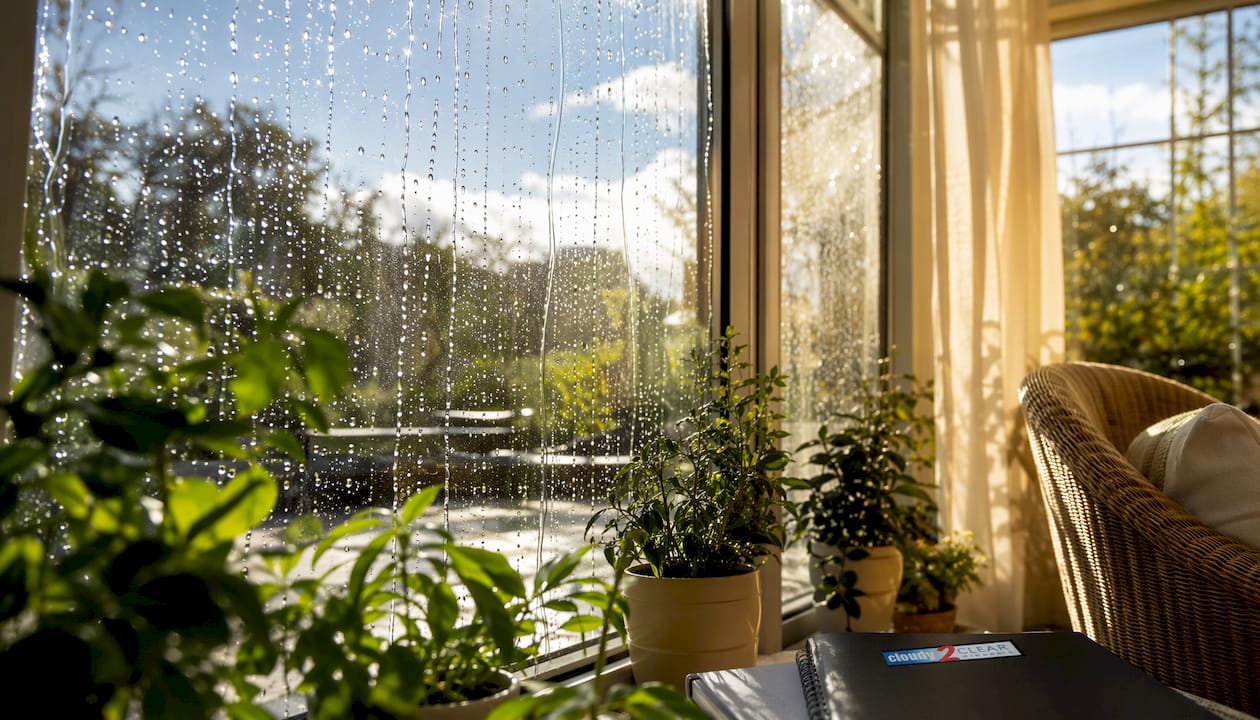
Stage two: hydrophilic sheeting. Once rain arrives, the same TiO2 coating causes water to spread across the glass in a thin, even sheet rather than forming droplets. That sheet carries the loosened particles down the pane and off the edge, leaving far fewer streaks than standard glass would show.
For the process to run effectively, three conditions must be met:
- Sufficient UV light (direct or indirect sunlight; deep shade reduces effectiveness)
- Rainfall or a deliberate rinse with a hose
- The coating must be on the outer face of the glass, exposed to the elements
A minimum installation pitch of approximately 10 degrees is generally required for water to run off properly. Windows set at a shallower angle, or those permanently under deep eaves, may never activate the coating fully.
Hydrophilic versus hydrophobic: what the product claims actually mean
Not all self-cleaning coatings work the same way. There are two principal approaches, and knowing the difference helps you read product datasheets with confidence.
| Coating type | How it cleans | Best suited to | Limitation |
|---|---|---|---|
| Hydrophilic (TiO2 photocatalytic) | UV breaks down organic dirt; water sheets across the surface and rinses particles away | Rain-exposed glazing: conservatory roofs, rooflights, south-facing windows | Does not remove inorganic deposits (limescale, mineral staining) |
| Hydrophobic (lotus-effect) | Water droplets bead up and roll off, carrying loose surface particles with them | Vertical façades where rapid run-off is the priority | Less effective against organic grime; no photocatalytic breakdown |
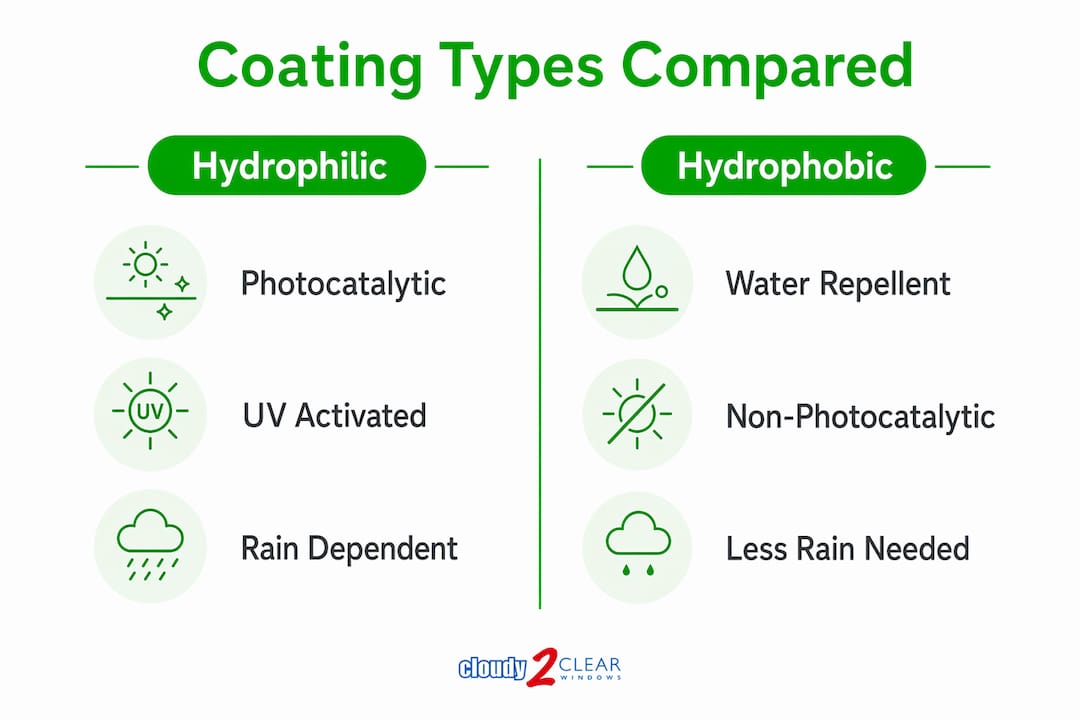
Most products sold in the UK residential market, including Pilkington Activ and SGG BIOCLEAN, use the hydrophilic photocatalytic approach. The TiO2 coating is applied during manufacture as a permanent layer, not a retrofit film, so you cannot add it to existing glass. Upgrading means replacing the glass unit entirely.
Hydrophobic coatings are more common in specialist architectural or automotive applications. For a conservatory roof or a rooflight, the hydrophilic route is almost always the right choice.
Where is self-cleaning glass most useful?
Ranked by practical value, these are the locations where the technology earns its premium most reliably:
- Conservatory roofs and rooflights. These are the strongest case. The glass sits at an angle, receives good UV exposure, and is genuinely difficult to clean safely without scaffolding or specialist equipment. Conservatory roof glazing is where most homeowners see the clearest payback.
- High-level or inaccessible windows. Upper-storey windows on a three-storey property, or glazing above a stairwell, can cost significantly more to clean professionally. Self-cleaning glass reduces that frequency.
- Commercial façades. Large glazed elevations on offices or retail units accumulate grime quickly. Specifying self-cleaning glass at build stage can reduce the commercial window maintenance burden considerably over a building’s lifetime.
- South- and west-facing windows. Maximum UV exposure means maximum photocatalytic activity. These orientations get the most from the coating.
One practical note: frames, sills, and surrounding sealants still need manual attention. The coating covers only the glass surface itself.
What self-cleaning glass won’t remove, and how to care for it
The coating has clear limits. It cannot break down inorganic contamination, and that covers a wider range of deposits than most people expect.
Limescale from hard water, mineral staining, lead leaching from flashings, heavy paint or sealant residues, and thick bird fouling all require manual cleaning. The photocatalytic reaction only degrades organic material; inorganic particles simply sit on the surface until you remove them.
When manual cleaning is needed, use a pH-neutral, non-abrasive detergent and soft water where possible. Abrasive cloths, scourers, or harsh chemical cleaners can scratch or chemically degrade the TiO2 layer, shortening its effective life. Hard water can leave mineral deposits that physically block the coating and reduce its performance over time.
Pro Tip: During extended dry spells, the photocatalytic stage will still break down organic dirt, but without rain the loosened particles stay on the glass. A gentle rinse with a hose is all that is needed to complete the process. For a full routine, our window cleaning checklist covers the steps in detail.
After installation, ask your installer to confirm the first-rinse procedure. Some manufacturers recommend an initial rinse to remove any handling residues before the coating is considered fully active.
How long does the coating last, and what does it cost?
Manufacturers including Pilkington state that the coating is designed to last for the life of the glass under normal circumstances. Performance, however, depends heavily on cleaning methods and environmental exposure. Abrasive cleaning or persistent hard-water deposits can degrade it well before the glass itself fails.
Cost at a glance: The typical UK price premium for self-cleaning glass is roughly 15–30% above standard double glazing, or approximately £60–£120 per square metre extra. Always request itemised quotes from at least two installers before committing.
On warranty, ask three specific questions before you sign anything:
| Question | Why it matters |
|---|---|
| Is the coating warranty separate from the unit warranty? | Some manufacturers cover the glass unit but not the coating performance separately |
| Does the warranty cover loss of effect or only physical damage? | Loss of photocatalytic performance is the more common complaint |
| Is the warranty transferable if you sell the property? | Relevant for resale value arguments |
The payback case is strongest where professional cleaning costs are high or access is genuinely difficult. For a straightforward ground-floor window you can clean yourself, the premium is harder to justify.
Self-cleaning glass products available in the UK
Two products dominate the UK market and are the names you will encounter most often when specifying or buying:
- Pilkington Activ. Widely regarded as the original commercial self-cleaning glass, it uses a nanocrystalline TiO2 film approximately 15 nm thick. Pilkington publishes detailed technical datasheets and maintenance guides on its website, which are worth reading before specifying.
- SGG BIOCLEAN (Saint-Gobain). Saint-Gobain’s equivalent product, also based on a photocatalytic hydrophilic coating. UK availability is good through major glazing distributors.
When comparing products, ask for the relevant datasheet and check whether the product is tested to EN 1096-5, the European standard that allows specifiers to differentiate self-cleaning performance between coatings. This is particularly useful for commercial projects where performance claims need to be verified.
The coating is factory-applied and cannot be added retrospectively. If your existing windows are standard double-glazed units, upgrading to self-cleaning glass means replacing the glass unit entirely, not applying a film.
Questions to ask your installer before fitting self-cleaning glass
A few straightforward checks before you commit will save you from a costly mismatch between the product’s requirements and your glazing’s actual conditions.
- Is the window sufficiently sun-exposed? Assess the orientation and whether nearby structures, trees, or overhangs will shade the glass for significant parts of the day.
- What is the installation pitch? Confirm the angle is at or above approximately 10 degrees for effective water run-off.
- How hard is your local water supply? In hard-water areas, mineral deposits will accumulate faster and require more frequent manual cleaning to maintain coating performance.
- How often do you currently clean that window professionally? If the answer is once a year and access is easy, the premium may not pay back.
- Ask your installer to confirm the coating is factory-applied, not a surface film, and to provide written warranty terms covering both the unit and the coating performance.
- Ask about sealant and frame compatibility. Some silicone sealants can leave residues that affect the coating near the edges; your installer should specify compatible products.
- Confirm disposal and recycling of replaced units. Responsible installers will handle this as part of the job.
Pro Tip: Self-cleaning glass works best as a targeted upgrade, not a blanket replacement for every pane in the house. At Cloudy2Clear Windows, we assess each window individually, looking at orientation, pitch, access difficulty, and local conditions, before recommending whether the upgrade makes practical sense. Our double glazing maintenance guidance covers what to check between professional visits.
When a failed or misted unit needs replacing anyway, that is the natural moment to upgrade to self-cleaning glass. The additional cost per unit is modest when you are already paying for a replacement.
Our view from the field
Self-cleaning glass genuinely earns its place in specific situations, and those situations are more common than many homeowners realise. Conservatory roofs, Velux-style rooflights, and high-level glazing on larger properties are where we see the clearest benefit: the coating reduces cleaning frequency, lowers the risk of access-related accidents, and can extend the intervals between professional cleans by a meaningful margin.
Where we are more cautious is on standard ground-floor windows in accessible locations. The premium is real, and if you can clean the glass yourself with a squeegee and a bucket, the payback period stretches considerably. The technology is sound; the question is always whether your specific glazing will give it the conditions it needs to perform.
Cloudy2Clear Windows has been assessing, replacing, and upgrading double-glazed units since 2005, across both residential and commercial properties. That experience tells us that the best time to specify self-cleaning glass is when a unit needs replacing anyway, not as a standalone retrofit project.
Ready to upgrade or replace your glazing?
Cloudy2Clear Windows handles glass-only replacements, conservatory and rooflight repairs, and commercial fenestration across the UK. If you have a misted, cracked, or failed unit and want to explore whether self-cleaning glass makes sense for your property, we can assess the glazing and provide a clear, itemised quote.
Whether you need a single pane replaced or a full conservatory roof upgrade, our team can advise on the right specification for your conditions. To book an assessment or request a quote for double glazing replacement, contact us Monday to Friday, 8:30am to 6:30pm.
Useful sources
- Pilkington: What is self-cleaning glass? — Manufacturer overview of the technology and product range; a good starting point for technical detail.
- Pilkington: How it works — Step-by-step explanation of the photocatalytic and hydrophilic stages from the original product developer.
- Pilkington: Self-cleaning glass FAQs — Covers warranty, maintenance, and performance questions in plain language.
- WindowCost: Self-cleaning glass UK guide — Independent UK cost estimates and practical limitations; useful for budgeting.
- Axiom Eco Homes: Is self-cleaning glass worth it? — Cost-benefit analysis with UK price premium data.
- Wikipedia: Self-cleaning glass — Neutral encyclopaedic overview of both hydrophilic and hydrophobic coating types.
FAQ
Does self-cleaning glass actually work?
Yes, for organic dirt on sun-exposed, rain-washed glazing. The photocatalytic coating breaks down grime and the hydrophilic surface rinses it away, but it will not remove limescale, mineral deposits, or heavy soiling without manual intervention.
Is self-cleaning glass a thing, or just a marketing claim?
It is a real, commercially available product. Pilkington Activ was the first commercial example and remains widely specified in the UK; SGG BIOCLEAN is the other major option available here.
How long does self-cleaning glass last?
Manufacturers state the coating is designed to last for the life of the glass unit under normal use. Abrasive cleaning or persistent hard-water deposits can degrade performance earlier, so gentle maintenance with a pH-neutral detergent is important.
How much more does self-cleaning glass cost?
The typical UK premium is roughly 15–30% above standard double glazing, or approximately £60–£120 per square metre extra. Get itemised quotes from at least two installers to compare accurately for your specific glazing.
Can Cloudy2Clear Windows fit self-cleaning glass?
Yes. When a unit needs replacing, Cloudy2Clear Windows can specify self-cleaning glass as part of a glass-only replacement. Contact the team Monday to Friday, 8:30am to 6:30pm, to discuss your glazing and get a quote.