Most tilt and turn window problems come down to a mishandling selector needing a reset, a misaligned hinge, or dry, grimy locking points. These fix in minutes with no tools beyond an Allen key. If the handle spins freely with no resistance, or a sash sags visibly on its hinges, stop trying to force it. That points to gearbox or hinge failure, and Cloudy2Clear Windows can inspect and repair it properly.
Quick troubleshooting checklist for tilt and turn window issues
Before reaching for a screwdriver, run through this sixty-second check. It sorts the genuine emergencies from the five-minute fixes.
- Confirm the sash is fully closed and square in the frame before touching the handle.
- Try the mishandling selector reset (the small button or catch near the handle spindle).
- Note whether the handle feels stiff, jammed solid, or spins with no resistance at all.
- Check hinge tracks and corners for grit, leaves, or old paint chips.
- Look for blocked weep holes along the bottom of the frame.
- Apply a small amount of the correct lubricant to locking points and test again.
A free-spinning handle is the one sign on this list that usually means a broken part rather than a simple jam, according to independent troubleshooting guides.
Step-by-step fixes for common tilt and turn window symptoms
Work through these in order. Each one takes under fifteen minutes and needs no specialist tools.
- Stuck in tilt or half-turn. Close the sash fully, then locate the mishandling selector, usually a small lever or button beside the spindle. Press it while gently moving the handle back to the vertical (locked) position. Do not force the handle if it resists; a jammed selector released under pressure can bend the linkage.
- Jammed or stiff handle. Remove the handle’s decorative cap, check the two fixing screws haven’t loosened, then apply grease to the spindle and cam. If it’s still tight, the cam compression may need easing slightly, which the MACO maintenance and adjustment instructions cover in detail.
- Free-spinning handle. Turn the handle slowly and watch whether the espagnolette bolts inside the frame move at all. If they don’t move, the gearbox or spindle has failed internally, not the handle itself.
- Sagging or misaligned sash. Check the reveal, the gap between sash and frame, along all four sides. An uneven gap suggests the hinges need adjusting rather than replacing.
Pro Tip: Photograph the gap at each corner with a coin for scale before adjusting anything. It gives you a baseline to check whether your fix actually worked.
Sash alignment and hinge adjustment: what’s safe to try
Tilt and turn hinges have two or three adjustment points: a height screw, a lateral screw, and sometimes a scissor-stay tension screw. Most use 4mm or 5mm Allen keys, though some German-pattern hinges use Torx bits.
- Adjust in quarter turns only, then close the sash and check the reveal before turning further.
- Work towards an even gap all round rather than a perfect number.
- Never lower the sash past any notch marked on the hinge arm.
- Stop immediately if the sash feels heavier or looser than before you started.
Locking mechanism faults account for a notable share of window repair callouts across UK homes, according to Glass and Glazing Federation technical guidance, and alignment is one of the most common culprits. The Maco standard fittings manual is explicit that incorrect bayonet bolt positioning during adjustment can let a sash drop out entirely. Full sash removal, or re-hinging a heavy triple-glazed unit, is a job for trained personnel, not a Saturday afternoon.
What lubricant should you use on tilt and turn windows?
Never use WD-40, household oil, or rust remover on locking cams and espagnolette strips. They cut through initial stiffness but attract dust and grit, which then grinds against the metal every time you operate the handle.
- Use lubrication grease or technical Vaseline on the gearbox and locking cams.
- Use PTFE or silicone spray on sliding tracks and scissor stays.
- Apply sparingly, then operate the handle several times to work it in, then wipe away excess.
- Check every six months; lubricate fully once a year as routine tilt and turn window maintenance.
Pro Tip: A little grease goes further than you’d think. Overdoing it just gives dust somewhere new to stick.
How to tell a handle problem from a gearbox failure
A stiff handle is nearly always fixable. A gearbox failure rarely is, not without opening up the frame.
Check the two visible screws under the handle’s decorative collar first; loose screws cause wobble that mimics gearbox wear. If the spindle looks chewed or rounded where it meets the handle, that’s a worn spindle rather than a gearbox fault, and it’s a cheap swap.
- Free-spinning handle with no resistance and no bolt movement: gearbox failure, needs sash access.
- Chewed or rounded spindle: replace the spindle, often under £20 in parts.
- Visible corrosion on the gearbox casing or a snapped scissor stay: stop and call a professional.
Photographing the handle, spindle, and any visible gearbox housing before calling for help speeds up diagnosis considerably, since a technician can often quote from images alone.
When should you call a professional for tilt and turn window problems?
Certain faults simply aren’t worth attempting yourself, whatever your DIY confidence.
- A handle that spins freely with zero resistance from the locking bolts.
- A sash that has visibly dropped or won’t sit square however you adjust the hinges.
- A snapped or bent scissor stay, the arm that controls the tilt function.
- Perished seals letting in draughts or water despite gasket adjustment.
- Cracked glass or a failed double-glazed unit showing internal misting.
Simple lubrication or a selector reset costs next to nothing and takes under an hour, whereas professional call-outs for hinge or gearbox replacement typically run into a higher labour bracket once parts are involved. Forcing a jammed handle or a stuck gearbox nearly always turns a straightforward repair into a full hardware replacement, which costs considerably more than calling someone early.
How often should you maintain tilt and turn windows?
A short, consistent routine beats an annual scramble.
- Monthly: wipe hinge tracks, check weep holes aren’t blocked, and glance at the reveal for uneven gaps.
- Every six to twelve months: lubricate all locking points, gaskets, and hinge pivots properly.
- Seasonally: ease cam compression slightly for winter (better seal against cold) and loosen it a touch for summer.
- Annually: run the paper test. Close the sash on a strip of paper at several points; if it slides out easily, compression has dropped and needs adjusting.
Cleaning debris from hinge channels and lubricating locking points on this kind of schedule prevents the majority of common failures, making it the cheapest maintenance habit a homeowner can build. If draughts persist despite this, it’s worth reading our guide on fixing window leaks or understanding why window seals fail in the first place.
Cloudy2Clear Windows: repairing hardware since 2005
Cloudy2Clear Windows has repaired and replaced double glazing, locks, hinges, and handles across residential and commercial properties since 2005. Our engineers see the same faults repeatedly: worn gearboxes, dropped sashes, and DIY lubrication gone wrong with the wrong products.
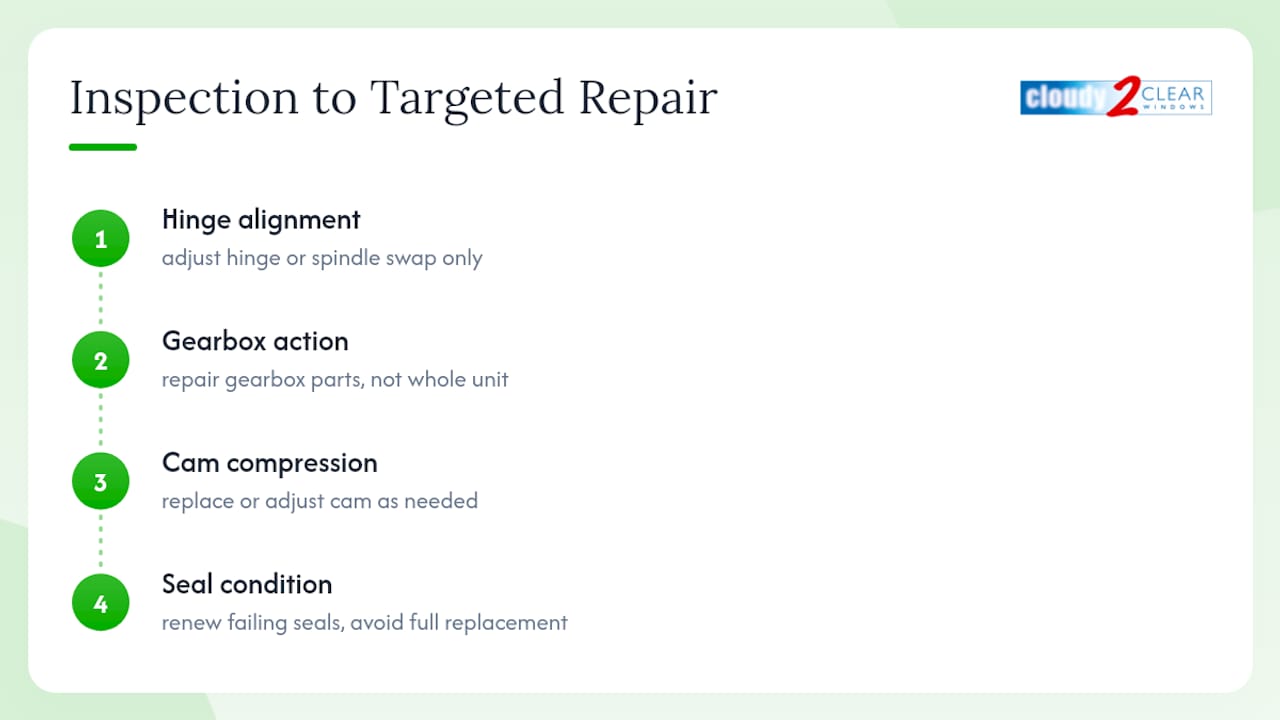
A typical inspection checks hinge alignment, gearbox action, cam compression, and seal condition, then repairs or replaces only what’s actually failed. We don’t push full hardware replacement when a spindle swap or hinge adjustment will do the job properly.
Our honest take on DIY versus calling a technician
We’d always rather you try the selector reset and a proper lubrication first; most calls we get could have been solved that way. Where homeowners go wrong is forcing a stuck handle or removing a sash without checking the notch markings, which turns a small job into a hinge replacement.
— Cloudy2Clear
Book a tilt and turn window repair with Cloudy2Clear Windows
If the checklist above hasn’t freed things up, or you’re staring at a free-spinning handle and a sash that won’t sit right, that’s exactly where Cloudy2Clear Windows steps in. Unlike a generic handyman callout, our engineers work on hardware like this daily, so diagnosis is quick and the first visit is usually the only one you need.

Get in touch through our lock, hinge and handle repair service with a short description of the fault, a couple of photos of the handle or hinge, and your preferred appointment times. If your seals or glazing are the real culprit rather than the hardware, our glass and double glazing replacement team can take it from there instead. For readers weighing up a full DIY replacement, it’s also worth reading a partner perspective on the pitfalls of DIY door and window replacement before committing tools and time. We operate Monday to Friday, 8:30am to 6:30pm, and if you’re near Oxford, our Oxford branch page has local booking details ready to go.
Sources
For technical detail beyond this guide, the MACO maintenance and adjustment instructions cover fitting-by-fitting lubrication and adjustment steps in full. The Maco standard fittings manual adds sash-removal safety warnings, and the LockLatch troubleshooting guide explains the mishandling selector reset in more depth, plus a useful note on secure ventilation gaps.
- MACO maintenance and adjustment instructions (standard fittings manual)
- Tilt and Turn Window Problems: Common Faults, Quick Fixes and the Ventilation Gap Nobody Mentions (LLR-i / LockLatch)
FAQ
What are the disadvantages of tilt and turn windows?
Their multi-point locking gearbox has more moving parts than a standard casement hinge, so it’s more prone to wear, and repairs often need sash access rather than a simple external fix.
What are the most common problems with uPVC tilt and turn windows?
Stuck selectors, stiff or free-spinning handles, sagging sashes, and draughts from compressed or perished gaskets account for the vast majority of faults reported.
How much does it cost to replace a tilt and turn window?
Simple lubrication or a selector reset costs very little and takes under an hour, while professional hinge or gearbox replacement involves parts and labour that Cloudy2Clear Windows can quote after seeing photos of the fault.
Can you adjust a tilt and turn window yourself?
Yes, hinge height, lateral position, and cam compression can be adjusted with an Allen key in small increments, but sash removal and heavy lifting should be left to trained personnel due to drop-out risk.