Critical locations are the places in a building where someone is most likely to walk, fall or knock into glass. In these spots, UK building rules expect the glass to be safety glass, or to be protected in some other way. In England the key measurements are 1500mm from the floor for doors and the glass beside them, and 800mm from the floor for other windows and partitions. This guide explains each location, the standards behind it, how Scotland differs, and how to check the glass you already have.
What a critical location is
A critical location is an area where people moving in or about a building are likely to collide with glazing. England’s Approved Document K asks for glass in these areas to break safely, so it does not cause cutting or piercing injuries, or to resist impact altogether.
Ordinary glass breaks into long, sharp shards. Safety glass either crumbles into small, blunt pieces (toughened) or holds together when it cracks (laminated). The rules apply mostly to new work, and the details depend on whether your property is in England, Wales or Scotland.
The three critical locations in England
Approved Document K names the following areas. The figures are measured from the finished floor level.
| Location | What counts | Height measured from the floor |
|---|---|---|
| Glazing in doors | Any glass in a door or door panel | Up to 1500mm |
| Glazing next to doors | Glass within 300mm of the door edge | Up to 1500mm |
| Low-level windows, walls and partitions | Any other glass at low level | Up to 800mm |
These figures are set out in the Approved Document K guidance for England. Wales uses the same measurements, as the Welsh Government’s doors and windows guidance states.
Glazing in doors
Any pane in a door that sits within 1500mm of the floor is a critical location. That covers front doors with decorative panels, patio and French doors, and internal doors with glass panels.
If your door glass is damaged or has misted, it is worth getting the replacement unit specified correctly. Our double glazed door repairs service replaces door glass, and the new pane can be made in safety glass where the location needs it.
Glazing next to doors
A side panel beside a door is a critical location when any part of it is within 300mm of the door edge and below 1500mm. People reaching for a handle, or stepping through in a hurry, are the reason. Sidelights next to front doors and glass beside conservatory doors are the usual examples.
Low-level windows and partitions
Any other glazing is critical if it falls within 800mm of the floor. Think of full-height windows in living rooms, windows with low sills in older cottages, glazed partitions in offices, and shop windows that run down to the pavement.
A window sill at 850mm needs no safety glass for this reason alone. A sill at 700mm does. The lower pane of a tall window may need safety glass even if the upper pane does not, so each pane is judged separately.
How safety glass must perform
For glass in critical locations, England’s building regulations offer four routes. The glass can break safely, be strong enough to resist impact, be in small panes, or be protected by a permanent screen. These options appear in Approved Document K.
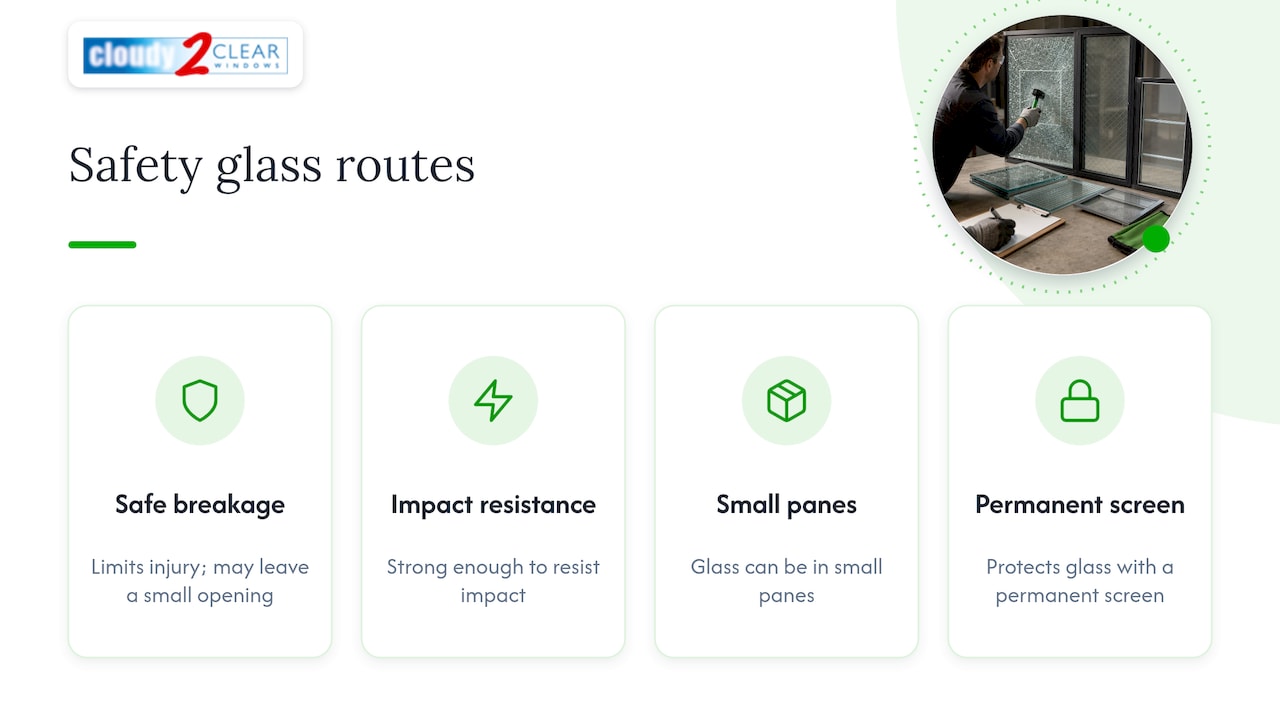
Safe breakage is the route most households meet. It is tested to BS EN 12600, or the older BS 6206. Glass that passes breaks in a way that limits injury, for example by leaving only a small clear opening, or by disintegrating into small, non-sharp particles.
A further standard, BS 6262-4:2018, gives recommendations for glass and plastics glazing in places likely to see accidental human impact.
Toughened or laminated
Both can meet the requirement. Your choice depends on what else you need the glass to do.
- Toughened glass is heat-treated for strength and shatters into small pieces. It is common in doors, side panels and low windows. Our guide to what toughened safety glass is covers how it is made.
- Laminated glass has a plastic interlayer that holds the pieces together after impact. It helps with security and noise as well as safety. See our guide on why to use laminated glass.
For a broader comparison, our types of safety glass article sets them side by side for homes and businesses.
Do the rules differ in Scotland?
The principle is the same, but the document is different. Scottish homes follow the Building Standards Technical Handbook, which treats glazing as vulnerable when it is within 800mm of the floor, part of a door leaf, or within 300mm of a door leaf and within 1.5m of the floor.
Scottish standards ask designers either to choose glazing that resists impact or breaks safely, referencing BS 6262: Part 4: 2005, or to give vulnerable glazing permanent protection.
Marking large glass areas
Scotland also addresses glazing manifestation. Large areas of transparent glazing where collision is likely need markings, particularly to help people with sight loss. The handbook gives marking heights of 850mm to 1.0m and 1.4m to 1.6m, again in the Scottish technical handbook.
If you own or manage property in Scotland, our window safety regulations Scotland guide goes through what this means for homeowners and builders.
Low sills create a real tension. A Scottish government consultation on accessible homes describes the trade-off between low window sills for views and the expense of safety glazing below 800mm. Upgrading glass is also a good moment to review your property’s energy efficiency rating, since new units can be chosen for insulation as well as impact performance.
Workplaces, landlords and housing associations
Homeowners meet critical locations when they do building work. Employers and landlords meet them every day. In workplaces, Regulation 14 of the Workplace (Health, Safety and Welfare) Regulations covers glazing and, where necessary, requires windows to be made of safety material or otherwise protected against breakage, as the HSE guidance on falls from windows explains.
That matters for shops, offices, schools, care settings and housing association blocks. Glazing that was installed years ago, before it was standard to fit safety glass, can still be sitting at hip height in a corridor or by a communal door.
A practical approach for a facilities manager:
- Walk each floor and list every glazed door, side panel and low window.
- Measure the glass height from the floor against the 800mm and 1500mm lines.
- Check each pane for a safety mark.
- Record panes that are unmarked, damaged or of unknown type.
- Plan replacement or protection, starting with busy routes and areas used by children or vulnerable people.
We have written a step-by-step version in our Regulation 14 glazing assessment guide for facilities managers.
Bathrooms and other wet areas
Bathrooms are not a separate critical location under the height rules, but they carry their own risk. The Glass and Glazing Federation identifies wet-area glazing as a risk because a person may slip and fall into it, including bath and shower screens and glazing around a bath, pool or similar area. A window beside a bath is a sensible place for safety glass even where no height rule applies.
How to check the glass you already have
You do not need to guess. Safety glass should usually carry a permanent stamp in one corner, and the Glass and Glazing Federation says panes must be stamped to identify the type, or where the product standard requires marking. Examples are EN 12150 for toughened glass and EN 14449 for laminated glass, as set out in its glass breakage booklet. If there is no stamp and the type is unknown, breakage characteristics can be examined.
A simple checklist:
- Look for a small etched mark in a corner of each low pane or door panel.
- Note any mark that mentions a standard, such as BS EN 12150 or BS EN 14449.
- Photograph what you find, including panes with no mark.
- Ask a glazier to confirm any pane you are unsure about.
If your glass does not meet the requirement
Existing glass does not always have to be replaced the moment you notice it. Building regulations mainly apply when work is done, and the rules for workplaces and landlords are about managing risk. Still, a pane that is unmarked, in a busy spot, and within the critical height is worth acting on.
Your options are:
- Replace the glass only. A new sealed unit in safety glass goes into your existing frame.
- Add protection. A permanent screen or barrier can protect vulnerable glazing.
Replacing only the glass is often the quickest route when the frame is sound, because nothing else needs to come out. Where the frame is also failing, a full unit may be the better answer.
Our perspective
We replace glass, not frames, and that has shaped how we see critical locations. Most of the failed or damaged panes we are called to are in exactly the places this article describes: door panels, side lights and low windows, because that is where glass gets knocked, slammed and stressed.
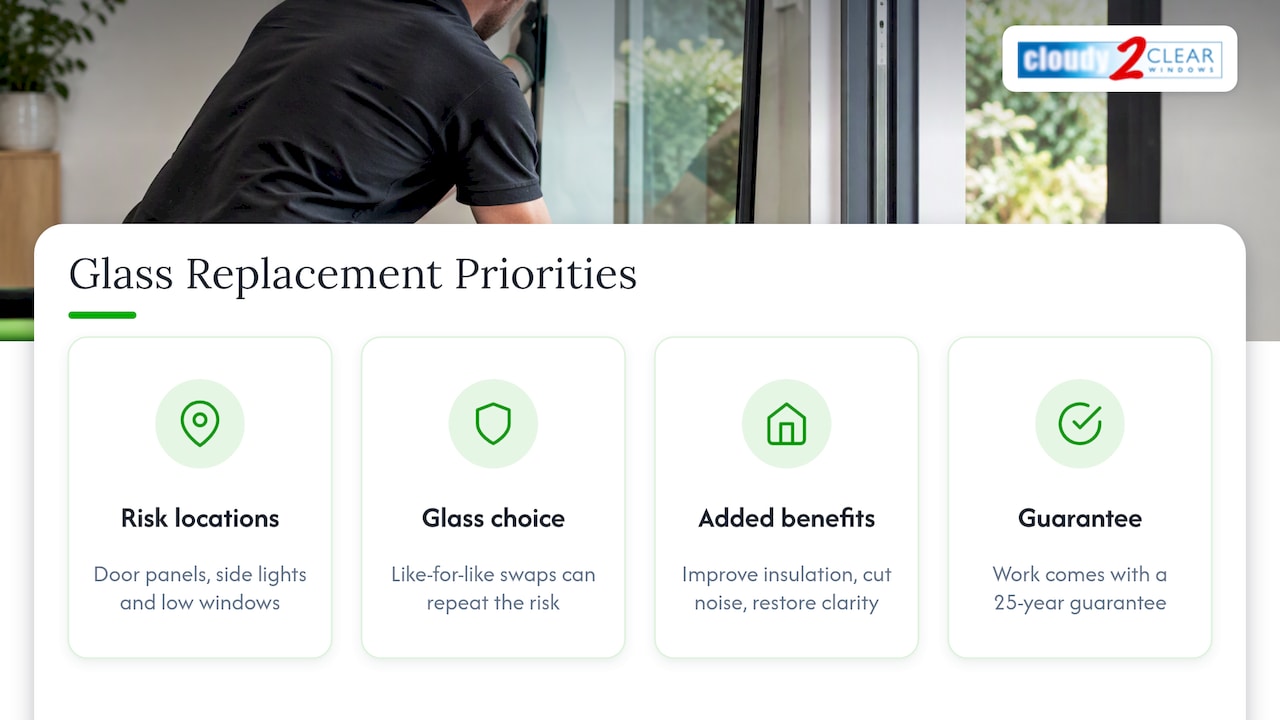
When a pane in one of those spots needs replacing, we think the specification deserves a conversation every time. A like-for-like swap is not always the right swap. If the old glass was installed before safety glass was routine, replacing it with another standard pane repeats the risk.
We also think safety is only one of the jobs the new glass can do. The same visit can improve insulation, cut noise and restore clarity, so we encourage customers to ask about all of it together. Our work comes with a 25-year guarantee, and our focus on glass-only replacement means less disruption and a faster job than replacing a whole window.
Getting safety glass fitted
If you have a cracked door panel, a misted side window or a low pane that worries you, we can inspect it and replace the glass with the right specification. Cloudy2Clear Windows repairs and replaces double glazing for homes, businesses and housing associations across the UK.
For homes, start with double glazing replacement or broken window repairs. For shops, offices and housing blocks, our inspection service helps you identify panes that need attention. Our office hours are Monday to Friday, 8:30am to 6:30pm.
Frequently asked questions
What is the 800mm rule for glass?
Glass within 800mm of the floor is a critical location in England, Scotland and Wales, so it needs safety glass or other protection. The rule sits alongside the 1500mm limit for doors and the glass within 300mm of them.
Do I need safety glass in a bathroom window?
Not automatically, unless the glass is within the critical heights. However, the Glass and Glazing Federation identifies glazing near baths and showers as a slip-and-fall risk, so safety glass is a sensible choice there.
What standard does safety glass have to meet?
Glass in critical locations must meet BS EN 12600, or the older BS 6206, for safe breakage. Scottish guidance also references BS 6262 Part 4. Look for a stamp on the pane to see which type you have.
Can I replace just the glass instead of the whole window?
Yes, if the frame is in good condition. A new sealed unit in the right safety glass can fit the existing frame, which usually means less disruption. A glazier should confirm the frame is sound first.
Sources
- Approved Document K: Protection from falling, collision and impact
- Building regulations: doors and windows, GOV.WALES
- BS 6262-4:2018 preview
- Building standards technical handbook 2020: danger from accidents
- Scottish consultation on accessible homes
- HSE: falls from windows and balconies
- GGF Regulation 14 guidance
- GGF glass breakage booklet