Condensation on patio doors is usually moisture from inside your home settling on the coldest large surface in the room. Wiping it away and improving ventilation often solves it. Where it sits matters. Droplets on the room side point to humidity. Droplets on the outside are a sign the glass is doing its job. Fog trapped between the two panes means the sealed unit has failed, and only new glass will clear it.
This guide helps you work out which of the three you have, what to do about each, and when it is time to call a glazing specialist. It applies equally to sliding patio doors, French doors and bifold doors.
Why patio doors mist up more than other windows
Condensation forms when water vapour in the air cools and turns into tiny droplets. RICS explains in its consumer guide that this happens on any cold surface at or below the dew point of the room air. It is most visible on window glass, but walls can suffer too.
A patio door is a very large sheet of glass, often facing the garden and often in a room with a lot going on. That combination makes it the first place you notice moisture. Rhino Aluminium notes that large areas of glazing make condensation more noticeable, particularly on north-facing elevations, in new extensions and in rooms where cooking, showering or drying clothes add moisture to the air.
A few everyday habits add to the load:
- Drying laundry on radiators or airers in the same room.
- Cooking without an extractor or a lid on the pan.
- Closing every vent to keep the heat in.
- Heating a room only in short bursts, so the glass stays cold between heating periods.
- Keeping the room packed with plants or a lot of people over an evening.
If you would like the science in more detail, our guide on how condensation forms explains it for property owners.
Inside, outside or between the panes: what each one means
Before you change anything, look closely at where the moisture is. This one check decides the whole fix.
| Where the moisture sits | What it usually means | What to do |
|---|---|---|
| On the room side of the glass | Too much moisture in the air, or too little airflow | Ventilate, manage humidity, keep the room evenly warm |
| On the outside of the glass | Efficient glazing keeping heat inside | Usually nothing: it clears as the day warms |
| Between the two panes | The sealed unit has failed and moist air has got in | The glass unit needs replacing |
To test, wipe the glass with a dry cloth. If the droplets move or disappear, they are on a surface. If the haze stays exactly where it was, it is inside the unit.
Condensation on the outside of the door
This one surprises people. The Glass and Glazing Federation (GGF) explains in its condensation booklet that condensation on the exterior of energy-efficient windows and doors is a natural phenomenon. It is a clear sign that the glazing is stopping heat escaping from the house. The outer pane stays cold on clear, still nights, so dew forms on it, much as it does on a car windscreen.
It tends to appear on cool mornings and fade as the day warms. You do not need to treat it.
Condensation on the inside of the door
This is the moisture you can do something about, and most of this article is about it. If it appears every cold morning and clears by lunchtime, your home is holding more moisture than the air is carrying out. If it never clears, or the frame and seals look dark and damp, treat it more seriously.
Fog between the panes
A double glazed patio door is made of two sheets of glass sealed around the edge with a gap between them. When the edge seal fails, moist air enters the gap. The moisture can no longer be wiped away because it sits inside the unit. You might see a milky haze, droplets that come and go with the weather, or a line of mineral staining at the bottom.
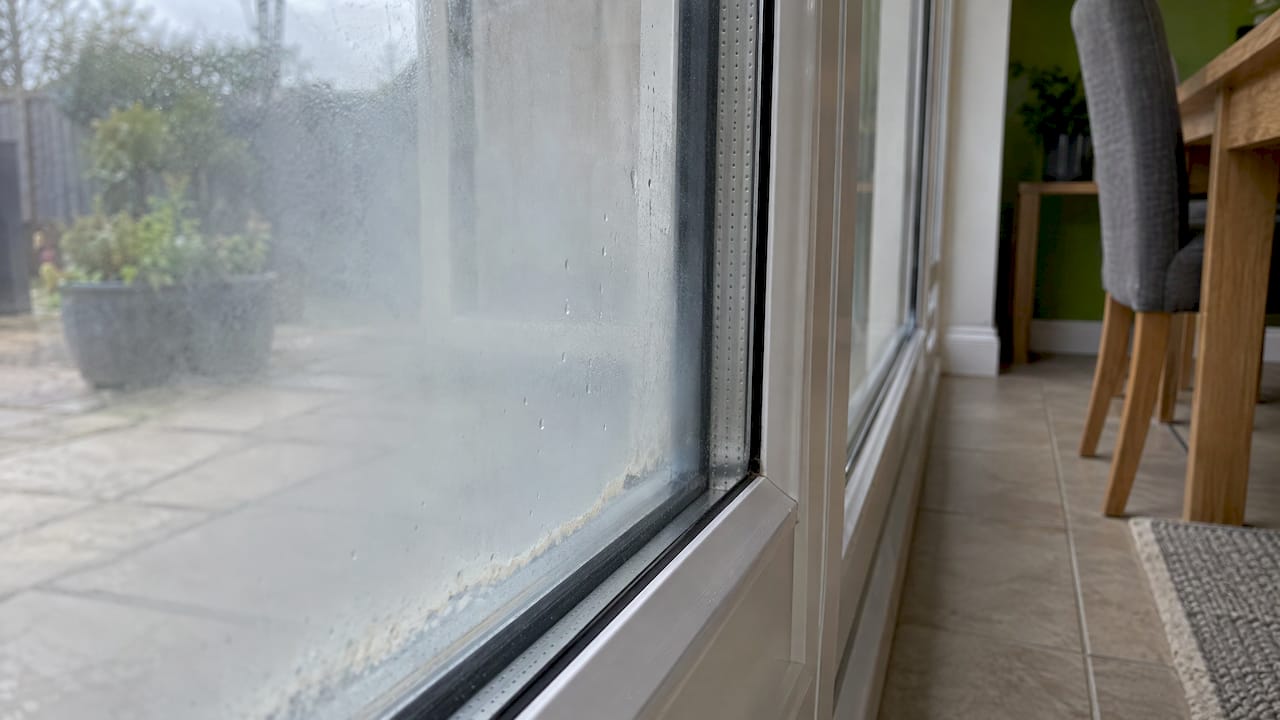
This is a fault in the glass unit, not a ventilation problem. Better airing of the room will not clear it. The sealed unit needs replacing, and in most cases the frame, track and handles can stay exactly where they are.
How to reduce condensation on the room side
The goal is simple: take moisture out of the air and keep the glass from getting too cold. Work through these in order.
1. Use the ventilation you already have
The GGF advises that condensation on the room-side surface is reduced by natural ventilation through an opening window section, a proprietary ventilating unit or an airbrick, and by checking that trickle vents are open. Many patio doors have a trickle vent in the top of the frame. If yours is shut, open it. If your door has none, a window in the same room or a wall vent can do the job.
The same booklet recommends opening at least one window in each room for part of each day to change the air. Ten minutes of a wide opening after cooking or showering is worth more than a slightly open window all evening.
2. Know the difference between background and purge ventilation
The FENSA Guide to Compliance describes two kinds of ventilation. Purge ventilation removes high levels of water vapour and pollutants quickly, for example after a shower. Background ventilation, most commonly through trickle vents, lets a dwelling breathe all the time and protects the building fabric from condensation and mould.
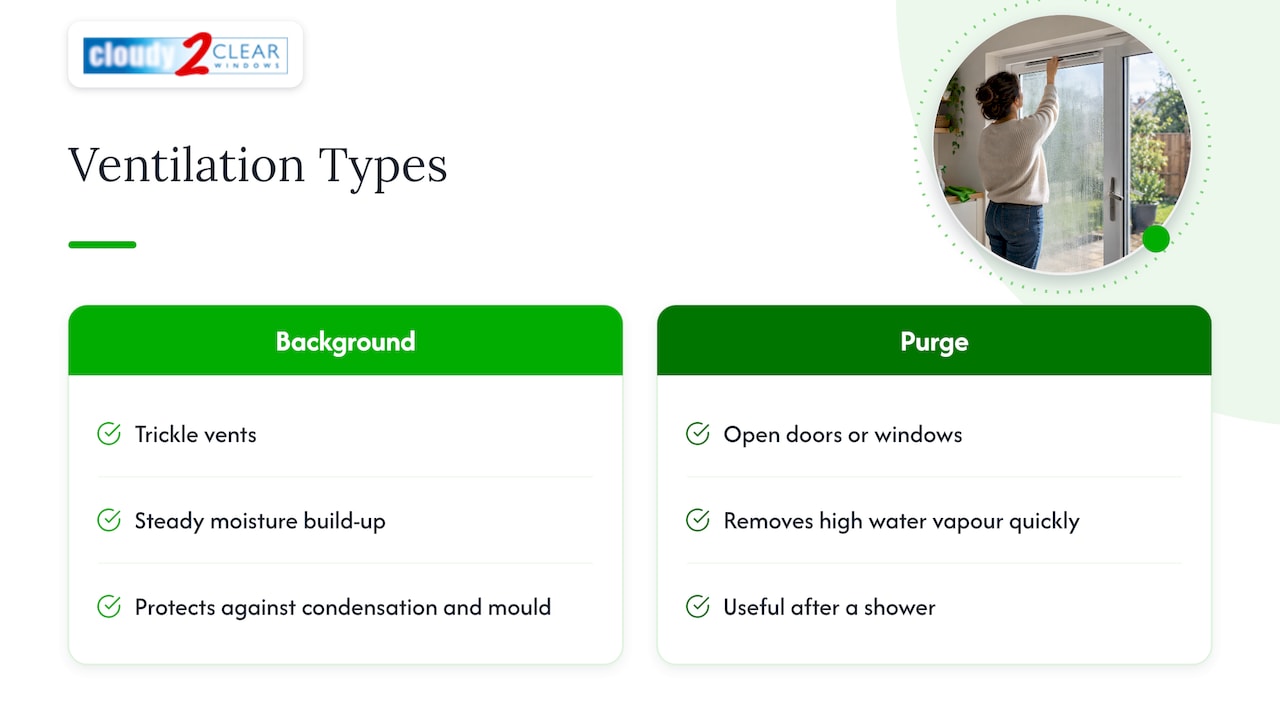
Think of it this way: trickle vents handle the steady build-up, and opening doors and windows handles the spikes.
3. Do not seal the house too tightly
Draught-proofing is sensible, but it should target unwanted gaps. Window Warehouse points out that blocking intentional ventilation can leave a home with poorer air quality and more condensation. If you are fixing draughts around a sliding door, leave the trickle vents alone. Our guide to patio door draughts explains which gaps to deal with and which to leave.
4. Control moisture at the source
- Run the extractor fan during cooking and showers, and for a while afterwards.
- Put lids on pans.
- Dry washing in a ventilated room with the door closed and a window open, rather than in the living room.
- Keep furniture a little way from the glass so air can move across it.
- Open curtains and blinds in the morning so the glass is not cut off from room warmth overnight.
5. Keep the room evenly warm
Warm air holds more moisture, and cold glass is where it drops out. A steady, moderate temperature is kinder to a patio door than a room that swings between cold and hot. Our step-by-step condensation prevention workflow lays out a routine you can follow through the winter.
Sliding doors and French doors: any difference?
The cause is the same for both: warm, damp air meeting cold glass. The practical differences come from how each door is built.
Sliding doors have very large panes and a fixed section next to the opening one. The fixed pane has no trickle vent of its own and no way to open, so you rely on the opening sash, the head of the frame or a nearby window. Check the track at the bottom too. Water that collects there needs clearing, and a blocked drainage slot can leave moisture sitting against the frame.
French doors have a pair of opening leaves with a meeting point in the middle. Because the glass is divided into smaller panes, there is less cold surface per pane, but the leaves rely on their seals closing evenly. If one leaf has dropped slightly, you can get draughts and cold patches that encourage condensation. Adjusting hinges or replacing worn gaskets often helps. Our lock, handle and hinge repairs cover this kind of adjustment.
Bifold doors have many panes and many seals. Any single failed unit can mist, so check each pane rather than assuming the whole set is the same.
Is it condensation or damp?
Moisture around a patio door is not always condensation. RICS describes penetrating damp as water moving from one side of a wall, ceiling, roof or floor to the other, for instance through broken sealant around a window that lets rainwater in. Condensation, by contrast, comes from inside the room.
Three checks help you tell them apart:
- Timing. Sussex Damp Experts say that a problem that is worst in cold weather, in the morning, or after showers and cooking points towards condensation. A patch that is clearly worse after rain on one side of the house points towards penetrating damp.
- The after-rain test. Note how the area looks after a few dry days. During the next spell of steady rain, look again within hours and over the next day or two. The same source says that if the patch darkens, spreads or starts to drip where it did not before, water is probably coming in from outside.
- Location. Condensation gathers on cold glass, frames and sills. A patch with a defined edge on the wall beside the door, or staining below the threshold, deserves a closer look at the outside: sealant, mortar, gutters and the threshold itself.
RICS advises finding out where the moisture is coming from before trying to solve it, and suggests checks anyone can make, such as looking for leaking gutters, ill-fitting doors and windows, and broken sealant or mortar around windows and doors. If you suspect water coming through the structure, record what you see with dated photographs. Guidance on how a flood damage assessment works and what to document shows the sort of notes and photos that help when someone needs to assess water damage. For anything beyond the glazing, RICS recommends a specialist building surveyor.
Our own articles on condensation versus damp and the different types of window condensation go further.
Is it normal for large glazed doors to mist?
Occasional light condensation on a big glazed door on a cold morning is common. The glass is the coldest part of the room, and it is the first place moisture shows. It is worth investigating when:
- It happens every day, even in mild weather.
- The moisture runs down and pools on the sill or track.
- You see black mould on the seals, frame or nearby plaster.
- The frame feels damp or the sill is stained.
- The haze is between the panes and never wipes off.
- The door feels noticeably colder or draughtier than it used to.
Heavy, persistent room-side condensation tells you that moisture or airflow needs attention. Haze inside the unit tells you the glass has failed. Our guide on how to identify window issues in your UK property gives a fuller checklist.
Our view: replace the glass, keep the door
Perspective
When a patio door has misted between the panes, many homeowners assume the whole door has to go. In our experience that is rarely the case. The frame, the track, the handles and the locks are usually in good order. It is the sealed glass unit that has failed.
That is why we replace the glass only. Since 2005 we have been repairing and replacing double glazed units across homes and commercial properties, and the approach is designed to mean lower costs, less disruption and a faster job than replacing a whole door set. Your door stays where it is, and the new glass is made to fit it.
It is also a chance to improve the door. New sealed units can be specified as energy-efficient insulating glass, and we can also supply soundproofing glass where road or neighbour noise is a concern. Our work comes with a 25-year guarantee.
Our advice is to sort the moisture in the room first, then deal with any failed glass once and properly. Clear glass, a door that slides or closes smoothly and a warmer room are all within reach without starting from scratch.
Misted patio door glass: how we can help
If you have found fog between the panes, we can replace the failed glass unit and leave your existing frame in place. We cover double glazed door glass, locks, handles and hinges, conservatory windows, Velux windows and caravan windows, as well as commercial and housing association properties.
Our double glazed door repairs and double glazing replacement pages explain the process.

You can call us 24 hours a day, 7 days a week to book a quote. Our operational hours are 8.30am to 6.30pm. You can also start from our home page.
Patio door glass repairs near you
We work through local branches across England. If your patio doors are in one of these areas, our local teams can help:
- Double glazing repairs Coventry
- Double glazing repairs Stockport
- Double glazing repairs Watford
- Double glazing repairs Oxford
- Double glazing repairs Norwich
- Double glazing repairs Milton Keynes
- Double glazing repairs Chesterfield
We also cover South Manchester, South Birmingham, Leicester and Loughborough, and East Lancashire. For conservatories with glazed patio-style doors, see our conservatory window repair page.
A simple routine for winter
A few minutes a week keeps most room-side condensation under control:
- Open the trickle vents on the door and windows before the cold weather begins.
- Wipe moisture from the glass and the sill in the morning, so it does not soak into seals or sit on the frame.
- Run extractors during and after cooking and showers.
- Open a window in each room for part of the day.
- Check the bottom track and drainage slots on sliding doors for debris.
- Look at each pane once a month for any haze that stays put when wiped.
If you manage a block, a housing association property or a commercial building, the same checks scale up. Our inspection service and commercial window work helps keep glazed doors compliant and clear.
FAQ
Why is there condensation on the inside of my patio doors in the morning?
Overnight, the glass cools and the moisture in your room air settles on it. Breathing, cooking, showers and drying clothes all add to it. Opening the trickle vents, airing the room for a few minutes and keeping the room evenly warm will reduce it.
Is condensation on the outside of patio doors a fault?
No. Outside condensation is a natural effect that shows the glass is keeping heat in the house, as the GGF explains. It forms on cold, clear nights and usually clears as the day warms up. No repair is needed.
What does it mean if there is mist between the panes of my sliding door?
The sealed glass unit has failed and moist air has entered the gap. You cannot wipe it away, and ventilation will not clear it. The unit needs replacing, which usually means the frame and track can stay. We can replace the glass only.
Do French doors need a different fix from sliding doors?
The moisture causes are the same, so ventilation and humidity control apply to both. With French doors, also check that both leaves close evenly against their seals. With sliding doors, keep the track clear and make sure there is ventilation near the fixed pane.
How do I book a visit?
You can call us at any time, 24 hours a day, 7 days a week, to book a quote. Our operational hours are 8.30am to 6.30pm.
Sources
- RICS: Damp and mould consumer guide
- Glass and Glazing Federation: Condensation booklet, April 2025
- FENSA Guide to Compliance
- Rhino Aluminium: Preventing door condensation
- Window Warehouse: Preparing your home for winter
- Sussex Damp Experts: Condensation, rising damp or penetrating damp
- Flood damage assessment: how it works and what to document