If a door contains glass, or sits right beside glass, the glass almost certainly has to be safety glazing. In England, Approved Document K says glass in a door leaf, glass within 300mm of a door edge up to 1500mm from the floor, and low-level glass within 800mm of the floor must either break safely, be robust, or be protected. Toughened glass is the most common way to meet that rule. Scotland has its own handbook, with very similar wording.
This guide explains the rules in plain terms. It covers where the requirement applies, which marks and standards to look for, how toughened glass differs from laminated glass, and what changes for commercial doors and housing association buildings. It also covers what to do if your existing door glass does not comply.
The short answer: where toughened glass is needed
Building regulations talk about “critical locations”. These are the places where people are most likely to collide with glass, fall against it or push through it. According to Approved Document K for England, the typical critical locations are:
- Any glazing within a door leaf, whatever its size.
- Glazing in a side panel or window within 300mm of the edge of a door, where it is also within 1500mm of the floor.
- Glazing in walls and partitions that sits wholly or partly within 800mm of the floor.
In practice, this means a glazed front door, a patio door, a back door with a vision panel and a side light next to an entrance door will nearly always need safety glazing. The same goes for the low panes in a conservatory door set.
Note the wording “wholly or partly”. A pane that starts at 700mm and rises to 2000mm still counts, because part of it falls inside the 800mm zone.
A quick check you can do yourself
Stand at the door and look at each pane of glass. Ask three questions:
- Is the glass part of the door itself?
- Is the glass beside the door, with any part of it within 300mm of the door edge and below 1500mm from the floor?
- Does any part of the glass sit below 800mm from the floor?
A “yes” to any of them means the glass is in a critical location. Then look for the permanent mark in the corner of the glass (more on that below). If you cannot find one, do not assume the glass is compliant.
What “safety glazing” actually has to do
The requirement is called K4 in England. It does not name toughened glass as the only answer. Instead, Approved Document K sets out three routes for glazing in critical locations:
- Break safely. If the glass breaks, it does so in a way that is unlikely to cause serious cuts. The document refers to BS EN 12600 Class 3 or BS 6206 Class C.
- Be robust. The glass is thick or strong enough to resist impact. Small panes are one example.
- Be permanently protected. A guard or barrier stops people from striking the glass.
For most homes and shops, the first route is the practical one. You fit glass that has been tested and marked to the right class, and the question is settled.
Why toughened glass fits the brief
Toughened glass is heat-treated during manufacture. As one UK glass supplier explains, it is up to five times stronger than regular glass, and if it does shatter it breaks into small pieces that cause less serious injuries than the large shards of ordinary glass. We cover the benefits in more detail in our guide to toughened glass benefits for UK properties, and our explainer on what toughened safety glass is is a good starting point if the term is new to you.
One practical point matters here. Toughened glass cannot be cut or drilled after treatment. It is made to size first, then toughened. That means the replacement unit must be measured accurately before it is ordered, and any holes for handles or letterboxes must be specified in advance.
Spotting compliant glass: marks and standards
Safety glass should carry a permanent mark, usually etched in one corner. It typically shows the manufacturer or supplier, the standard (BS EN 12150 for thermally toughened glass, or BS EN 14449 for laminated) and the impact class, such as 1C1 or 2C2 under BS EN 12600.
BS EN 12600 is the impact test most often referred to for glass in doors. It grades glass by how it behaves when struck by a heavy impactor, and the class tells you the height from which it survived or broke safely.
If you are reading an old specification, you may see BS 6206. It was the earlier standard, and Approved Document K still recognises Class C under it.
Two things to bear in mind:
- A mark in a corner of one pane does not prove every pane in the door is safety glass. In a double glazed unit, both panes in a critical location should be safety glazing. Check both sheets.
- Some older doors were fitted before the rules were tightened, or with ordinary glass that was never replaced. The glass may look sound and still not meet today’s standard.
England and Scotland: two rulebooks, one common idea
Building regulations are devolved. England follows the Approved Documents. Scotland uses the Building Standards Technical Handbook. Wales and Northern Ireland have their own versions, so check the local authority if you are outside England and Scotland.
England
Approved Document K covers the rule described above. Whether a particular job needs building control sign-off depends on the work. Replacing glass in an existing door with like-for-like safety glass is a different job from fitting a brand-new glazed opening. If you are unsure, ask your local building control team before work starts.
Scotland
The Scottish handbook, section 4.8, says glazing in a door leaf, or within 300mm of a door leaf and within 1.5m of floor level, should be safety glazing. The same section covers glazing wholly or partly within 800mm of floor level: it should resist impact, break safely or be protected by guarding.
There is one Scotland-specific detail worth noting. An unframed glazed door operating on a pivot must have any exposed vertical edge highlighted so that it contrasts visually with its surroundings. This matters for frameless glass doors in shops and offices.
For more on the Scottish position, see our guide to window safety regulations in Scotland.
| Question | England (Approved Document K) | Scotland (Technical Handbook 4.8) |
|---|---|---|
| Glass in a door leaf | Safety glazing | Safety glazing |
| Glass beside a door | Within 300mm of the door edge, up to 1500mm from floor | Within 300mm of the door leaf, within 1.5m of floor |
| Low-level glass | Within 800mm of the floor | Within 800mm of the floor |
| Ways to comply | Break safely, be robust, or be protected | Resist impact, break safely, or be protected |
Toughened glass or laminated glass?
The question “what is the difference between toughened glass and security glass?” comes up often, because the two do different jobs.
- Toughened glass is heat-treated. It is strong and, when it breaks, it crumbles into small granular pieces. That is why it is called a safety glass.
- Laminated glass has a plastic interlayer between two sheets. When it breaks, the pieces stay stuck to the interlayer, so the pane tends to hold together.
As a UK glazing professional notes, building regulations focus on whether glazing in critical locations will not break or will break safely, and both toughened and laminated glass can meet that safety requirement.
So the regulation does not force you to choose toughened over laminated. The choice comes down to what else you want the door to do.
| Feature | Toughened glass | Laminated glass |
|---|---|---|
| Meets safety glazing rules | Yes, when marked to the right class | Yes, when marked to the right class |
| How it breaks | Small granular pieces | Cracks but stays bonded to the interlayer |
| Resistance to forced entry | Limited once broken | Better, as the pane stays in the frame |
| Cutting to size | Cut before toughening | Can be cut to size locally |
| Typical use | Doors, side panels, low-level glass | Security doors, side lights by locks, replacement glazing where rebates allow |
The last row has a practical consequence. A West Sussex County Council construction guide explains that laminated glass is preferred for high-security uses and for reglazing where rebate depths allow, and that it can be cut to size locally, unlike toughened glass.
Security is a separate question
Safety and security are not the same thing. Safety glazing protects people from injury. Security glazing resists attack. Scottish guidance in section 4.13 of the handbook recommends preventing access to door locks from outside by breaking adjacent glazing, using laminated or similarly robust glass.
If a pane sits within arm’s reach of your lock, laminated glass is worth considering. Our guides on laminated glass for doors, why use laminated glass and P1A laminated glass for door security go into the detail. If you are comparing the full range, our types of safety glass guide sets them side by side.
Commercial doors and shopfronts
Business premises have a few extra points to cover on top of the critical-location rule.
Manifestation
Approved Document K requires transparent glazing in non-domestic buildings to incorporate features that make it apparent. This is known as manifestation. It usually means bands, logos or frosted patterns at eye level. The requirement does not apply to dwellings.
Many shops meet this with decals or etched graphics. If you apply them yourself, the way they are fitted matters, and a guide on getting window stickers to stick shows the installer checks that keep graphics in place on glass.
Door widths
Glass is only part of the picture. Approved Document M, Volume 2 sets the minimum effective clear width for entrance doors in new non-domestic buildings at 1000mm, and internal doors typically need at least 800mm. This is a common question alongside glass, but it applies to the door opening, not to the glazing. When you swap glass only, the door and frame stay the same, so the opening width does not change.
This is one reason why glass-only work is useful for premises that are already in use. You can bring door glazing up to standard without altering the structure.
Fire doors
If a glazed door is also a fire door, extra rules apply. Fire-rated glass is a different product from ordinary toughened glass, and the glazing, the beading and the frame work as a system. Replacing the glass with the wrong type can undo the door’s fire rating.
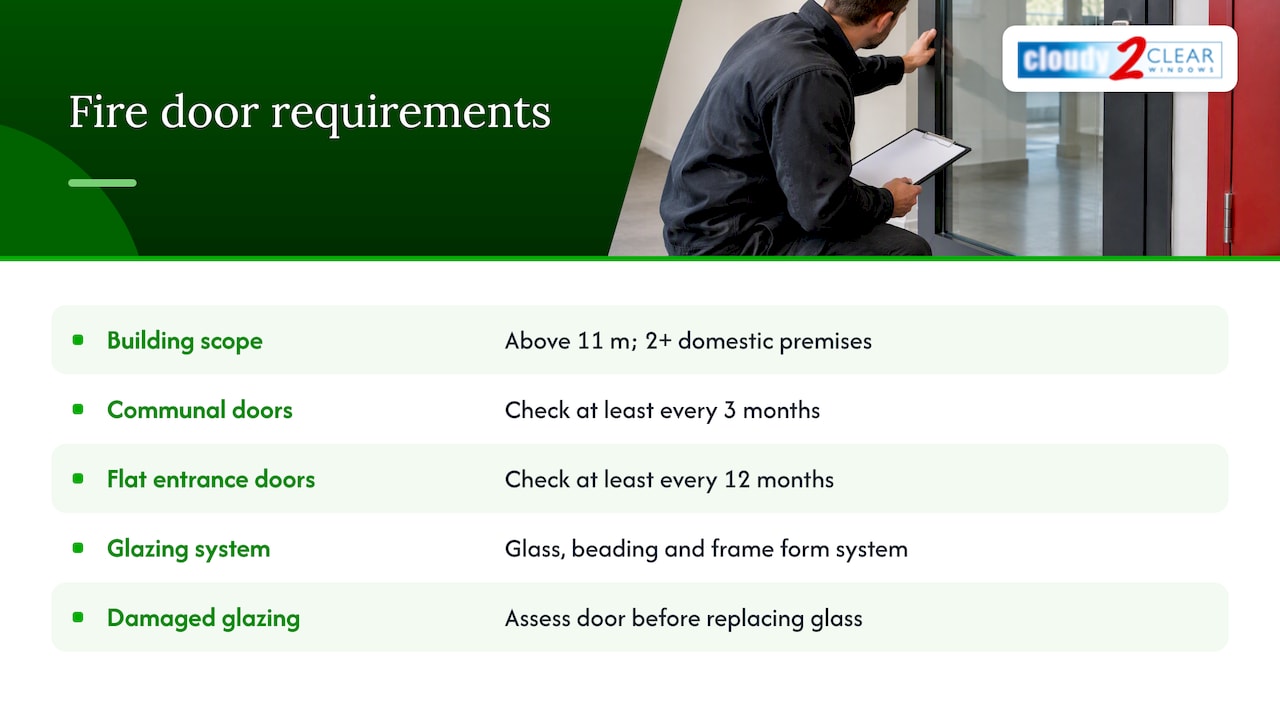
For residential buildings, the Fire Safety (England) Regulations 2022 require responsible persons in buildings above 11 metres with two or more sets of domestic premises to check communal fire doors at least every 3 months. They must also use best endeavours to check flat entrance fire doors at least every 12 months. The government fact sheet on regulation 10 adds that information about fire doors must be given to residents of multi-occupied residential buildings with common parts.
If a check finds damaged or cracked glazing in a fire door, do not simply swap in toughened glass. Get the door assessed first.
Our perspective
Most of the glass problems we are called to are not dramatic. A homeowner has a misted unit in a back door, or a tenant reports a cracked panel in a communal entrance. The question then is what the replacement glass has to be.
Our experience is that the critical-location rule catches people out more than any other. A pane looks like part of an ordinary window, but it sits low, or close to the door edge, and it was never safety glass. When we replace glass only, we start by checking exactly where the pane sits and what the marks on the old unit say.
We also think safety and security should be discussed together. If the pane has to be safety glazing anyway, it costs nothing to ask whether it is next to a lock and whether laminated glass would suit it better. That is a decision for you, and we would rather explain the options than push one.
Because we replace only the glass and leave the frame in place, the job is usually quicker and less disruptive than replacing the whole door. That matters when a door is a business entrance or a communal route.
What to do if your door glass may not comply
Not every older door needs urgent action, but a cracked, misted or unmarked pane in a critical location is worth dealing with. Follow these steps.
- Identify the critical panes. Use the 300mm, 800mm and 1500mm checks above.
- Look for the etched mark. Check each pane in a double glazed unit, not just one.
- Note the damage. Cracks, misting between panes, and failed seals each need a different fix.
- Check the frame. Glass-only work depends on a sound frame and sufficient rebate depth, especially if you want laminated glass.
- Ask for the standard in writing. A competent installer will tell you which class of glass is going in and where the mark will be.
- Keep the paperwork. For rented property, social housing and commercial premises, records of what was fitted help during inspections.
Our page on double glazed door repairs covers door glass, and if a pane has already broken, see broken window repairs. For conservatory doors and low-level roof-line glazing, there is a dedicated conservatory window repair service.
Housing associations and property managers
If you manage a block or a portfolio, door glass can turn into a compliance list. A reliable approach is to survey the glazed doors and side panels, record which carry the safety mark, and flag fire doors for separate assessment. Our inspection service and full replacements are set up for this kind of work, and our commercial window repair page covers business premises.
Getting compliant door glass from Cloudy2Clear Windows
We have been installing, replacing and repairing double glazed windows for homes and businesses since 2005. We replace only the glass, not the frame, which keeps disruption low, and our work comes with a 25-year guarantee. You can see what is involved on our double glazing replacement page, or get in touch through our main site. Our lines are staffed Monday to Friday, 8:30am to 6:30pm.
If you also want better insulation or less noise from a door unit, ask about insulating glass and soundproofing glass at the same visit.
Frequently asked questions
Does every glazed door need toughened glass?
Glass in a door leaf is a critical location, so it needs safety glazing. Toughened glass is the usual choice, although laminated glass can also meet the rule. The glass must carry a recognised mark to show it has been tested.
Can I use laminated glass instead of toughened glass in a door?
Yes, provided it is marked to the right impact class. Laminated glass holds together when broken, which makes it a good option near locks. Check that the frame has enough rebate depth to take it.
Do the rules differ in Scotland?
The principle is the same, but Scotland follows the Building Standards Technical Handbook rather than Approved Document K. Section 4.8 sets the door leaf, 300mm and 800mm tests, and it adds a rule for exposed edges of unframed pivot doors.
How do I tell if my door glass is safety glass?
Look for a permanent etched mark in a corner of each pane, showing the standard and class. If you cannot find one, or the unit is old, ask a glazier to inspect it. Do not rely on thickness or appearance alone.
Does replacing only the glass in a door need the frame changed?
Not usually. Glass-only replacement works when the frame is sound and the rebate is deep enough for the new unit. A survey will confirm this before any glass is ordered.
Sources
- Approved Document K: Protection from falling, collision and impact
- Scottish Building Standards Technical Handbook 2020, 4.8 Danger from accidents
- Scottish Building Standards Technical Handbook 2020, 4.13 Security
- Approved Document M, Volume 2, with 2024 amendments
- The Fire Safety (England) Regulations 2022, regulation 10
- Fire doors (regulation 10) fact sheet, GOV.UK
- When do I need safety glass in doors and windows, and what type
- Property Services Construction Guide: glazing, West Sussex County Council
- When do you need toughened glass?