If you can wipe a mark away from the room side or the outside, it is surface dirt. If it stays put and seems to sit inside the glass, it is between the panes, and cleaning will never reach it. Marks, haze or droplets in that gap mean the sealed unit has failed. The lasting answer is a new sealed glass unit, and at Cloudy2Clear Windows we replace only the glass, so your existing frame stays where it is.
This guide shows you how to tell the difference in a few minutes, what causes the problem, why household tricks do not last, and what to do next. It is written for homeowners, business owners and housing association managers in England and Scotland.
How to tell whether the mark is between the panes
A double glazed unit is two sheets of glass held apart by a spacer bar and sealed around the edge. The gap between them is meant to stay clean and dry. That gives you four surfaces: the room side of the inner pane, the two faces inside the gap, and the outside of the outer pane. Only the two outer faces can be wiped. Before you book anything, find out which surface the mark is on.
- Check in dry daylight. Look at the window in even natural light, not direct sun and not by torchlight. Glass judged under harsh conditions, such as at night or inches from the pane, often looks worse than it is, as independent glazing experts point out.
- View it from several angles. A mark on a surface stays on that surface. A mark that seems to have depth, or that shifts against the frame as you move, is usually inside the unit.
- Wipe the room side. Use a clean, soft cloth. If the mark disappears, or moisture comes off on the cloth, it was on the indoor surface.
- Check the outside face safely. Do this only from ground level or a safe position. Never lean out of an upstairs window or climb onto a conservatory roof to test a mark.
- Take a photo. Note the date and the weather. A picture helps when you speak to an installer about a guarantee.
A simple rule sums it up: if you can touch the moisture, it is an indoor humidity issue, and if you cannot, it is trapped inside. A window cleaning company’s quick test gives the same guidance.
Signs the problem is inside the unit
According to a practical guide to marks on windows, a mark is between the panes when:
- The cloudy patch stays after both accessible surfaces are clean.
- It appears to have depth instead of sitting on one surface.
- Condensation forms inside the unit rather than on the room-facing glass.
- Its appearance changes with temperature, yet it never wipes away.
Scratches and installation marks are different
Not every mark is moisture. Scratches, scuffs, silicone smears and tool marks can come from installation or from other trades working nearby. A scratch is damage to the glass, not dirt, so no amount of cleaning will remove it. Occasionally, fingerprints or debris are trapped inside a unit during manufacture. Whether that is acceptable depends on whether it is visually disturbing when viewed normally: from at least 2 metres away, at a right angle and in daylight, according to the same independent guidance.
Humidity condensation is not a failed unit
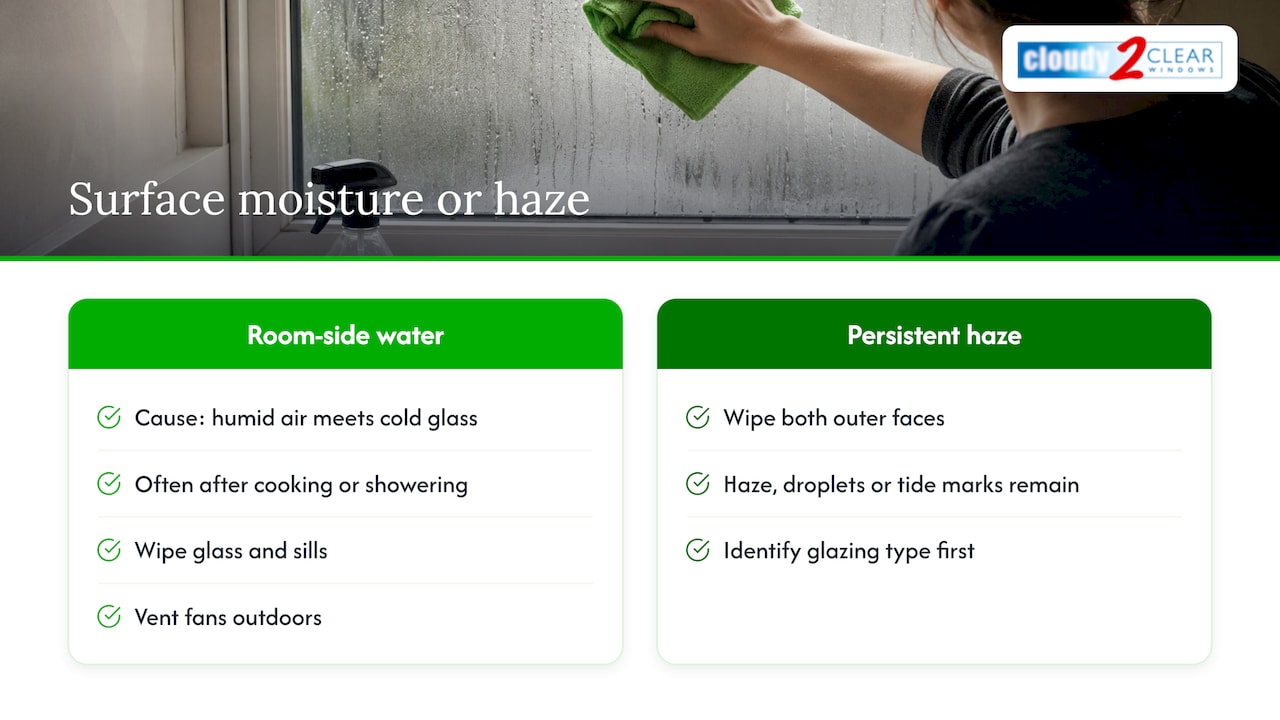
Water on the room-facing glass, often on bedroom windows overnight or after cooking and showering, forms when humid air meets cold glass. That is ordinary condensation, not a seal failure. Wiping the glass and sills, using extractor fans that vent outdoors, covering pans and keeping washing off cold windows all help, according to the same quick test. Secondary glazing also behaves differently, so identify what type of glazing you have before deciding a unit has failed.
If you have wiped both outer faces and the haze, droplets or tide marks are still there, read on. We also cover the full picture in our guide to how to diagnose misty windows.
What puts dirt and haze between the panes
The gap is sealed on purpose. Inside the spacer bar sits a drying agent called desiccant, which absorbs the small amount of moisture trapped during manufacture. It has a limited capacity. If the seal breaks, the constant arrival of moist air eventually uses up the desiccant, and the glass clouds between the panes.

Once that happens, the cycle feeds itself. Moisture condenses, evaporates and condenses again, and each round leaves a film of dirt behind. Fine Homebuilding reports that fogging between panes is usually caused by seal failure or small stress cracks near the glass edges, and that it typically gets worse over time.
Common triggers
- Seal ageing. Sealants wear over years of daily heating and cooling.
- Movement. Thermal expansion or an uneven opening can flex the unit enough to open the seal, as the same article explains.
- Heat from direct sun. South-facing windows get the most intense daytime heating followed by night cooling, which stresses seals.
- Residue and chemical reactions. Film deposits from insufficient washing during manufacture, or reactions between sealants, spacers and other components, can cause permanent fogging, according to Window + Door magazine.
- Poor installation. Wrong materials or fitting can shorten a unit’s life.
Pinning down the exact cause is difficult, and it rarely changes the answer. Once moisture is inside, the unit has done its job and needs replacing. Our article on why glazed units mist up goes into more detail.
Can you clean between the panes?
No. The cavity cannot be reached without breaking the seal, and a window cleaner’s brush or cloth only touches the outer faces. Exterior cleaning cannot reach the cavity and should not be presented as a repair for it. Only a proper glazing assessment can confirm what is going on.
It is tempting to try something yourself. Resist these:
- Drilling the unit. Holes do not restore the factory seal, and they can affect appearance, performance and your guarantee rights, as the quick test guide warns.
- Injecting household de-fogging products. The same warning applies.
- Prising the panes apart. This destroys the unit and its insulation.
These approaches also do nothing for the real issue. A unit with a broken seal has lost much of its insulating ability, so it will leave rooms colder and heating less efficient even if the glass looks clearer for a while.
When the sealed unit needs replacing
Glass manufacturers give clear guidance. Cardinal Glass advises replacing a unit when condensation is evident in the airspace, usually because of seal failure or a small crack in the glass. It also says to clean the indoor and outdoor surfaces first, to confirm the moisture really is in the gap. Room-side sweating from high humidity is not a reason to replace anything.
That gives you a straightforward decision:
| What you see | Likely cause | What to do |
|---|---|---|
| Mark wipes off the room side | Surface dirt or humidity | Clean and ventilate |
| Mark wipes off the outside | Surface dirt | Clean from a safe position |
| Haze, droplets or tide marks that never wipe away | Failed seal in the sealed unit | Replace the sealed glass unit |
| Scratch you can feel | Damage to the glass | Glass assessment and replacement |
| Cracked pane | Broken glass | Prompt glass replacement |
If your frame, hinges and locks are sound, the glass is the only part that has failed, and the glass is the only part you need to replace.
Glass-only replacement: how it works with us
At Cloudy2Clear Windows, we replace only the glass, not the frame. For many homes, offices and housing association properties, that means less disruption and a faster job than replacing the whole window. Here is how it goes, step by step.
- You get in touch. Describe the marks, tell us which windows are affected, and send a photo if you have one. You can call us 24 hours a day, 7 days a week to book a quote. Our operational hours are 8.30am to 6.30pm.
- The glass is assessed. We confirm whether the problem is a failed sealed unit, a crack or something else, so you are not paying to treat the wrong cause.
- The new unit is made to fit. The replacement glass is matched to your existing frame.
- The old unit comes out and the new one goes in. Your frame stays in place.
- You are left with clear glass. The new unit restores both clarity and energy efficiency, and you can ask about upgraded options such as insulated glass for better efficiency or glass for noise reduction.
Our work comes with a 25-year guarantee. If you are keen to understand the process in more depth, read our guide on fixing misted double glazing without replacing the frame, or our answer to whether failed double glazing can be repaired.
Why leaving it makes things worse
A failed unit does not heal. Moisture keeps cycling, the staining spreads and the unit insulates less each season. We explain the consequences in what happens if you do not repair double glazing. If your windows are fairly new, check whether the installer’s guarantee still applies before anything else, and keep the installation date and your photos to hand.
Double glazing repairs near you: Coventry and our other branches
We cover the whole of the UK, and our local branches serve the areas around them. If you are looking for double glazing repairs in Coventry, our Coventry branch is the place to start. Other branch pages include:
- Double glazing repairs in South Manchester and Stockport
- Double glazing repairs in Milton Keynes and Oxford
- Double glazing repairs in South Birmingham
- Double glazing repairs in Watford and Colchester
- Double glazing repairs in Leicester and Loughborough
- Double glazing repairs in Norwich
- Double glazing repairs in East Lancashire and Chesterfield
Wherever the misted window is, the process above is the same.
Beyond standard windows
Dirt and haze between panes is not limited to ordinary house windows. We also repair glass in these places:
- Conservatory windows, where large units and sun exposure put seals under strain.
- Double glazed doors, including the glass panels in patio and front doors.
- Velux roof windows.
- Commercial premises, where we also offer inspection and full replacement services for commercial and housing association properties.
If a lock, handle or hinge is also failing, we can look at locks, handles and hinges during the same visit.
Our view: treat the cause, not the cloud
Most people who contact us have already tried to wipe the mark away, and many have wondered about drilling or injecting something into the unit. The instinct is understandable, because the window looks fine apart from the haze.
Our view is simple. A misted unit is a sealed unit that no longer seals. The kindest thing you can do for your home or building is to replace that unit with new glass and keep the frame that is still doing its job.
That is why we replace only the glass. It means less disruption for you, a quicker job and a result that restores clarity and energy efficiency. The 25-year guarantee on our work reflects how seriously we take that.
For housing associations and commercial owners with many windows, the same approach lets you deal with failed units one by one, without taking on a full window programme.
Get clear glass back
Our double glazing replacement service replaces misted, cracked or failed panes while keeping your existing frame. We have been installing, replacing and repairing double glazing for homes and businesses since 2005.

Call us any time, 24 hours a day, 7 days a week, to book a quote. Our operational hours are 8.30am to 6.30pm.
FAQ
Why are my windows dirty on the inside?
If the dirt wipes off the room side, it is surface dirt or condensation caused by indoor humidity. Ventilating the room and wiping the glass regularly will help. If a haze stays after you have cleaned both outer faces, it is inside the sealed unit.
Can I clean between the panes of a double glazed window?
No. The gap is sealed, so cloths and brushes cannot reach it. Marks that will not budge from either side point to a failed seal, and the lasting answer is to replace the sealed glass unit.
What are the marks inside my double glazing?
They are usually moisture and the film it leaves behind after a seal has failed. Occasionally they are debris trapped during manufacture, or a scratch on the glass, which is damage rather than dirt. A glazier can confirm which it is.
Do I need to replace the whole window?
Not if the frame, hinges and locks are sound. When only the glass has misted, stained or cracked, a new sealed unit is what is needed. At Cloudy2Clear Windows, we replace only the glass and leave your frame in place.
Is the average lifespan of a double glazed unit fixed?
No, because it depends on installation quality, movement and sun exposure. Seals wear gradually, and when one fails, haze or droplets appear between the panes. That is the moment to arrange a replacement.
Sources
- Scratches, marks and odd reflections in new double glazing
- Condensation or Failed Double Glazing? A Quick Test
- Marks on Windows: Inside, Outside or Between Panes?
- Desiccants 101, USGlass magazine
- Window Fogging Causes and Solutions, Fine Homebuilding
- Insulating Glass: Problems and Prevention, Window + Door
- Insulating Glass guidance, Cardinal Glass