Double glazing blocks some ultraviolet (UV) light, but not all of it, and ordinary clear double glazing is not designed as a UV filter. How much gets through depends on the glass in the unit, mainly whether one pane is laminated, meaning two layers of glass bonded to a plastic interlayer. If your floors, sofas or curtains are fading behind a south-facing window, the answer is usually a change of glass, not a change of frame. That is where glass-only work, the kind we do at Cloudy2Clear Windows, makes sense.
This guide explains what UV does inside your home or premises, how much different types of glass let through, what coatings can and cannot do, and how to read a specification so you know what you are getting.
What UV light does to the inside of a building
Sunlight contains three bands of UV. UVB and UVA are the ones that reach us through the atmosphere, and UVA is the band that passes most readily through glass. Indoors, UV is one of the main causes of fading and ageing in fabrics, carpets, wood flooring, artwork and printed materials.
Historic England’s guidance on secondary glazing states that UV light from the sun can cause extensive damage to paintings, fabrics and furnishings. The same guidance says a UV-absorbing film, either within laminated glass or applied to the window, absorbs UV and reduces that risk.
UV is not the only cause. Visible light and heat also fade materials, which is why no glass can promise to stop fading completely. What UV-filtering glass does is remove the largest single contributor.
For most households the effect shows up in familiar places:
- A sofa with a paler stripe where the sun lands each afternoon.
- Oak or laminate flooring that has bleached near a patio door.
- Curtains and blinds that have gone brittle and faded on the window side.
- Shop displays, stock and printed signage in a retail unit with a large frontage.
For a business owner or a housing association manager, the same problem appears as faded stock, worn interiors in communal areas, or tenant complaints about fading in south-facing flats.
Does double glazing block UV?
Partly. A standard double glazed unit has two panes of glass with a sealed gap between them. Glass absorbs some UV on its own, and two panes absorb more than one, but ordinary clear float glass still lets a significant share through.
A laboratory study summarised on PubMed tested several glass types. It found that smooth ordinary glass transmitted the highest UVA dose, 74.3%, while laminated glass blocked UVA totally. All the glasses tested blocked UVB.
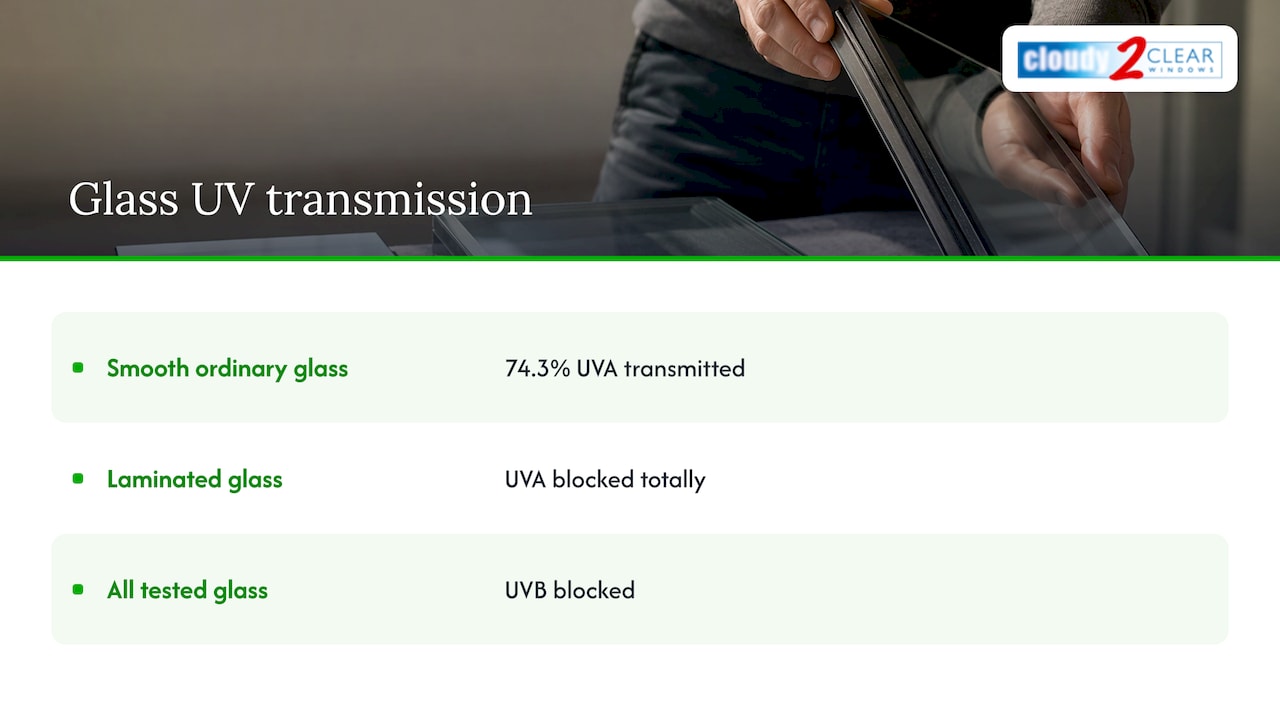
That difference explains a common confusion. People say glass blocks UV because they do not tan or burn behind a window. That is true for UVB, which causes sunburn. UVA is the band that still gets through, and it is the band that contributes to fading and long-term damage to furnishings.
So the honest answer for your windows is this: ordinary double glazing reduces UV, but a unit with a laminated pane filters it far more effectively.
How much UV different glass lets through
Saint-Gobain Glass UK publishes measured data in a technical note on UV performance. Its figures give a useful sense of scale:
| Glass type | UV transmittance | CIE damage factor |
|---|---|---|
| 6 mm clear glass | 70.3% | 82.1% |
| 6.8 mm UV-filtering laminated glass | 0.9% | 57.6% |
These are from Saint-Gobain’s measurement of UV related performance for single panes of each product. The first column is the share of UV that passes through. The second, the CIE damage factor, estimates how damaging the transmitted radiation is to materials. It covers a wider range of wavelengths, including some visible light, which is why it falls by less than the UV figure does.
That second column carries a lesson. Even when almost all UV is removed, the damage factor does not drop to zero, because visible light still fades some materials. Expect a real reduction in fading, not a guarantee against it.
Other UK manufacturers quote similar results for laminated products:
- Saint-Gobain’s brochure states that laminated glass with a 0.8 mm interlayer blocks over 99% of UV, helping protect furnishings and decor from fading.
- Guardian Glass states that the interlayer in its LamiGlass ExtraClear laminate absorbs up to 99.5% of UV light.
- Pilkington states that its OptiView Protect laminated glass blocks over 99% of UVA and UVB, and notes its suitability for museum display glazing and retail shopfronts.
The pattern is consistent. The plastic interlayer inside laminated glass does the filtering, and it does so while the glass stays clear.
Why coatings are not the UV answer
Many homeowners assume that a low-emissivity (low-E) coating, the thin metallic layer that keeps heat in, also acts as a UV shield. It helps with heat, but it is not the main UV control.
Saint-Gobain’s technical team explains that adding thermal or solar-control coatings makes only a relatively insignificant difference to UV transmittance. The reason is that these coatings are designed to keep visible light high, so you still get bright rooms. Replacing the inner pane with a UV-filtering laminated glass is what significantly reduces UV transmittance.
In practice this means two things for you:
- A window sold on energy efficiency alone should not be assumed to protect your furnishings from UV.
- If fading is your concern, ask about the make-up of the glass, not only the heat rating.
The good news is that heat retention and UV control can sit in the same unit. A sealed unit can carry a low-E coating on one pane and a laminated pane on the other, giving you thermal performance and a UV filter together. If you want to understand the heat side first, our guide on how double glazing reduces heat loss explains the science in plain terms.
Laminated glass: the pane that filters UV
Laminated glass is made of two or more sheets of glass bonded with a clear plastic interlayer, usually polyvinyl butyral (PVB). The interlayer absorbs UV, and it also holds the glass together if it breaks, which is why it is common in security and safety glazing.
The benefits stack up for a homeowner or a property manager:
- UV filtering. The interlayer absorbs most UV, as the figures above show.
- Safety. If the glass cracks, the fragments stay bonded to the interlayer instead of falling as loose shards.
- Security. Saint-Gobain states that its laminated glass, with compliant framing, is tested to meet Secured by Design and Building Regulations Doc Q requirements.
- Clarity. Modern clear interlayers keep the view and the daylight you expect.
For housing associations, the safety and security angle often matters as much as the fading. Glass that stays in the frame when struck is easier to make safe quickly, and it reduces the risk of injury in communal areas.
Reading a specification without a degree in physics
When a quote or data sheet mentions UV, three terms are worth knowing.
UV transmittance
This is the percentage of UV that passes through the glass. Lower is better for protection. Saint-Gobain explains that it is assessed under EN 410:2011, the European standard for glazing light and solar characteristics, over the 300 to 380 nanometre band using a spectrophotometer.
CIE damage factor
This is a wider measure of how much damage the transmitted light can do to materials, covering 300 to 600 nm. It is always higher than the UV figure alone because it includes some visible light. Use it to compare products, not as a promise.
Calculation of multiple glazing
A double glazed unit is more than one pane, so its performance comes from the combination. The international standard ISO 9050 covers these characteristics, including UV transmittance, and requires spectral data for each glass component when calculating multiple glazing. In plain terms: the figure for the unit depends on every pane in it, so the make-up of both panes matters.
For most homes, you do not need museum levels of protection. Museum glazing guidance, which Saint-Gobain summarises, calls for UV transmission of less than 1% between 320 and 380 nm. That is a demanding benchmark and useful to know, but a laminated pane delivers most of the practical benefit for living rooms and shop frontages.
Which windows benefit most
Not every window needs the same treatment. Prioritise by how much direct sun the glass gets and what sits behind it.
- South and west-facing windows get the strongest and longest sunlight, so fading appears here first.
- Conservatories have large glazed areas and often a lot of overhead glass, so UV exposure is high. Our conservatory window repair service covers glass in these structures.
- Roof windows such as Velux units receive sun at a steep angle for much of the day. We cover them under Velux window repairs.
- Shop and office frontages protect stock, displays and furnishings that customers see every day. See our commercial window repair page.
- Patio and French doors often sit next to the most expensive flooring in the house, and the glass in them can be replaced too, as described under double glazed door repairs.
If you own a heritage or listed property, Historic England’s advice on secondary glazing is a useful starting point, because changes to the window may need consent. Check with your local planning authority before altering the windows of a listed building.
Replacing the glass instead of the whole window
If the frames are sound, you do not need to replace the whole window to improve what the glass does. The frame is the structure. The sealed glass unit is the part that controls light, heat, sound and UV.
That is why glass-only replacement suits this problem. Our positioning is simple: we replace only the glass, not the frame, which is designed to mean lower costs, less disruption and faster service compared with replacing the entire window. For someone who wants the fading to stop in one room, that is a proportionate fix.
There is also a practical sequence that works well:
- Identify the windows where fading is worst, usually the sunniest elevations.
- Check the condition of the frames, seals and hardware.
- Decide whether the unit needs replacing anyway, for example because it has misted, cracked or lost its seal.
- Where it does, use that opportunity to choose a glass make-up with better UV performance, plus heat or sound upgrades if you want them.
Step 3 matters. A failed unit is the cheapest moment, in terms of effort, to improve the glass, because the work is already happening. Our double glazing replacement service is built around this glass-only approach, and our insulating glass page explains the energy-efficient unit options.
If you are comparing this to adding a second window inside the first, our article on primary versus secondary glazing sets out how the two approaches differ.
Combining UV control with heat and sound
UV control rarely stands alone. Most people who ask about it are also thinking about bills or noise, and a single replacement unit can address several of these at once.
- Heat retention. A low-E coating and a sealed gap reduce heat loss. Our guide on how to reduce window heat loss covers the options.
- Sound. Glass of different thicknesses, or laminated glass, can cut traffic and neighbour noise. We offer soundproofing and noise reduction glass upgrades through our services range.
- Eco-friendly choices. We offer eco-friendly insulated glass options, so a replacement can improve efficiency as well as appearance.
Because laminated glass is both a UV filter and a sound and safety performer, it is one of the few upgrades that improves several things at once. Discuss your priorities with us so the glass specification fits the room it is going into.
Double glazing glass replacement across our branch areas
We cover the country, with local branches serving areas including:
- Double glazing repairs in Stockport and South Manchester
- Double glazing repairs in Wigan and East Lancashire
- Double glazing repairs in Coventry and South Birmingham
- Double glazing repairs in Leicester and Loughborough
- Double glazing repairs in Oxford, Milton Keynes and Watford
- Double glazing repairs in Norwich and Chesterfield
Whether you are in England or Scotland, and whether the property is a home, a business premises or a housing association block, the same glass-only approach applies.
What to do if you manage commercial or housing association property
Property managers face a different version of the same problem. A single window might be fine, but a block of 60 flats or a row of units has hundreds of panes, and conditions vary by elevation.
A sensible approach is to start with an inspection. We run an inspection service for commercial and housing association properties, along with full replacements, described on our commercial fenestration page. An inspection records which units have failed, which elevations take the most sun, and where a glass upgrade will be most useful. That gives you a planned programme instead of reactive call-outs.
For communal areas such as stairwells and entrance lobbies, laminated glass has the added value of safety and security. Where a pane is cracked or broken, our broken window repairs service deals with it directly.
Our perspective
We are asked about UV protection far less often than about misted units or draughts, yet it often explains why a room looks tired long before the frame does.
Our view is simple. The frame rarely needs to change for you to get a better result, and the glass is where the performance sits. That is why we replace only the glass. It means less disruption in your home or business, a faster job and a result that keeps the frames you already have.
When a unit has failed, that is the moment to think about what you want from the new glass: clearer views, better insulation, less noise and, where the sun is strong, kinder treatment of your furnishings. We stand behind our work with a 25-year guarantee, and we have been installing, replacing and repairing double glazing since 2005.
Talk to us about the room, the aspect and what you are trying to protect. We will explain the glass options for that window plainly.
Cloudy2Clear
Book a glass-only upgrade
If your glass has misted, cracked or failed, or you simply want better performance from the windows you have, Cloudy2Clear Windows can replace the glass without replacing the frame. We repair and replace double glazing for homes, businesses and housing associations, and our eco-friendly insulated glass options let you improve efficiency at the same visit.
Our operating hours are 8.30am to 6.30pm, and you can call us 24 hours a day, 7 days a week to book a quote. Start with our double glazing replacement page or visit Cloudy2Clear Windows to see everything we do.
FAQ
How much UV is blocked by double glazing?
It depends on the glass. In Saint-Gobain’s measurements, a 6 mm clear pane transmits 70.3% of UV, while a 6.8 mm UV-filtering laminated pane transmits 0.9%. A standard clear double glazed unit therefore lets through a meaningful share, and a unit with a laminated pane lets through very little.
Does double glazing block UVA and UVB?
Glass generally blocks UVB well, which is the band that causes sunburn. UVA passes through ordinary glass more readily, and an experimental study found that smooth ordinary glass let through 74.3% of UVA while laminated glass blocked it totally. Laminated glass is the pane to look for if UVA matters to you.
Will UV-blocking glass stop my furniture fading completely?
It will reduce fading, but no glass can guarantee that nothing fades. Visible light and heat also contribute, which is why the damage factor in the measurements above does not fall to zero. Combining a UV-filtering pane with sensible habits, such as rotating rugs and using blinds in peak sun, gives the best result.
Does a low-E coating protect against UV?
Only slightly. Saint-Gobain notes that thermal and solar-control coatings make a relatively insignificant difference to UV transmittance, because they are designed to keep visible light high. The UV filtering comes mainly from a laminated pane, which can sit in the same unit as a low-E coating.
Can I improve UV protection without replacing my frames?
Yes, if the frames are in good condition. The glass unit is the part that controls UV, so replacing the glass alone can change how the window performs. That is the work we do, and you can call us at any time to book a quote.
Sources
- Measurement of UV related performance characteristics, Saint-Gobain Glass UK
- SGG Your Extended Home brochure, Saint-Gobain Glass UK
- The role of glass as a barrier against the transmission of ultraviolet radiation, PubMed
- Energy Efficiency and Historic Buildings: Secondary Glazing, Historic England
- LamiGlass ExtraClear, Guardian Glass
- Pilkington OptiView Protect
- ISO 9050:2003 international standard