The physical security features that make the biggest difference are laminated or toughened glazing, multi-point locks with a key or thumb-turn deadlock, reinforced frames with increased fixings, hinge protection, and anti-snap cylinders. Together, these are the building blocks of any credible window or door upgrade, and they are what PAS 24 — the British Standards Institution’s enhanced-security standard — tests as a complete unit. Cloudy2Clear Windows fits and repairs all of them across residential and commercial properties throughout the UK.
The single most important behaviour to adopt right now is the ‘LIFT, LOCK, REMOVE’ routine, recommended by ProtectUK and the Door and Hardware Federation: lift the handle to engage the locking points, turn the key or thumb-turn to fully deadlock, then remove the key. Leaving a multi-point lock on the handle-lift alone does not fully engage the deadlock and leaves the window or door vulnerable.
Key features to prioritise:
- Laminated or toughened glass (or a laminated interlayer in double-glazed units)
- Multi-point espagnolette locks with key or thumb-turn deadlock
- Reinforced frames with fixings into the structural reveal
- Hinge claws, dogbolts or internally located hinge fixings
- Internal beading with security clips or screw-fixed retention
- Window restrictors that allow ventilation without compromising security
- Anti-snap cylinders on any door within the same property
Pro Tip: If you are leaving the property now and have not yet upgraded, lock every window with the key, remove the key, and store it away from the window. That single step removes the most common route for opportunistic entry.
What are the essential security features for your windows?
NPSA’s technical guidance identifies six factors that determine a window’s resistance: opening mode, material assembly, locking mechanism, hinges, glazing method, and installation fixings. Upgrading only one of these while leaving the others weak is a common and costly mistake.
Glazing
Laminated glass holds together when struck, delaying entry by forcing an attacker to work through a sticky, fragment-retaining interlayer. Toughened glass shatters into small pieces on impact, which reduces injury risk but offers less delay. For higher-risk properties, a toughened-plus-laminated unit combines both benefits. Anti-shatter film is a retrofit option that provides similar fragment retention and typically needs periodic replacement to maintain its rated performance.
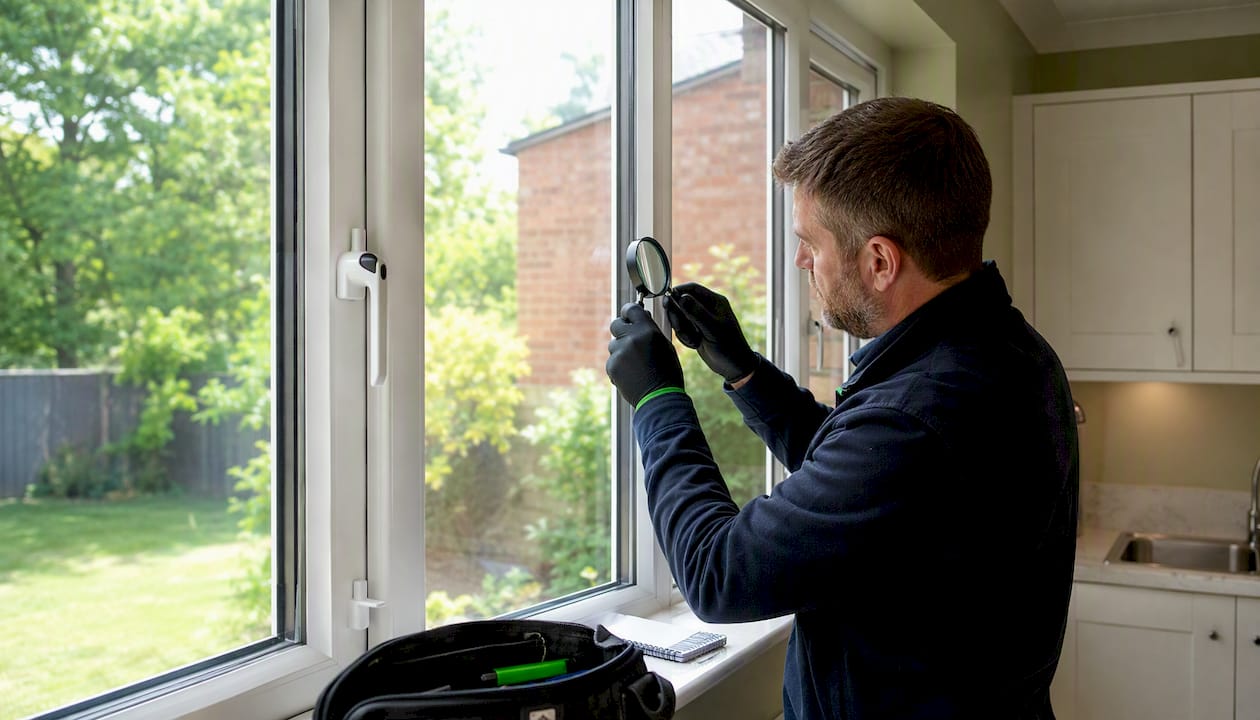
For casement and tilt-and-turn windows, a laminated inner pane is usually the most practical upgrade. Sash windows often benefit from secondary glazing fixed securely to the reveal, which also adds acoustic performance.
Locks and locking points
Single-point locks secure the window at one location only. Multi-point espagnolette systems engage at the top, bottom, and sides simultaneously, distributing load across the frame. The critical detail: most multi-point systems are not fully secure unless the key or thumb-turn is turned to deadlock after lifting the handle.
“Balanced design means every component — fixings, frame, glazing, locks and hinges — must be upgraded to the same resistance level. Upgrading one part alone leaves weaknesses that an attacker will find.” NPSA
Frames, hinges, and beading
Reinforced frames with fixings set into the structural reveal resist lever attacks far better than frames fixed only into the surrounding plaster. Hinge claws and dogbolts prevent outward-opening windows from being lifted off their hinges even when the hinge itself is exposed. For externally beaded windows, ProtectUK and NPSA recommend security clips, double-sided security tape, or screw-fixed beading to prevent undetected glass removal from outside.
Restrictors allow ventilation while limiting how far a window opens. On escape routes, choose a restrictor with a quick-release mechanism so occupants can exit in an emergency. Shutters can add a further layer of delay when fixed correctly, particularly for ground-floor or basement windows.
Pro Tip: Secondary glazing fixed to the reveal is one of the most cost-effective upgrades for sash windows in conservation areas, where replacing the original frame is not permitted. Check whether the secondary unit carries a security rating before specifying it.
Which UK standards apply and what does compliance actually mean?
PAS 24 is the primary enhanced-security standard for doors and windows in the UK. It tests the complete unit — frame, glazing, and hardware — as a single configuration. A window where the glass meets PAS 24 but the frame does not is not a PAS 24 compliant product.
Part Q of the Building Regulations requires easily accessible windows in new dwellings to resist physical attack. PAS 24 and BS EN 1627 are the two accepted routes to demonstrating compliance. Part Q applies to new builds; it does not retrospectively require existing windows to be replaced, but it sets a useful benchmark when you are specifying replacements.
“PAS 24 compliance is not a component-level claim — it belongs to the whole tested assembly. Swapping the glazing or the hardware after testing voids the compliance evidence.” LABC
Documents to request from any supplier or installer:
- The manufacturer’s whole-unit PAS 24 test certificate, showing the exact frame, glazing, and hardware configuration tested
- LPCB or BRE listing reference where applicable
- UKAS accreditation details for the test laboratory
- Installer membership of FENSA or CERTASS (for replacement windows under Building Regulations notification)
- Written guarantee covering both the product and the installation
- Proof of public liability insurance
Secured by Design accreditation is a useful additional signal: it requires products to meet PAS 24 as a minimum and involves independent assessment.
Repair or replace? Typical UK costs and timelines
The decision usually comes down to three questions: how much frame damage is there, how old is the hardware, and does whole-unit test evidence exist for the current installation?
| Job type | Approximate cost range | Typical on-site time |
|---|---|---|
| Single lock or hinge repair | — | 1–2 hours |
| Multi-point lock replacement | — | 2–3 hours |
| Anti-shatter film (per pane) | — | 1 hour |
| Secondary glazing (per window) | — | Half to full day |
| Full double-glazed unit replacement | — | Half to full day |
| Full window replacement (PAS 24) | — | 1–2 days |
Ranges are illustrative and vary by frame size, material, access, and region.
Factors that push costs higher include bespoke frame sizes, listed-building or conservation-area constraints, scaffold requirements for upper floors, and the need for PAS 24 tested replacements where Part Q applies. Lead times for standard double-glazed units are typically 2–4 weeks; bespoke heritage profiles can take longer.
When to repair rather than replace:
- The frame is structurally sound and undamaged.
- The hardware is faulty but the unit itself has no compliance issues.
- The property is listed or in a conservation area where replacement is restricted.
- Budget constraints make a phased approach necessary — prioritise locks and hinges first.
What does a professional inspection and repair actually involve?
A competent installer will ask about the age of the installation, any known faults, access restrictions, and whether the property is listed or in a conservation area before visiting.
On-site, a thorough inspection covers:
- Opening mode and frame condition
- Frame fixings and depth into the reveal
- Glazing retention method (internal or external beading, clips, tape)
- Number and location of locking points
- Cylinder type on any associated doors
- Hinge condition and whether hinge protection is present
- Evidence of previous repairs or upgrades
The written report should include photographic evidence, a clear description of recommended works, any compliance implications, and itemised pricing. Vague quotes that bundle everything into a single figure make it impossible to compare contractors fairly.
On completion, a professional will demonstrate the ‘LIFT, LOCK, REMOVE’ routine to every household member or building manager present, hand over written warranty details, and confirm their public liability insurance is in place. Practical repair steps and expected workmanship standards are worth reviewing before any contractor visit so you know what to expect.
How do you choose the right contractor and what should you ask?
The right contractor will answer your questions directly, provide written evidence, and never pressure you into an immediate decision.
Selection criteria:
- Public liability insurance (ask for the certificate, not just a verbal confirmation)
- Written guarantee covering product and installation
- FENSA or CERTASS membership for replacement window work
- PAS 24 test certificates for any products they propose
- Local references and photographic examples of similar past work
Questions to ask on first contact:
- Do you supply PAS 24 tested units, and can you show the whole-unit test certificate?
- Are the fixings and installation method included within the tested scope?
- What warranty do you offer, and is it backed in writing?
- Can you provide proof of public liability insurance before work starts?
“Any installer who cannot produce a whole-unit test certificate for a PAS 24 product is either supplying a non-compliant product or cannot verify what they are fitting. Either way, walk away.” LABC
Red flags to watch for:
- Evasive or vague answers about test evidence
- No written, itemised quote
- Cash-only payment requests
- Inability to provide trade references or insurance documentation
Pro Tip: Shortlist two or three local installers, compare written quotes line by line, and confirm lead times and contract terms before committing. A contractor who resists putting terms in writing is telling you something important.
For listed buildings or conservation areas, check with your local planning authority before specifying any replacement unit. Secondary glazing and window coverings that meet current regulations are often the only permitted route to improved security without planning consent.
The upgrade that most property owners overlook
Most of the properties Cloudy2Clear Windows visits have at least one window where the lock is worn, the beading is external, or the glazing unit has failed. The glass gets noticed because it looks cloudy; the lock gets ignored because it still turns. That is the wrong priority. A failed seal is a comfort issue. A worn multi-point lock on an accessible ground-floor window is a security issue.
Since 2005, the upgrades that have made the most consistent difference for our customers are multi-point lock replacements, laminated glass units on ground-floor and accessible windows, and hinge protection on outward-opening casements. These are not the most expensive jobs. They are the ones that remove the easiest entry points. Customers who have had these done consistently report fewer concerns at insurance renewal and greater confidence when the property is unoccupied.
We provide itemised quotes, test evidence where applicable, and public liability insurance details on every job. No surprises.
Cloudy2Clear Windows can help you upgrade your window security
Worn locks, failed glazing units, and unprotected hinges are the three most common security gaps Cloudy2Clear Windows finds on inspection visits. Fixing them does not always mean a full window replacement.
Cloudy2Clear Windows offers lock, hinge, and handle repairs, glass replacement with laminated or toughened units, secondary glazing, and fully compliant whole-unit replacements for residential and commercial properties. Every job comes with a written quote, itemised pricing, and a written guarantee.
To book an inspection or get a quote, visit the Cloudy2Clear Windows website or call your local branch. Have the age of your windows, any known faults, and your property type ready to speed up the process. The team is available Monday to Friday, 8:30am to 6:30pm.
Useful sources
- NPSA: Protect Your Home — Comprehensive guidance on physical security measures for domestic properties, including windows, doors, and perimeter security.
- GOV.UK: Approved Document Q — The Building Regulations document setting security requirements for doors and windows in new dwellings in England.
- LABC: Part Q security of windows — Plain-language explanation of Part Q scope, PAS 24 evidence requirements, and what installers must provide.
- ProtectUK: Physical security measures — Police-backed guidance on anti-shatter film, locks, and complementary deterrents including lighting and alarm systems.
- BSI / NBS: PAS 24 enhanced security standard — The primary UK standard for whole-unit testing of doors and windows; request this reference when asking suppliers for compliance evidence.
Request manufacturer test certificates, installation evidence, and written warranties from any supplier before work begins.
FAQ
What does PAS 24 compliance mean for a window?
PAS 24 tests the entire window assembly — frame, glazing, and hardware — as one unit. A product is only PAS 24 compliant when all three components match the tested configuration exactly.
Does Part Q require me to replace existing windows?
No. Part Q applies only to easily accessible windows in new dwellings. It does not require existing windows to be upgraded retrospectively, but it sets a useful benchmark when you are specifying replacements.
What is the ‘LIFT, LOCK, REMOVE’ routine?
Lift the handle to engage the locking points, turn the key or thumb-turn to fully deadlock the window or door, then remove the key. Leaving the lock on handle-lift alone does not engage the deadlock.
How long does a multi-point lock replacement take?
A straightforward multi-point lock replacement typically takes 2–3 hours on site. Cloudy2Clear Windows carries out this repair alongside hinge and handle work as part of a single visit where possible.
Do I need planning permission to upgrade window security on a listed building?
Replacing windows on a listed building or in a conservation area usually requires listed building consent or planning permission. Secondary glazing and security film are often the only permitted options; always confirm with your local planning authority before specifying any replacement unit.