Child-safe windows prevent falls and save lives. Fit compliant restrictors or guarding on every upstairs and low-cill window, move climbable furniture away from sills, and check that existing hardware actually works. RoSPA recommends restrictors that allow ventilation while stopping a child from opening a window wide enough to fall. Building Regulations Part K sets the legal thresholds, and Awaab’s Law now compels social landlords to act within tight timeframes. Cloudy2Clear Windows can inspect, repair, or replace window hardware and glazing to bring your home up to standard.
Right now, do these three things:
- Fit window restrictors or guarding on all upstairs windows and any window with a low cill
- Move beds, chairs, and other climbable furniture at least 500mm away from every window
- Test every existing restrictor by hand; if it moves more than 100mm or feels loose, treat it as failed
Statistic: Research published in the Archives of Disease in Childhood found that 73.3% of children hospitalised after window falls were under five years old.
Why do so many children fall from windows?
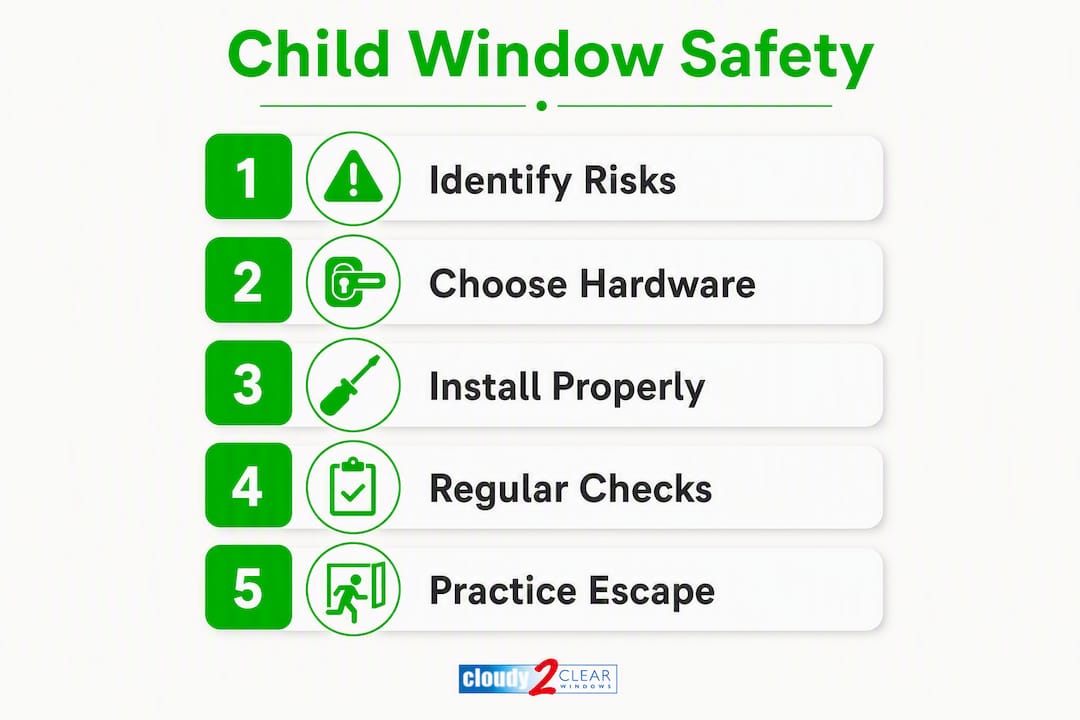
Toddlers are the highest-risk group precisely because they are curious, fast, and have no sense of height. A child under five can climb onto a low bed, step onto a windowsill, and lean against a pane before an adult in the next room has time to react.
The National Child Mortality Database briefing on falls from windows and balconies found that in 8 of 13 recorded child deaths involving windows, a restrictor was present but broken or disabled. That figure reframes the problem: the issue is not always the absence of safety hardware, but the failure to maintain it. Head trauma is the most common serious outcome, and many children who survive a fall from height face long-term neurological consequences.
Risk concentrates around three patterns: low cills that a toddler can step onto unaided, furniture placed within reach of a window, and restrictors that have been overridden or have corroded. Addressing all three together is what actually reduces harm. Restricting the opening alone is insufficient if a child can still climb to the sill.
What do UK law and regulations require?
Awaab’s Law: landlord obligations
Awaab’s Law applies to social landlords in England and requires them to investigate significant hazards, including unsafe windows, and complete relevant safety work within five working days of finishing the investigation. Where a hazard cannot be resolved in time, the landlord must provide suitable alternative accommodation for the family, including children. Guidance for social landlords makes clear that hazards affecting children are to be prioritised.
Building Regulations Part K
Part K requires protection wherever a person could fall more than 600mm. For openable windows in those locations, the rules are:
- The window must be restricted so it cannot open more than 100mm, or
- Guarding of at least 1,100mm must be provided with a non-climbable barrier
NHBC guidance notes that standard releasable restrictors may not satisfy Part K where a 100mm opening must be prevented; permanent or robust guarding may be required instead.
Landlord and homeowner action checklist:
- Report broken or missing restrictors to your landlord in writing and keep a copy
- Document the date of any repair request; this starts the Awaab’s Law clock for social tenants
- Choose hardware that is certified to resist a 100mm sphere where Part K applies
- Confirm with your installer whether a releasable restrictor or fixed guarding is legally required for your window type
Which window types carry the greatest risk?
Not every window presents the same hazard. Knowing your window type helps you prioritise.
- UPVC casement windows open outward on a side hinge; a child leaning against the pane can push it open if the restrictor is weak or absent
- Sash windows slide vertically; the lower sash can be pushed up by a toddler, and the upper sash may be overlooked as a risk
- Low-cill windows and French doors have sills close to floor level, making them climbable without any furniture nearby
- Velux and roof windows sit in the roof plane; a child who reaches one faces a steep fall onto a pitched surface
- Balcony doors and floor-to-ceiling glazing require guarding rather than restrictors, per BCA Technical Guidance Note 16, which provides dimensional guidance on when non-climbable barriers are required
Low-cill windows are particularly deceptive. A cill at 300mm above floor level is within easy step-up range for a two-year-old. As children grow, their reach and climbing ability change rapidly, so a window that seemed safe at 18 months may become a hazard by age two and a half.
Pro Tip: Get down to your child’s eye height in each room and look at every window from their perspective. You will often spot climbable routes, low cills, or furniture positions that are invisible from adult height.
What hardware options are available for child window safety?
| Hardware type | How it works | Best suited to | Escape-route compatible? |
|---|---|---|---|
| Releasable restrictor | Limits opening to ~100mm; adult can release with key or push-button | Bedrooms, living rooms | Yes, if adult-operable |
| Permanent restrictor / fixed guard | Fixed bar or grille; cannot be released without tools | Low-cill windows, communal areas | No — do not fit on escape windows |
| Keyed window lock | Locks sash or casement shut; key required to open | Ground-floor rooms, sash windows | Yes, if key is accessible |
| Sash stop | Small device fitted to sash channel; limits travel | Sash windows | Yes |
| Cable restrictor | Steel cable limits opening width | Casement and tilt-and-turn windows | Yes, if adult-operable |
Selection checklist:
- Age of youngest child (under two: prioritise fixed guarding on low-cill windows)
- Whether the window is a designated escape route
- Cill height and whether Part K guarding thresholds apply
- Material strength: the device must resist a 100mm sphere under load
- Maintenance access: can you test and replace it without specialist tools?
Pro Tip: For family bedrooms, choose a restrictor that an adult can release in under five seconds but that a child under ten cannot operate unaided. For communal stairwells or rooms with low cills, fixed guarding is the safer default.
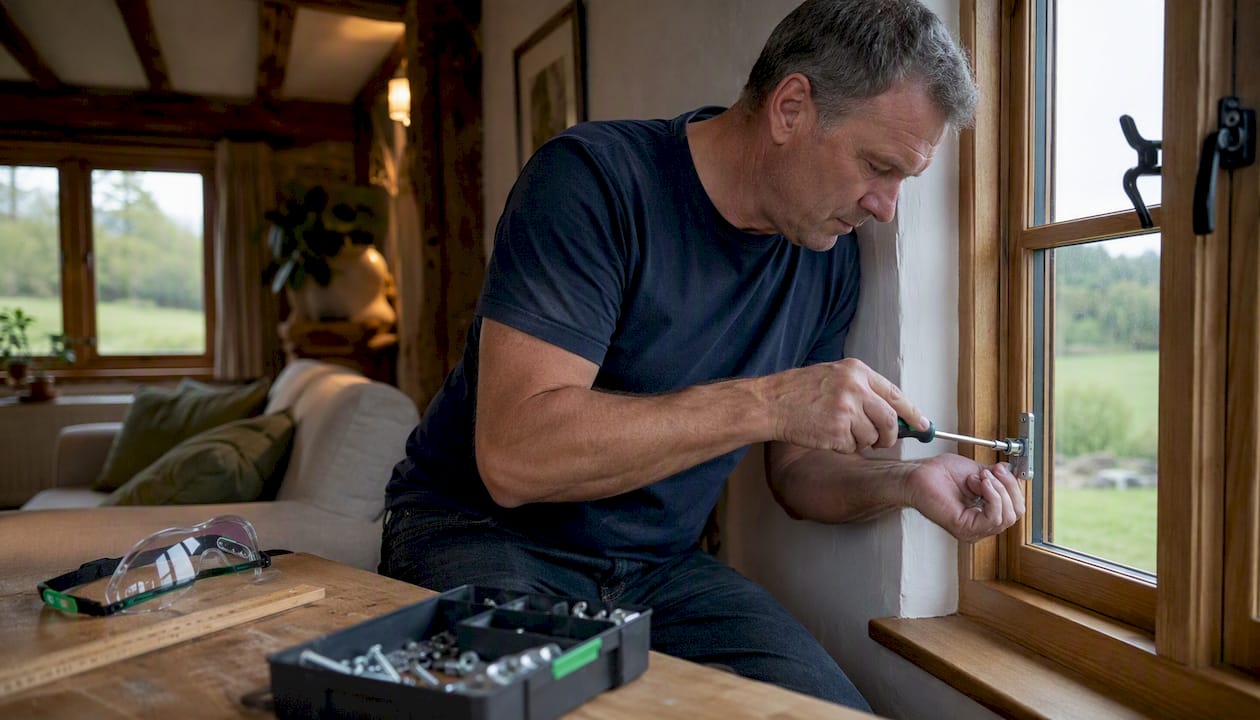
How do you balance ventilation with emergency escape?
Permanent restrictors solve the fall problem but can reduce purge ventilation, the ability to open a window fully to clear stale air or smoke. They also create a conflict with escape requirements if the window is the only means of exit from a room.
The practical rule: never fit a permanent, non-releasable restrictor on a window that serves as a means of escape. Use a releasable restrictor or keyed device instead, and store the key where adults can reach it in seconds but children cannot.
Safe ventilation options that preserve escape:
- Trickle vents built into the frame (no opening required)
- Releasable restrictors that allow a controlled 100mm opening for background ventilation
- Keyed casement stays that adults can open fully when supervised ventilation is needed
Pro Tip: Label escape-route windows clearly, for example with a small sticker on the frame, and tell every adult in the household where the release key or device is kept. Run a practice drill so the action is automatic under stress.
Inspection, maintenance, and typical costs
Inspection schedule
- Monthly: Visually check every restrictor and lock; tug the restrictor to confirm it holds at 100mm; look for corrosion, loose fixings, or cracked frames
- Annually: Book a professional inspection; test resistance to a 100mm sphere; lubricate hinges and moving parts; replace any corroded or worn components
- Immediately: After any reported damage, forced entry attempt, or tenant complaint about a window not locking
Typical repairs and indicative timelines
| Repair or upgrade | Indicative timeline | Approximate cost band |
|---|---|---|
| Restrictor installation (per window) | 30 minutes | — |
| Lock or handle replacement | 30 minutes | — |
| Double-glazing pane replacement | Half to full day | £300+ depending on size |
| Fixed guarding installation | 1–3 hours | £200+ per window |
These are broad estimates. Actual costs vary by region, window type, and condition. Always obtain a written quote.
Social landlords operating under Awaab’s Law must complete significant hazard repairs within five working days of investigation. Homeowners should aim for the same urgency when a restrictor is broken or a window will not lock.
Immediate home-proofing steps you can take today
- Move beds, sofas, and chairs at least 500mm from any window
- Fit window stops or temporary restrictors on upstairs windows right away
- Lock windows whenever they are unattended, even briefly
- Use cord shorteners or cord cleats on all window blinds to eliminate strangulation risk
- Supervise children actively whenever any window is open
Temporary adhesive restrictor devices and window alarms are available as short-term measures, but treat them as interim only. They are not a substitute for a properly fitted, tested restrictor or guarding that meets Part K. For practical security steps that complement child safety, Cloudy2Clear Windows has published a homeowner guide.
Pro Tip: Keep a simple notebook log of every window check, repair request, and professional visit. If you are a tenant, this record is your evidence if a landlord disputes a repair timeline under Awaab’s Law.
When should you call a professional?
Some problems cannot wait and should not be handled with a temporary fix.
Call a professional if you notice:
- A restrictor that is broken, missing, or moves beyond 100mm
- A frame that is warped, cracked, or no longer holds the sash square
- Failed double glazing (misting between panes indicates seal failure, which also weakens the unit)
- A window that will not lock or latch securely
- Visible damp or mould around the frame linked to a broken seal or damaged window
Questions to ask your repairer or installer:
- Are you insured, and can you provide a written guarantee?
- Does this installation comply with Building Regulations Part K?
- Will you fit permanent guarding if the restrictor is not legally adequate for this window?
- Can you provide a written quote and confirm the timeline before starting work?
Expect a professional visit to include a safety check, a quoted repair or replacement, and an estimated time on site. Tenants in social housing should note the date of any professional visit, as this forms part of the Awaab’s Law repair timeline. For risks associated with ageing windows, Cloudy2Clear Windows outlines the warning signs that indicate a window is past repair.
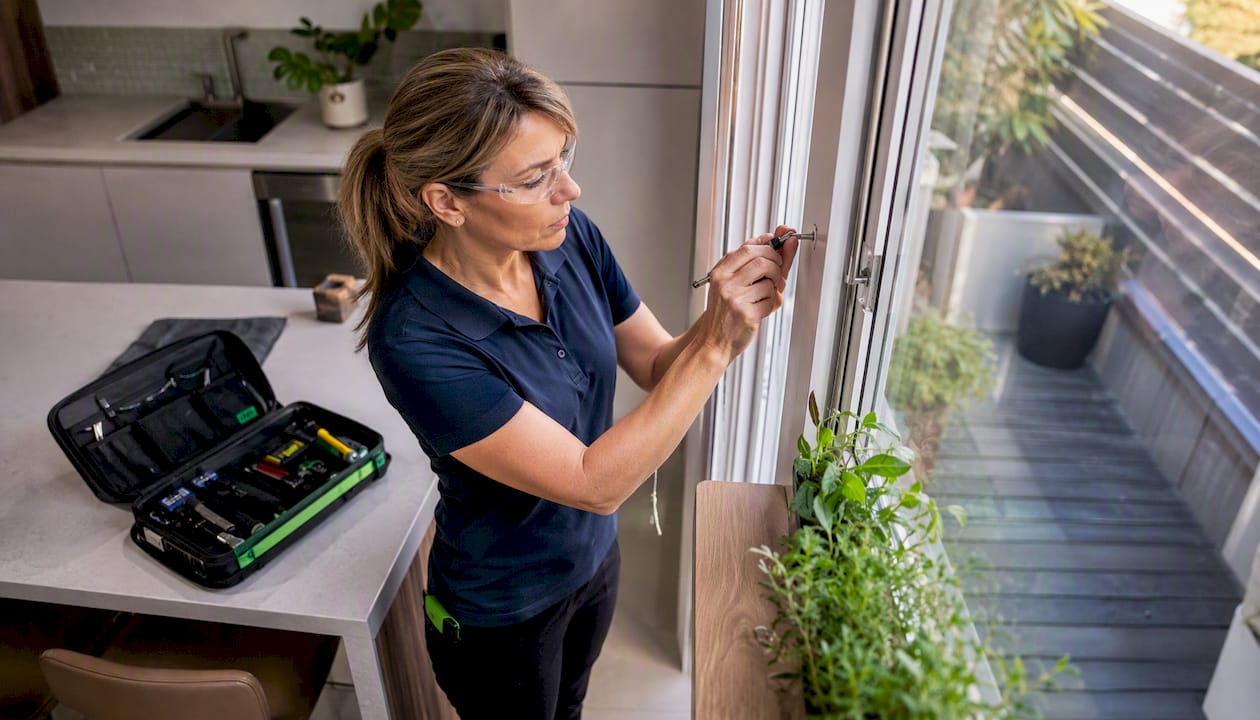
Choosing the right solution for your child’s age and stage
A newborn presents no window risk, but a home changes fast. By 12 months, a child pulls to stand; by 18 months, they climb. By three, many children can operate simple lever mechanisms.
- Under 18 months: Focus on furniture placement and ensuring windows cannot be opened at all when unsupervised
- 18 months to 3 years: Fit restrictors rated for child resistance; this is the highest-risk window, so prioritise bedrooms and play rooms first
- 3 to 7 years: Children can operate push-button restrictors; move to keyed devices or fixed guarding on high-risk windows
- 7 and above: Educate children directly about window danger; keyed devices remain appropriate for upper floors
Reassess your hardware every time a child reaches a new developmental stage. What was adequate at two may be insufficient at four.
Emergency escape: making child-safe fittings work in a fire
A fire changes everything. The fitting that keeps a child safe on a Tuesday afternoon must not trap the family on a Wednesday night. Every escape-route window needs a releasable restrictor or keyed lock, with the release mechanism stored within adult reach but out of a child’s sight and grasp.
For child safety window options that address both fall prevention and escape, a range of hardware types is available to suit different frame materials and opening configurations.
Check that any guarding or restrictor leaves the minimum clear opening required for escape once released. Practice the release action with every adult in the household so it becomes automatic. Never assume a child can operate a release device in a panic; the adult must be the one who acts.
Educating carers and family members about window safety
Consistent safety depends on everyone in the household understanding the rules, not just the primary carer. Grandparents, older siblings, childminders, and occasional visitors all need a brief, clear briefing.
Cover three points with every carer:
- Which windows have restrictors and how they work
- Where escape-route keys are stored and how to release the device quickly
- The rule: never leave a window open and unattended when a child under seven is in the room
A laminated card on the inside of a cupboard door, listing window rules and key locations, takes five minutes to make and removes ambiguity. Newham Council’s guidance on keeping children safe around windows is a useful reference to share with carers who want more detail.
Our view on child window safety
The cases that concern us most are not the homes with no restrictors at all. They are the homes where a restrictor was fitted years ago, was never tested again, and had quietly failed. Hardware corrodes, fixings loosen, and children grow stronger. A restrictor that passed a tug test in 2021 may not pass one today.
Cloudy2Clear Windows has been repairing and replacing double glazing since 2005, and in that time we have seen the same pattern repeatedly: a window that looks fine from the outside has a handle that spins freely, a lock that no longer engages, or a restrictor arm that snaps under light pressure. These are not dramatic failures. They are gradual ones, and they are entirely preventable with a scheduled annual inspection.
If you have not tested your window restrictors recently, do it today. If anything feels wrong, book a professional check before the end of the week.
Cloudy2Clear Windows can help you secure your home
Cloudy2Clear Windows offers glass-only double-glazing repairs, lock and handle replacements, and compliance inspections for residential and housing association properties across the UK. If a window pane has failed, a restrictor is broken, or you need guarding fitted to meet Part K, the team can assess, quote, and complete the work efficiently.

For a broken window repair or a full double-glazing replacement, contact your nearest branch to arrange a visit. The team operates Monday to Friday, 8:30am to 6:30pm. Find your local branch at cloudy2clearwindows.co.uk and book a time that suits you.
Useful sources
- GOV.UK: Awaab’s Law in the social rented sector — the legal framework and repair timeframes for social landlords
- HSE Research Report RR1219: Fall protection related to windows and guarding — the evidence base behind Part K thresholds
- Newham Council: keep your child safe around windows — local authority guidance suitable for sharing with carers
Report hazards to your landlord in writing and reference Awaab’s Law and Building Regulations Part K when requesting urgent repairs.
FAQ
What is the best way to childproof windows in a UK home?
Fit a releasable restrictor that limits the opening to 100mm on all upstairs and low-cill windows, move climbable furniture away from sills, and test every device monthly. Where Part K requires it, permanent guarding is the legally compliant option.
What are the benefits of fitting child-safe window restrictors?
Restrictors prevent a window from opening wide enough for a child to fall through, while still allowing ventilation. RoSPA guidance recommends devices that adults can release quickly in an emergency but that children cannot operate in everyday use.
How quickly must a social landlord repair an unsafe window?
Under Awaab’s Law, social landlords in England must complete repairs for significant hazards within five working days of completing their investigation, or provide suitable alternative accommodation for the household.
How often should window restrictors be inspected?
Check restrictors by hand every month and arrange a professional inspection annually. Replace any device that moves beyond 100mm under light pressure, shows corrosion, or has loose fixings.
At what age are children most at risk from window falls?
Research shows that 73.3% of children hospitalised after window falls are under five years old, making the toddler years the highest-risk period and bedrooms and play rooms the priority spaces for safety hardware.