If you let a home in the UK, you are almost always the one responsible for repairing its windows and glazing. In England and Scotland the law treats windows as part of the structure and exterior of the property, so a misted unit, a cracked pane or a failed lock is normally your job to put right, whatever the tenancy agreement says. This guide covers where that duty comes from, how Scotland differs and what counts as urgent.
The short answer: windows belong to the landlord’s repair duty
GOV.UK states that landlords are always responsible for repairs to the structure and exterior of a rented property. Windows, frames, sills and the glass in them sit within that. Shelter England lists windows among the repairs landlords must carry out, and says this applies even when the tenancy agreement is silent on the subject.
In practice, that covers cracked or smashed glass, failed sealed units, rotten or warped frames, broken handles, hinges and locks, and gaps around frames that let in wind and rain.
A tenant cannot be made to fix any of this. GOV.UK is clear that tenants cannot be forced to do repairs that are their landlord’s responsibility.
What the law says in England
Three pieces of legislation shape your duties in England. Torbay Council summarises them as section 11 of the Landlord and Tenant Act 1985, the Homes (Fitness for Human Habitation) Act 2018 and the Housing Act 2004, which introduced the Housing Health and Safety Rating System (HHSRS).
Fitness for human habitation
The GOV.UK guide to the Homes (Fitness for Human Habitation) Act 2018 says landlords must make sure a rented home is fit to live in at the start of the tenancy and throughout it. A court looks at matters such as disrepair, instability, serious damp, and inadequate natural light and ventilation. Every one of those can be caused or worsened by faulty windows.
Under the HHSRS, councils can inspect for hazards and take enforcement action where serious ones exist.
What a good standard looks like
Local authorities spell out what they expect. Manchester City Council says landlords should keep external doors and windows solid, in good repair, suitably draught-proofed and fitted with suitable locks. The same page says that where timber frames are so rotten that repair is unreasonable, they should be replaced.
What the law says in Scotland
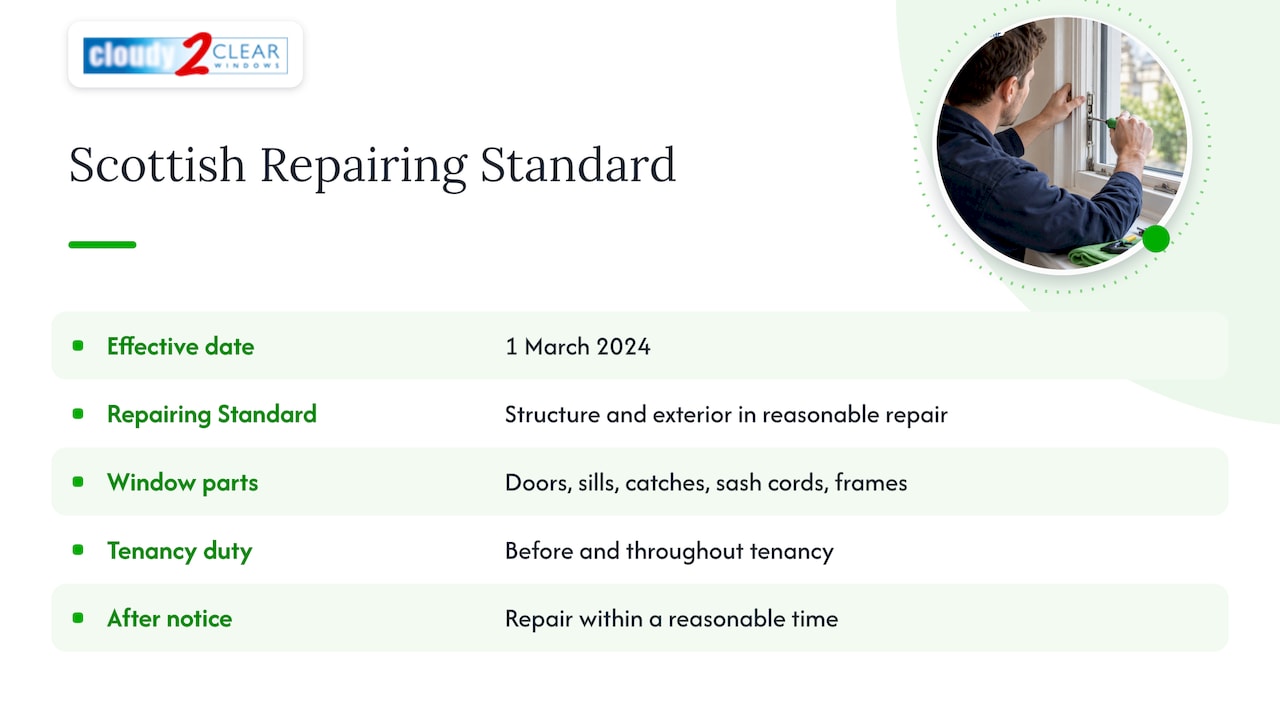
Scotland has its own regime, and it is worth knowing if you let property there or manage a mixed portfolio. The Repairing Standard guidance, which applies from 1 March 2024, says the structure and exterior of a privately rented house must be in a reasonable state of repair and proper working order. The test takes into account the age, character, prospective life and locality of the building.
The Scottish Government’s tenancy notes go further on windows. They say the landlord’s structural repair duty includes outside doors, windowsills, window catches, sash cords and window frames. The same page says the property must be wind and watertight and fit to live in, and gives an example of non-compliance: gaps between window or door frames and walls that let wind or rain enter.
Two further points matter. The landlord must meet the standard before and throughout the tenancy, and repair defects within a reasonable time after being told. And using a letting agent does not move the duty: mygov.scot confirms that you stay responsible, and that a tenant can take you to a housing tribunal if the property fails.
If you own property in Scotland, our guide to window safety regulations in Scotland covers the wider rules, and our best window types for Scotland article helps if a repair turns into an upgrade conversation.
England and Scotland compared
| Point | England | Scotland |
|---|---|---|
| Main source of duty | Landlord and Tenant Act 1985, Homes (Fitness for Human Habitation) Act 2018, Housing Act 2004 | Repairing Standard for private tenancies |
| Windows covered | Structure and exterior, which includes windows | Window frames, sills, catches and sash cords named in guidance |
| Weather protection | Fitness for habitation and HHSRS hazards | Wind and watertight requirement |
| Where tenants go if nothing happens | Local council environmental health | First-tier Tribunal for Scotland (Housing and Property Chamber) |
| Landlord’s duty if an agent is used | Remains with the landlord | Remains with the landlord |
Do windows have to open in a rented property?
This is a common question, and there is no tidy single rule to quote. The better way to think about it is through the duties above. A home must have adequate natural light and ventilation to be fit for human habitation, as the GOV.UK landlord guide sets out. A window that has been painted shut, has a seized hinge or has a broken handle may stop a room being ventilated properly, and in a bedroom it may also matter for escape in a fire.
Treat every habitable room as needing at least one window that opens, closes and locks properly. If you are unsure about a particular room, ask your local council or a fire risk assessor before you seal or change anything.
How quickly must you act?
Neither England’s private rented rules nor Scotland’s Repairing Standard set one fixed number of days for glazing. The standard is a reasonable time, and what is reasonable depends on the risk.
- Security risk: After a break-in or attempted break-in, Manchester City Council says the landlord should arrange at least a temporary repair straightaway. Boarding or a temporary pane restores security while a proper unit is made.
- Weather getting in: A cracked pane can quickly lead to damp, which becomes a habitability issue.
- Misted units and stiff handles: These are less urgent, but they should not be left.
GOV.UK advises tenants to contact their landlord straight away when something needs repair. A landlord who answers promptly and records what was done is in a far stronger position than one who lets the report sit.
Housing associations and social landlords in England
The timetable is tighter for social housing. From 27 October 2025, Awaab’s Law applies to England’s social rented sector. Social landlords must investigate potential emergency hazards and complete necessary safety work within 24 hours. The guidance gives broken external windows that present a home security risk as an example of an emergency hazard.
For a housing association, that makes glazing a same-day triage matter. Our article on housing association window repairs started in 24 hours shows how that works.
Scotland’s Right to Repair
In Scotland, the statutory Right to Repair scheme applies to Scottish secure and short Scottish secure tenants, not generally to private residential tenants. Qualifying repairs include external windows, doors or locks that are not secure, and the landlord must give the applicable maximum completion time.
Who pays when a window is damaged?
The starting point is simple: the repair duty sits with you, but responsibility for the cost can move when a tenant causes the damage. GOV.UK says tenants are responsible for paying for damage they cause, including damage caused by family and friends.
A fair approach looks like this:
- Ordinary wear and failure: Misted units, rotten frames and worn locks are yours to deal with.
- Damage by a tenant or visitor: The tenant is responsible for the cost, but arrange the repair promptly so the home stays secure.
- Damage by a third party, such as a break-in: The repair is still urgent, and any insurance claim depends on your policy.
Document each window with dated photographs at the start of every tenancy, so disputes about who caused a crack can be settled.
Tenants also have a part to play in everyday care. Reporting faults early, keeping vents clear and looking after the property all help, and a regular routine such as keeping a rental home clean makes it easier to notice a seal failing, a cracked pane or a sticking catch before it becomes a bigger job.
If you do not act, tenants in England can contact the local council’s environmental health department, and in Scotland they can apply to the First-tier Tribunal. Keep a clear reporting route and a written trail of what was reported and when.
Our perspective: repair the glass, not the whole window
We have been repairing and replacing double glazing across the private and commercial sectors since 2005, and one pattern shows up again and again with rental properties. A landlord is told a window has failed, and the assumption is that the whole window must go. Very often it does not.
If the frame is sound and only the sealed unit has failed, the glass can be replaced on its own. That means less disruption for the tenant, a quicker turnaround, and a lower bill than a full window replacement. It is also the route to take when a frame is perfectly good and you simply want to bring a unit up to a better standard, with energy efficient or soundproofing glass in place of a tired older unit.
We would give landlords three pieces of advice:
- Inspect before a problem is reported. Our guide to identifying window issues in your property shows what to look for.
- Treat locks as part of the glazing. See our steps to repair window locks and our overview of security features in windows.
- Know when a frame is beyond saving. Where timber has rotted badly, glass-only work will not solve it, and we will say so.
Our 25-year guarantee and nationwide coverage mean you can fix a property once.
Commercial and housing association properties
Commercial premises have different duties, and housing associations carry the extra obligations described earlier. A periodic inspection of all glazing, a written record and repairs ordered by risk work better than reacting to every report. We offer an inspection service and full replacements, plus commercial window repair.
A practical checklist for landlords
Use this before each new tenancy and at every routine inspection.
- Check that every window closes fully, with no gaps for wind or rain.
- Look for fogging between the panes, which signals a failed seal.
- Test every lock, handle and hinge.
- Check that windows in habitable rooms open.
- Photograph each window and date the record.
Getting glazing repairs done
If you need help with the glass, Cloudy2Clear Windows can repair or replace failed units without replacing the frame, and can also deal with double glazed door repairs, broken window repairs and locks, handles and hinges. Our office hours are Monday to Friday, 8:30am to 6:30pm. Contact us through our site to arrange a visit, or see our double glazing replacement page for how a unit swap works.
Frequently asked questions
Is a landlord responsible for broken windows?
Yes, in almost every case. Windows form part of the structure and exterior, and GOV.UK says landlords are always responsible for repairs to those. The exception is damage a tenant or their visitors cause, where the tenant may have to pay for the repair.
How fast must I repair a broken window?
The private rented rules ask for a reasonable time rather than a set number of days, and a security or weather risk makes the job urgent. For social landlords in England, Awaab’s Law sets 24 hours for emergency hazards, which can include a broken external window that creates a security risk. In every case, a temporary repair straight away is better than waiting for a perfect fix.
Do the rules differ in Scotland?
Yes. Scotland uses the Repairing Standard, which names window frames, sills, catches and sash cords. Tenants there can apply to the First-tier Tribunal, while in England they go to the local council.
Sources
- Private renting: Repairs, GOV.UK
- Landlord responsibilities for repairs, Shelter England
- Housing repair obligations, Torbay Council
- Guide for landlords: Homes (Fitness for Human Habitation) Act 2018, GOV.UK
- Doors and windows, Manchester City Council
- Repairing Standard statutory guidance, Scottish Government
- Repairs and maintenance obligations, Scottish Government
- Repairs and maintenance as a private landlord, mygov.scot
- Awaab’s Law: guidance for social landlords, GOV.UK
- Right to Repair, Scottish Government