The best shopfront glass for security is laminated glass, ideally fitted into a sound frame and backed by strong door hardware. Toughened glass is a safety glass, so it protects people if it breaks, but it shatters into small pieces and leaves an open hole. Laminated glass cracks but holds together, which keeps a physical barrier in place. This guide explains the difference, the standards to ask for, the rules that apply in England and Scotland, and how to upgrade without replacing your whole shopfront.
Safety glass and security glass are not the same thing
Safety glass is designed to reduce injury. If someone falls against it, or it breaks, it should not leave long, sharp shards. Security glass is designed to resist attack and stay in the frame long enough to stop or delay a break-in.
Toughened glass is the usual example of safety glass. It is made to BS EN 12150, the standard for thermally toughened soda-lime silicate safety glass. It is much stronger than ordinary annealed glass and breaks into small, blunt fragments. It is not the same as security-rated laminated glass, which holds together on impact.
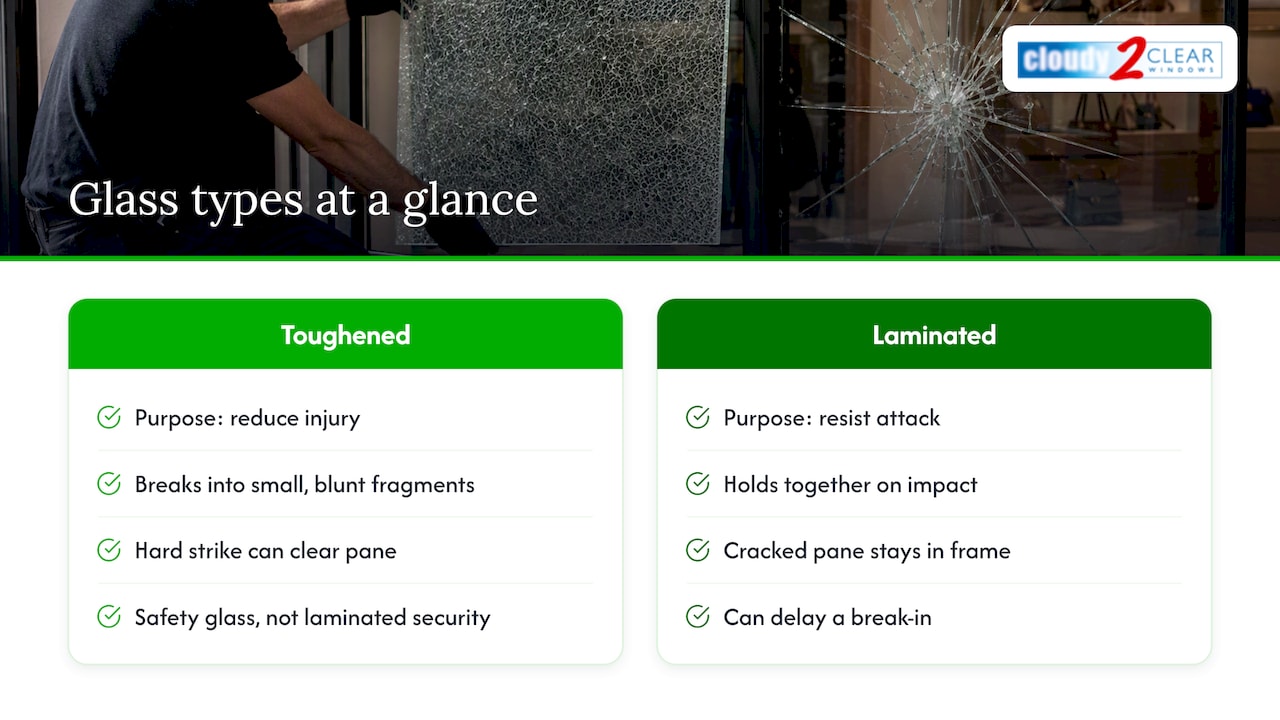
For a shopfront, that gap matters. A toughened pane that is struck hard can disappear in one go. A laminated pane can be cracked and still stay put.
How the main glass types compare
| Glass type | How it breaks | Safety performance | Security performance | Typical use |
|---|---|---|---|---|
| Annealed (ordinary) | Large, sharp shards | Poor, not suitable in critical locations | Low | Upper windows away from foot traffic |
| Toughened | Thousands of small, blunt pieces | Good | Moderate: strong, but the pane is lost once it breaks | Display windows, door leaves |
| Laminated | Cracks but stays bonded to the interlayer | Good | High: the pane stays in the frame | Door glazing, display windows, shops at higher risk |
| Toughened and laminated | Strong outer resistance, pane retained | Good | Highest of the common options | Jewellers, phone shops, high-value stock |
Local authority guidance points the same way. Lancaster City Council’s conservation advice says that specialist security glass, such as laminated or polycarbonate-blended panels, can give robust protection without the look of heavy roller shutters.
Why keeping the pane in place matters
Bradford’s shopkeepers’ guide describes laminated security glass with a strengthened frame as extremely hard to break through, and notes that when it is linked to a window sensor, the alarm sounds as soon as an attack on the glass begins.
Because a laminated pane tends to stay in its frame after an attempted break-in, you can often keep the shop closed off and secure until the repair is done. With toughened glass, you may be left with an open frontage and the need for an emergency board-up. Our guide on what to do in the first hour after smashed shopfront glass covers that situation step by step.
The standards worth asking for
When you ask a glazier for security glass, a thickness figure is not enough. Ask which tested standard the product meets.
- BS EN 12150 covers toughened safety glass. It confirms the glass is thermally toughened and breaks safely.
- BS EN 12600 governs impact classification for safety glass, which is how glass is rated for safety in the event of human impact.
- BS EN 356 describes the testing and classification of security glazing against manual attack. Ratings such as P1A, P2A and above are part of this family.
- Loss Prevention Standards (LPS) from the Loss Prevention Certification Board give a tiered rating based on resistance to manual and forced entry. Croydon Council’s shopfront addendum notes that LPCB security ratings run from 1 to 5. It also points owners to the Red Book listing to check that a product is approved.
Ask your installer for the test classification of the exact glass they propose.
For doors, which are the most common point of forced entry, we explain the P1A and PAS 24 rating questions in more detail in our guide to asking for P1A and PAS 24 door security glass.
What the law requires: safety first
Security is your choice. Impact safety is not.
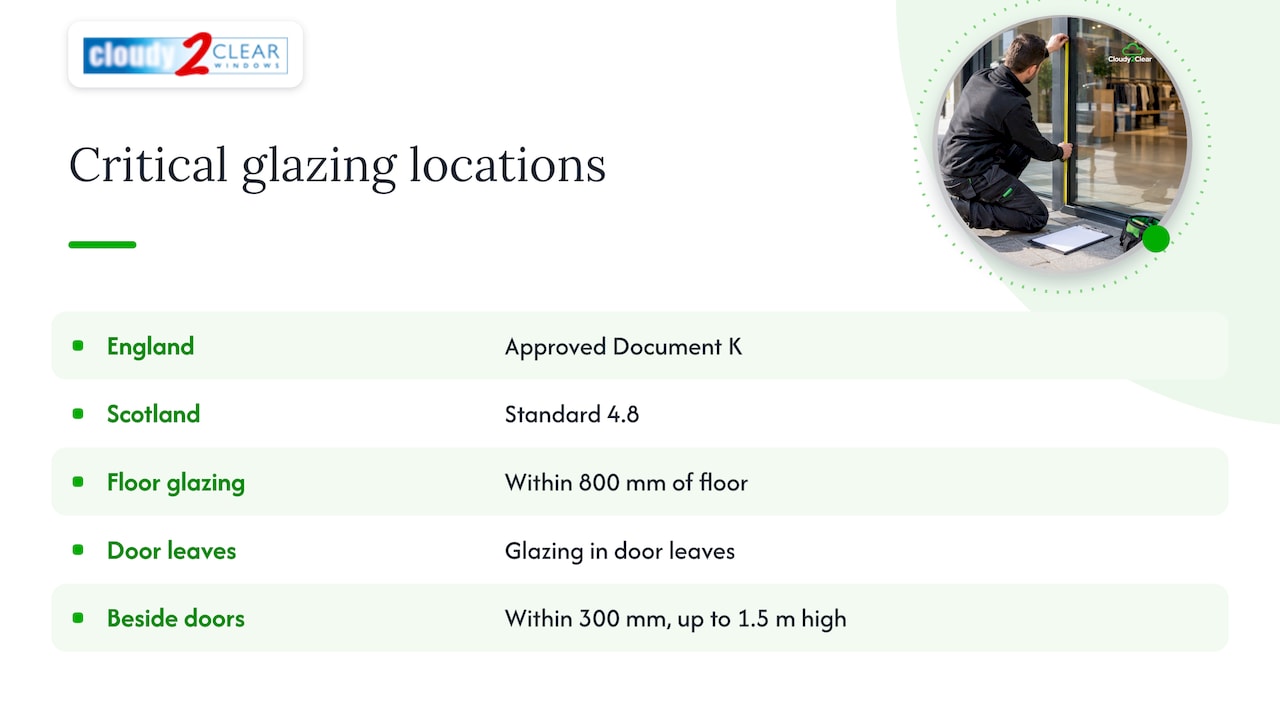
In England, Approved Document K sets requirements for glazing in critical locations. In Scotland, the equivalent is Standard 4.8 of the building standards technical handbook. Both treat the same positions as higher risk. According to Approved Document K, critical locations include glazing within 800mm of floor level, glazing in door leaves, and glazing within 300mm of a door leaf up to 1.5m high.
Glass in those places must resist impact without breaking, break safely, or be shielded by a permanent screen. Scotland’s Standard 4.8 is written to protect people from injury caused by fixed glazing, projections and moving elements.
On a typical shopfront, that covers the lower display panes and the glass in and beside the entrance door. Have any older annealed glass in those areas checked.
If you manage a workplace, you also have duties under Regulation 14 of the Workplace (Health, Safety and Welfare) Regulations. Our five-step Regulation 14 glazing assessment for facilities managers walks through how to assess it, and our window safety checklist for businesses is useful for a quick audit.
Planning permission and listed buildings
Replacing or upgrading glass does not normally need planning permission. Lancaster’s guidance says internal grilles, films and toughened glass do not generally need consent, but it adds that works on a listed building may be different. Listed buildings need formal consent for alterations, and Bradford’s design guide warns that failing to obtain it first can lead to serious legal and financial consequences.
Check your property’s status with your local planning authority before you order any glass, because the consequences of getting it wrong fall on you as the owner.
Glass is only one part of the shopfront
Upgrading to security glass helps, but it will not make a weak shopfront secure on its own. Bradford’s design guide stresses that even high-grade glazing can fail if it is poorly fitted into a weak or rotten timber frame, or if the stall riser is not reinforced against ram-raid impact.
Here are the weak points to check alongside the glass:
- The frame. Timber that is soft or rotten, or glazing beads that can be prised off from outside, undermine good glass. The glass needs a sound frame and secure fixing.
- The stall riser. This is the solid base below the display window, and it needs reinforcing against ram-raid impact.
- The door. Check the leaf, locks and hinges. A strong pane next to a weak lock is a poor trade.
- Alarm and sensors. A glass-break or window sensor adds early detection.
If your locks, handles or hinges are worn, our lock, handle and hinge repair service deals with those weak points, and our double glazed door repairs cover door glass.
Security without the fortress look
Many owners reach for external roller shutters. Council guidance notes that heavy shutters can give a fortress appearance that harms local character and discourages evening footfall.
Bradford’s design guide takes a more balanced view. It says security features are often highly visible and can significantly affect the look of the shopfront and street, and it encourages natural surveillance so that the interior stays visible to passers-by. A lit, visible shop interior deters crime in its own right.
Croydon’s addendum describes security glazing as an ideal solution with no detrimental effect on the appearance of the shop, although it adds that measures must comply with planning rules.
Our perspective: keep the frame, upgrade the glass
At Cloudy2Clear Windows, we replace only the glass, not the frame. For many shopfronts, that is the most practical route to better security. If your frame is sound, you can upgrade the glazing without the disruption of a full shopfront replacement, and you can often get back to trading sooner.
We say “if your frame is sound” deliberately. We would rather tell you a rotten frame needs attention than fit good glass into a weak setting.
There are three things we would ask any shop owner to do before choosing glass:
- Decide what you are protecting against. Opportunist smash-and-grab, forced entry after hours and vehicle impact need different answers.
- Ask for the tested rating, not just a thickness.
- Think about the day after an attempt. Glass that stays in the frame keeps you open for business and your stock protected.
We also see the safety side as inseparable from security. Older glazing in a public-access building may not meet current impact safety expectations. When we repair or replace the glass, we can help you bring it up to current safety requirements as well as improving security. Our 25-year guarantee adds confidence to the investment.
Choosing glass for your type of shop
The right specification depends on your stock, your location and your risk.
General retail and cafés
For standard display windows and door glazing, toughened glass meets the safety requirement. Where you want better resistance to break-ins, laminated glass is the stronger choice, and it is worth specifying at the door and beside the lock.
Higher-value stock
Jewellers and phone shops are more attractive targets. A toughened and laminated unit with a higher security classification is worth discussing, and an LPCB-listed product gives independent evidence of performance.
Premises in conservation areas
Internal security glass is generally easier to justify than external shutters. Speak to your local planning authority early.
Shops that also want better insulation or less noise
Security glass can be combined with other benefits. If you are on a busy road, our soundproofing and noise reduction glass options and our insulating glass can be specified in the same visit.
Our team also provides an inspection service for commercial and housing association properties, useful if you manage several sites and need to know where damaged or non-compliant glazing sits.
Talk to Cloudy2Clear Windows about your shopfront
If you want security glass fitted without replacing the whole frontage, our commercial window repair service covers glass replacement and repairs for business premises. For cracked or smashed panes that need attention now, see our broken window repairs. Our lines are open Monday to Friday, 8:30am to 6:30pm.
Frequently asked questions
Is toughened glass the same as safety glass?
Toughened glass is a type of safety glass. It is made to BS EN 12150 and breaks into small, blunt pieces rather than sharp shards. Laminated glass is also a safety glass, but it behaves differently: it holds together when broken.
What is shopfront glazing?
Shopfront glazing is the glass in the front of a shop, including display windows, door panels and side lights, usually set in a timber, aluminium or steel frame.
Is BS EN 12150 glass considered safety glass?
Yes. BS EN 12150 is the standard for thermally toughened soda-lime silicate safety glass. It is not, however, the same as security-rated laminated glass, so it should not be assumed to offer the same resistance to forced entry.
Do I need planning permission to change my shopfront glass?
Usually not for a like-for-like or toughened glass upgrade, but a listed building needs formal consent for alterations. Check with your local planning authority before ordering anything if your property is listed or in a conservation area.
Sources
- Approved Document K: Protection from falling, collision and impact
- Building standards technical handbook 2020, Standard 4.8
- BS EN 12150-1, BSI Knowledge
- Shopfront Security Addendum, Croydon Council
- Shopfront Design Guide, Bradford Council
- Shop Keepers Guide to Securing Their Premises, Bradford Council
- Shopfront Security in Conservation Areas, Lancaster City Council
- Laminated glazing requirements, British Woodworking Federation