The best bathroom privacy glass is an obscure glass at privacy level 4 or 5, fitted into your existing frame. It keeps the room bright, stops anyone seeing in, and you do not need a whole new window. Most bathroom windows can have the glass swapped on its own, and that is what we do every day at Cloudy2Clear Windows.
This guide explains the types of obscure glass, how the privacy levels work, what can still be seen at night, and how to choose for your own bathroom.
What obscure glass actually means
People use “obscure”, “frosted”, “patterned” and “textured” as if they were the same thing. They are related, but they are not identical.
Obscure glass is a purpose rather than a single product. It is glazing that reduces clear visibility while still letting light through. Glass suppliers use the term as a category, and both patterned and etched glass can fall within it.
Within that category there are two main finish families:
- Patterned or textured glass. A design is pressed into one surface while the glass is made. Pilkington describes its Texture Glass as rolled patterned glass, where the pattern scatters light to give obscuration and decoration while still passing diffused light.
- Frosted or etched glass. The surface is treated, usually with acid, to give a smooth, soft, misty finish. Pilkington notes that acid etching can produce patterns, designs or obscuration.
The two families are separate. Pilkington’s UK decorative range lists five privacy levels for its Texture designs and four for its etched glass. So when a supplier says “frosted”, ask whether they mean etched or a patterned glass that looks frosted. The look, the feel and the way each cleans are different.
How privacy levels work
Most UK manufacturers grade obscure glass on a scale of 1 to 5. Pilkington classes its Texture Glass patterns relative to one another, from level 1 (least obscuring) to level 5 (most obscuring).
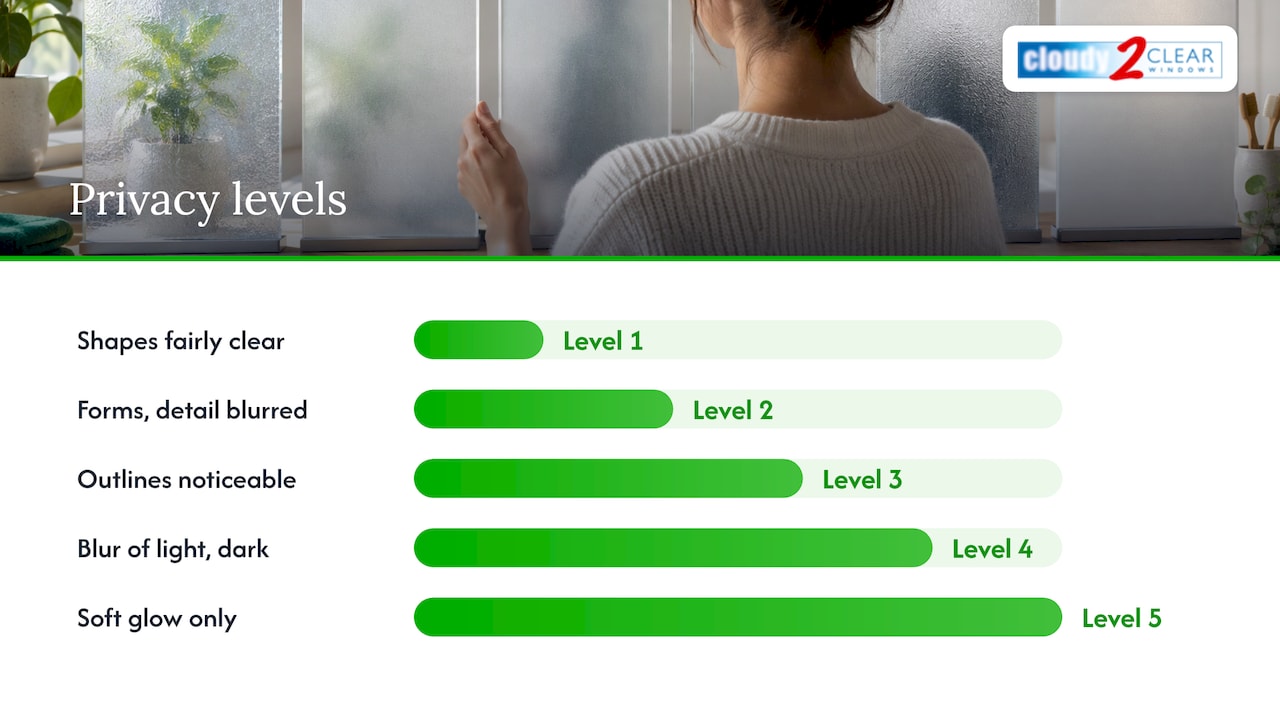
That word “relative” matters. The scale compares patterns within one range. A level 3 from one manufacturer will not look exactly like a level 3 from another, so always look at a physical sample held against your own window before you decide.
A rough guide to what each band usually means in a bathroom:
| Privacy level | What you see through it | Typical bathroom use |
|---|---|---|
| 1 | Shapes and colours are fairly clear | Rarely enough for a bathroom |
| 2 | Forms visible, detail blurred | Landings, hallway panels |
| 3 | Movement and outlines noticeable | Cloakrooms with a high window |
| 4 | Only a blur of light and dark | Most bathrooms and en suites |
| 5 | Very little beyond a soft glow | Ground floor bathrooms, shower areas |
Some installers go further. Safestyle, for example, recommends levels 4 to 5 for all bathroom windows so that privacy holds even when the room is brightly lit at night. We take the same cautious approach for any bathroom that faces a street, a neighbour or a path.
Can people see in at night?
This is the question that worries people most, and the honest answer is that it depends on the level you choose.
With a light on inside and darkness outside, the glass behaves differently from how it does in daylight. Outlines and movement can become more noticeable through obscure glass in the evening, and higher obscurity levels reduce this. That is why we steer ground floor bathrooms and any window overlooked by a neighbour towards level 4 or 5.
A few practical habits help as well:
- Position the bath, shower or toilet away from the window line where you can.
- Use a lower-wattage or warm light in the part of the room nearest the window.
- Add a blind for the evening if the window is large and faces a busy spot.
- Choose the glass for the worst viewing angle, not the best. Stand outside at night and imagine the view from the pavement.
We recommend choosing for the situation you will actually live with. A first floor window over a back garden needs less than a ground floor window beside a public path.
Choosing the right glass for your bathroom
Privacy is only one half of the choice. The other half is light. Pilkington notes its Texture Glass range offers privacy levels from 1 to 5 and transmits diffused light while maintaining privacy. A well-chosen obscure glass does not make a bathroom dark. It softens the light and spreads it around the room.
Work through these questions in order:
- Who can see the window? Ground floor, street-facing and neighbour-facing windows need level 4 or 5. A high window over a garden may be fine at level 3.
- How much natural light does the room get? A small windowless-feeling room benefits from a lighter pattern. A bright, south-facing room can take the densest finish.
- What style is the room? Fine, even patterns suit modern bathrooms. Bolder, more traditional designs suit period homes.
- How much cleaning do you want? Smooth etched finishes wipe quickly. Deep patterns can hold more dirt.
- Do you also want warmth or quiet? Obscure glass can be made up inside a sealed unit that also helps with insulation. Our insulated glass service covers this, and we also offer glass for noise reduction if the bathroom faces a busy road.
If you want to see how privacy glass fits into the wider picture of a home, our guide to window privacy solutions looks at the main alternatives room by room.
Glass, film or blinds?
Obscure glass is not the only route to privacy. You will also see window film, blinds and shutters. Each has a place.
- Window film is a thin layer applied to clear glass. It is water-resistant and should not peel easily when the bathroom steams up. The Glass and Glazing Federation notes that frosted, translucent film prevents clear vision in or out, day and night.
- Blinds and shutters can be closed when needed, but they are an extra layer to look after and they cut light when closed.
- Obscure glass is built into the unit itself. There is nothing to peel, fade or adjust, and the privacy is there around the clock.
For a bathroom you will use for years, many people prefer privacy that is part of the glass. It is a single, permanent fix with nothing to maintain beyond normal cleaning.
Replacing only the glass, not the frame
Here is where many homeowners save themselves a great deal of disruption. If your frame is sound but the glass is clear, misted or cracked, you do not need a new window. We replace only the glass. That means less mess, a faster visit and no need to disturb the surrounding plaster, tiles or sill.
In practice the process looks like this:
- We check the frame condition first, because a sound frame is what makes a glass-only job suitable.
- We measure the sealed unit and agree the privacy level and pattern with you.
- The new obscure unit is made to size.
- We remove the old glass and fit the new unit into your existing frame.
Our article on replacing only the glass in UK windows explains why checking the frame comes first.
This route also suits a misted bathroom window. Condensation trapped between the panes means the seal has failed. Fitting a new obscure unit fixes the misting and gives you the privacy upgrade in one visit. Our double glazing replacement page sets out how the service works.
Safety glass in bathroom windows
Bathrooms are one of the places where safety rules matter. Glass close to the floor, or low down beside a bath or shower, is a critical location where safety glass may be required. Safety glass means toughened or laminated glass, which is designed to break more safely if it is hit.
Two points for a bathroom window:
- Check the position. A low window beside a bath, or one that reaches near floor level, is the case to ask about before you order.
- Look for the mark. Genuine toughened glass carries an etched marking in one corner. Our guide to verifying Kitemark toughened glass shows what to look for.
The rules are set under building regulations, and they are not identical across the UK. England and Scotland each have their own building standards, so tell us where the property is and we will advise on the right glass for your window. Our page on toughened glass requirements is a useful companion if the bathroom also has a glazed door.
If you are planning a wider refit, a bathroom renovation checklist can help you sequence the work so the window glass is dealt with at the right moment.
Obscure and safety glass can be combined. A toughened or laminated unit can also be patterned or frosted, so you do not have to choose between privacy and safety.
Keeping patterned and frosted glass clean
Bathroom glass faces steam, soap and hard water. A few habits keep it looking good.
- Wipe the glass with a soft cloth and a mild, non-abrasive cleaner.
- Use a soft brush on textured patterns, so that dirt does not stay in the grooves.
- Dry the glass if you can after a shower to reduce limescale marks.
- Avoid scouring pads, which scratch the surface.
Where patterned glass is used in a shower enclosure, installers advise placing the smooth side towards the water so soap scum and mineral deposits do not collect in the texture. The same thinking applies to a bathroom window that gets a lot of steam: ask which face of the pattern should sit inside.
Our view on bathroom privacy glass
We fit privacy glass into bathrooms for a living, and our advice is simple. Choose the privacy level for the worst viewing situation, not the best one.
Most people we speak to want two things at once: a bathroom that feels light, and one where nobody can see in. Good obscure glass delivers both. It is also the neatest answer, because the privacy is part of the glass and not something stuck on or hung in front of it.
That is why we replace only the glass, not the frame. If your frame is sound, there is no reason to pay for a new window, put up with the mess, or wait for a full unit to be made. A glass-only replacement is quicker and less disruptive, and it lets us fit the exact privacy level you need.
We also like to use the visit to put right other glass problems. A misted unit, a cracked pane or a tired seal can all be dealt with together, and our insulated glass options can add warmth in the same job. Our glass work comes with a 25-year guarantee.
Whatever you choose, look at a sample against your own window before you commit. It is the best way to be sure you will be happy every time you switch the light on.
Bathroom privacy glass near you
We cover the UK through our branches, and the work is the same wherever you live: a visit, a measure and a glass-only replacement. If you are in Manchester, we have teams for South Manchester, Stockport and Wigan. In the Midlands, look at South Birmingham, Coventry and Leicester and Loughborough. Further south and east we serve Oxford, Milton Keynes, Watford and Norwich.
Get your bathroom glass replaced
If your bathroom window is clear, misted or cracked, we can replace the glass with an obscure unit in the privacy level you choose. We work on homes, businesses and housing association properties, and our glass-only approach means less disruption than a full window replacement. Our lines are open Monday to Friday, 8:30am to 6:30pm.
See our double glazing replacement service, or visit Cloudy2Clear Windows to arrange a visit.
Frequently asked questions
What is the best obscure glass for a bathroom window?
For most bathrooms, a level 4 or 5 obscure glass is the safest choice, because it blurs shapes and movement even when the room is lit at night. Level 3 can be enough for a high window that nobody overlooks. Always check a sample against your own window before you decide.
Is frosted glass the same as obscure glass?
Not quite. Obscure glass is the wider category for any glass that reduces clear sight while letting light through. Frosted, or etched, glass is one finish within it, and patterned or textured glass is another. Both can give strong privacy.
Can I get privacy glass without replacing my whole window?
In many cases, yes. If the frame is in good condition, we replace only the glass and fit a new obscure unit into the existing frame. This is quicker and less disruptive than a full window replacement. We check the frame condition first to confirm it suits a glass-only job.
Does bathroom glass have to be safety glass?
Only in certain positions. Glass low down, near the floor, or close to a bath or shower can be a critical location that calls for toughened or laminated glass. Rules differ between England and Scotland, so tell us where you live and which window it is, and we will advise.
Sources
- Pilkington Texture Glass
- Pilkington Decorative Glass
- Pilkington Gl@ssary
- Bespoke Obscure Glass, Express Glass Warehouse
- Obscure (privacy) glass, GlazeDirect
- Obscured glass types, Ideal Home
- Window Film, Glass and Glazing Federation
- Frameless Shower Enclosures Design Guide
- Types of Obscure Glass for Windows, Safestyle
- Bathroom renovation checklist