Spontaneous glass breakage happens when a pane of toughened glass shatters without any impact, usually because of a microscopic nickel sulphide inclusion expanding inside the glass or a sudden temperature difference across the surface causing thermal shock. If you hear glass break with nobody near it, keep everyone away from the area, avoid touching any shards, and treat the debris as sharp until it is professionally cleared. The risk can be reduced through better specification and testing, but never fully removed.
What causes spontaneous glass breakage beyond the obvious two?
Nickel sulphide inclusions and thermal shock account for most cases, but they are not the whole story. Several other factors contribute, and they often combine with one another rather than acting alone.
- Nickel sulphide (NiS) inclusions: tiny impurities left over from the manufacturing process that expand slowly and crack the pane from the inside, sometimes years after installation.
- Thermal shock: uneven heating or cooling across the glass surface, which creates tension the glass cannot absorb.
- Edge damage: nicks, chips, or “shelling” on the glass edge from cutting or handling, which concentrate stress at a single point.
- Poor fixings: glass sitting directly against metal frames, clips, or fixings with no cushioning, transferring point loads into the pane.
- Impact damage that looks spontaneous: a small stone chip or a knock from months earlier that only fully fractures the glass later, once thermal movement finishes the job.
Environmental change matters more than most people expect. A conservatory that gains a new blind, a garden that grows a mature tree casting fresh shade, or a building extension that alters airflow around a window can all shift a previously stable pane into a failure zone. This pattern is regularly seen in older properties where nobody has touched the glazing in years, yet the surrounding conditions have quietly changed.
What are nickel sulphide inclusions and how does heat soak testing help?
Nickel sulphide inclusions form during the float glass manufacturing process, when tiny nickel and sulphur particles combine into crystals that get trapped inside the glass as it cools. These crystals exist in two phases, and one phase is slightly larger than the other. Over time, sometimes years, the crystal slowly converts from the smaller alpha phase to the larger beta phase. That expansion, occurring inside a pane already under enormous internal tension from the toughening process, is enough to shatter the glass with no warning.
Heat soak testing (HST) under EN 14179-1 deliberately accelerates that phase change by baking toughened panes at around 290°C for several hours, forcing weak panes to fail in the factory rather than on your building.
One industry model estimates that untested toughened glass carries roughly a 1 in 1,100 probability of NiS-related breakage. Heat soaking removes a large share of that risk, but it does not bring the figure to zero.
Visual inspection cannot reliably catch these inclusions. They are often smaller than 200 microns, invisible to the naked eye and to most standard site checks. Confirming NiS as the cause of an actual break requires laboratory elemental analysis (EDS), which examines the fracture origin under magnification to detect the tell-tale crystal residue. A “butterfly” or figure-eight fracture pattern radiating from a central point can suggest an inclusion, but that pattern alone is not conclusive proof.
What does thermal shock look like and why does it happen?
Thermal shock, or thermal fracturing, happens when one part of a pane heats or cools faster than the rest, and the resulting expansion difference creates more tension than the glass can handle. The classic sign is a single, fairly straight crack running in from an edge, often at a right angle to the frame, rather than the radiating spider-web pattern typical of impact damage.
Float glass is far more vulnerable to this than toughened glass. Ordinary float glass can fracture with a temperature differential of around 40°C across the pane, while toughened glass tolerates a much wider range before it reaches that same breaking point.
Common triggers include:
- Strong sun hitting one section of glass while the rest sits in shade, such as a window partly shielded by an overhang.
- Internal heaters or radiators positioned close to glazing, warming the inner face unevenly.
- New external shading, blinds, or films fitted after installation, which change how heat distributes across the pane.
- Cold night air meeting glass that has been heated all day, especially on large south-facing façades.
How do edge damage and fixings raise the risk?
Glass edges are far weaker than the flat surface, and any nick, chip, or rough “shelled” edge from cutting or handling becomes a concentration point for stress. A pane that would otherwise sit comfortably under normal thermal movement can crack from that single weak spot years later.
Direct contact between glass and metal, whether a poorly packed frame, a loose clip, or a fixing bolted straight against the pane with no gasket, creates the same problem from a different angle. Every gust of wind or thermal expansion cycle transfers a small point load into the glass instead of spreading it evenly.
When commissioning a repair or replacement, ask your installer to confirm:
- The edges have been properly ground and polished, with no visible chips or shelling.
- All fixings and clips use appropriate gaskets or setting blocks, never bare metal-to-glass contact.
- Handling records exist for the pane, particularly for larger commercial units transported over long distances.
- The glazing detail allows for thermal movement rather than clamping the pane rigidly in place.
How common is spontaneous glass breakage, and when does it happen?
Most NiS-related failures cluster early, commonly within six to eight years of installation, with the cumulative failure rate flattening out after roughly a decade. That said, exceptions exist, and inclusions have caused breaks well beyond that window, so a pane reaching its tenth birthday without incident is reassuring rather than a guarantee.
The residual risk estimate on heat-soaked toughened glass sits well below the 1 in 1,100 figure quoted for untested units, though industry papers are careful to frame this as a conservative modelled estimate rather than a hard guarantee. Larger façades carry proportionally more risk simply because more panes and more total glass area mean more chances for an inclusion to be present somewhere in the batch. Glass manufactured during periods when quality control was less rigorous also shows up disproportionately in failure records.
How can you reduce the risk when replacing or specifying glazing?
The choice of glass type matters as much as the testing regime; many homeowners appreciate the luxury of glass interior doors when considering replacement options involving interior glass. Here is how the three main options compare in plain terms:
- Toughened glass: strong and safety-rated, but carries inherent NiS risk unless it has been heat soak tested.
- Heat-strengthened glass: lower internal tension than fully toughened glass, meaning inclusions need to be larger before they cause a failure, though it is not impact-rated in the same way.
- Laminated glass: bonds two or more panes with an interlayer, so even if breakage occurs, fragments stay held together rather than falling as sharp shards.
Heat soak testing adds cost and lead time to a project because it deliberately triggers failure in susceptible panes on the factory floor rather than leaving that risk on site. Expect longer delivery windows on tested stock, particularly for bespoke or oversized units, and factor that into any renovation timeline.
Pro Tip: For skylights, balustrades, or any glazing over head height, ask specifically for a laminated or laminated heat-strengthened option rather than standard toughened glass. Fragment retention matters more than raw strength in these locations.
When tendering a replacement, insist on properly finished edges, documented handling history, heat soak testing on any large toughened pane, and a laminated build wherever the glass sits somewhere a failure would be genuinely dangerous. Professional installers can talk you through which specification fits your particular replacement project.
What should you do immediately after a pane breaks?
Acting in the right order protects people first and your paperwork second.
- Clear the area and keep children, pets, and passers-by well away from the glass debris.
- Do not touch or sweep the shards yourself until you know whether they need to be kept as evidence.
- Photograph the break from several angles, including the frame, any nearby heaters or shading, and the wider room or façade.
- Note recent changes nearby, such as new blinds, extensions, or landscaping, since installers routinely check these when investigating repeat failures.
- Call a glazing specialist for repair or replacement, and for large façade panes, consider a structural engineer if there is any doubt about surrounding support.
- Contact your insurer if the pane was part of a larger claim, providing photos and the installer’s assessment.
Warranty outcomes vary. Many manufacturer and installer warranties specifically exclude NiS-related breakage because it stems from a manufacturing defect outside the installer’s control. In practice, reputable installers still tend to handle these cases fairly, even when the strict wording of a warranty would let them decline.
Are there early warning signs before glass shatters?
Genuine spontaneous breakage rarely announces itself, which is what makes it unsettling. Unlike a slow leak or a rattling frame, a pane under internal tension from an NiS inclusion gives almost no external clue until the moment it fails.
That said, a few things are worth watching. Hairline surface scratches or edge chips that appeared during installation or a later knock can act as a starting point for eventual failure, so any visible edge damage is worth photographing and monitoring rather than ignoring. A faint ticking or popping sound from a window on a hot day, followed by nothing visible, can occasionally indicate stress building at an edge, though this is far more often just normal thermal expansion of the frame.
The most useful “early warning” is really about your glass’s history rather than the pane itself. If you know a unit is toughened glass from a manufacturing period before heat soak testing became standard practice, or if it sits in a large façade with several sister panes that have already failed, treat that unit as higher risk and plan a proactive inspection rather than waiting for it to break.
Do all glass types and thicknesses break the same way?
No, and the differences matter when you are deciding what to specify. Toughened glass, thanks to the compression it holds at the surface, tends to shatter into small, relatively blunt fragments across the whole pane the instant it fails, whether the cause is NiS, thermal shock, or impact. That is the safety benefit toughened glass is known for, but it also means a spontaneous failure is total and immediate rather than a slow crack.
Annealed (standard, untoughened) float glass behaves differently again. It is more prone to thermal shock at lower temperature differentials, but when it does crack, it tends to produce large, dagger-like shards rather than crumbling, which is precisely why building regulations restrict its use in many hazard locations.
Thickness affects outcome more than it affects likelihood. A thicker toughened pane is not meaningfully less likely to contain an NiS inclusion, since the inclusion’s presence is about manufacturing quality rather than pane dimensions, but a thicker or laminated build changes what happens once failure starts. Laminated units, regardless of the glass thickness either side of the interlayer, hold fragments in place after breakage, which is why they remain the preferred choice for overhead glazing and balustrades.
How much do weather and building movement affect breakage risk?
Weather does not cause NiS inclusions, but it frequently provides the final trigger that turns a weak pane into a broken one, and it is the dominant cause of thermal shock outright. A cold snap following a spell of strong sun, or a sudden downpour cooling one face of a sun-warmed pane, can create exactly the temperature differential needed to crack float glass.
Building movement plays a quieter but real role. Seasonal ground movement, settlement in a newer extension, or expansion and contraction in a large steel-framed façade can all place unexpected loads on glass that was fitted assuming a static frame. Over years, that repeated flexing can turn a minor edge chip into the starting point of a full fracture.
Property managers overseeing larger sites should treat environmental change as an ongoing variable rather than a one-off installation consideration. A new tree casting shade over half a window, an added external awning, or a change in a building’s heating schedule can each shift the thermal balance a pane has coped with for years. Installers investigating a spontaneous break routinely check for exactly these kinds of recent site changes before settling on a cause.
How does heat soak testing actually work, and how effective is it?
Heat soak testing takes finished toughened panes and places them in a chamber, raising the temperature to around 290°C for a controlled soak period before cooling them gradually. Any pane containing an NiS inclusion large enough to be a near-term risk is pushed through its phase change during that cycle and breaks in the chamber rather than on your building.
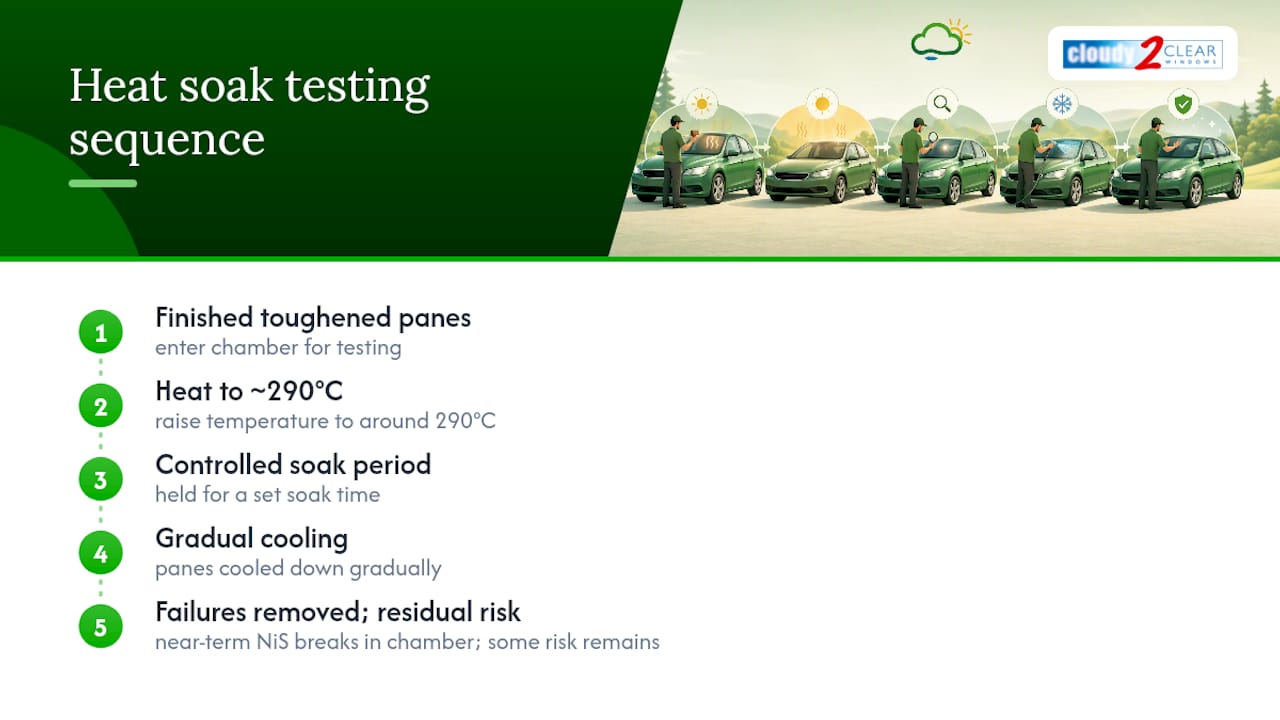
The process is genuinely destructive by design. Panes that would likely have failed in service are deliberately triggered to fail at the factory, which is why HST adds cost: every batch loses a percentage of stock to breakage during testing, and that loss gets priced into the tested glass you eventually receive.
Effectiveness is strong but not absolute. Heat soaking catches the inclusions large enough and positioned to fail within the test’s timeframe, but experts are consistent in framing HST as risk reduction, not risk elimination, since current manufacturing and inspection techniques cannot guarantee an inclusion-free pane. Some smaller or borderline inclusions may survive the soak only to complete their phase change months or years later on site. That is the honest ceiling of the technology, and any specification decision should treat HST as a strong mitigation rather than a certainty.
What ongoing maintenance reduces the risk of a spontaneous break?
Glazing is often treated as fit-and-forget, but a periodic visual check catches the human-caused risk factors long before they turn into a shattered pane. Inspect exposed edges for chips or shelling every couple of years, particularly on ground-floor windows and doors where knocks are more likely.
Watch for changes in the building’s immediate environment rather than the glass itself. A tree that has grown enough to newly shade part of a window, a heater relocated closer to glazing, or blinds fitted after the original installation can all shift the thermal pattern a pane experiences. Reviewing site conditions after any renovation is a sensible habit, not just a reaction to a break that has already happened.
For commercial and housing association portfolios, keep a simple record of glass age, type, and where possible, whether units were heat soak tested. That record becomes invaluable if one pane fails, since it lets a property manager identify sister panes from the same batch or manufacturing period that may carry similar risk. Reviewing that register annually, alongside a basic visual sweep of accessible glazing, catches the majority of preventable contributors before they escalate.
What do real spontaneous breakage incidents typically look like?
Documented cases tend to follow a handful of recognisable patterns rather than being random one-offs. A common scenario involves a large toughened glass balustrade or shopfront panel that shatters overnight with nobody present, later traced through fracture analysis to an NiS inclusion near the pane’s centre, consistent with the phase-change mechanism rather than any impact.
Another frequent pattern involves conservatory or rooflight glazing that fails on a hot afternoon following several cooler days, pointing towards thermal shock rather than an inclusion, particularly where the fracture runs in a single line from an edge rather than radiating from a central point. Property managers investigating these cases usually find a recent environmental change nearby, such as a newly added blind or a repositioned outdoor umbrella casting partial shade.
Larger façade installations occasionally reveal a cluster of failures across panes manufactured in the same batch, which is one reason industry guidance treats manufacturing history and heat soak testing records as genuinely useful evidence when investigating repeat incidents on a single building, rather than assuming each break is an isolated event.
Our take on spontaneous glass breakage after years in the trade
Most guidance on this subject focuses heavily on nickel sulphide inclusions, and understandably so, but Cloudy2Clear Windows sees just as many cases where the real story is a chipped edge, a badly packed fixing, or a blind fitted six months after installation that nobody thought to connect to the eventual crack. Treating every spontaneous break as a manufacturing mystery misses the site-level factors that are often within a property owner’s control.
Heat soak testing deserves its reputation as the strongest single mitigation available, but it should never be sold as a guarantee, and any installer who implies otherwise is not being straight with you. The honest position is that specification choices, careful handling, and sensible site awareness stack together to bring risk down meaningfully, even though no combination removes it entirely.
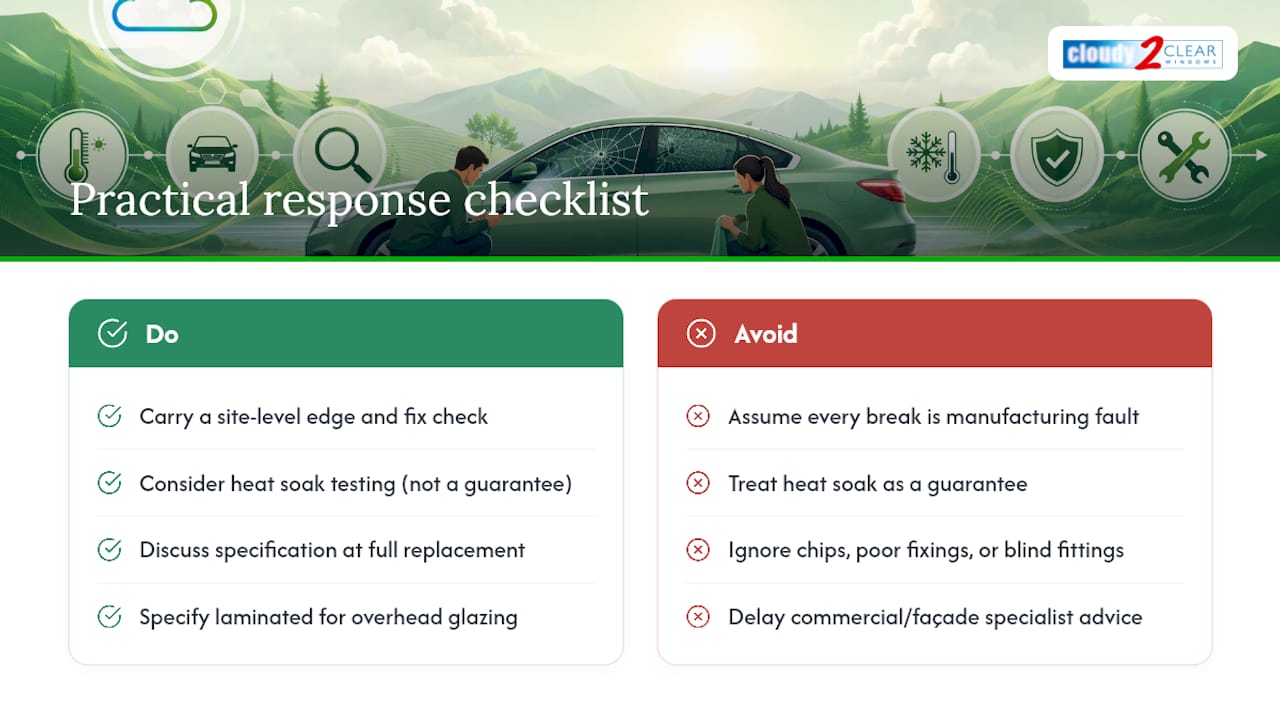
The pattern holds true across residential, commercial, and housing association properties: a proper on-site check after a break, covering the edge condition, the fixings, and anything that has changed in the surrounding environment, tells you far more than guessing at a cause. Where a full pane replacement is on the table, that is also the moment to discuss whether the original specification still makes sense, particularly for skylights, balustrades, or anything overhead where laminated glass offers real peace of mind.
If you are dealing with a broken pane, book an assessment through Cloudy2Clear Windows’ repair service, and for larger commercial or façade glazing, its commercial repair team can advise on heat soak testing and laminated options as part of any replacement quote.
Sources
- Spontaneous glass breakage explained | DGCOS
- Technical note: Spontaneous breakages of toughened glass | FIS
- NiS in heat-soaked glass: technical paper | Saint-Gobain Glass
- Thermal fracturing in glass | IQ Glass
FAQ
What does it mean if glass breaks by itself?
It usually means a nickel sulphide inclusion trapped during manufacturing has expanded inside the pane, or the glass has experienced thermal shock from an uneven temperature difference across its surface.
Why would glass suddenly shatter with no impact?
Toughened glass holds enormous internal tension, so a microscopic flaw like an NiS inclusion, or a sharp temperature swing across the pane, can release that tension all at once without anyone touching it.
Why is my window randomly shattered overnight?
Overnight breaks are commonly linked to temperature changes between a warm day and a cooler night, or to an NiS inclusion completing its slow phase change, both of which can trigger failure hours after the original stress began.
How common is spontaneous glass breakage?
One industry model puts the probability at roughly 1 in 1,100 for untested toughened glass, with heat soak testing reducing that figure substantially, though not to zero, and most incidents occurring within the first six to eight years after installation.