Most stuck uPVC window handles come down to a mechanical or alignment fault, not a broken window, so you can usually try a safe fix before calling anyone out. Start by moving the handle gently to its open position and checking whether it feels stiff, jams part-way, or spins with no resistance at all. If it spins freely or you feel real resistance building, stop. That is your cue to bring in a professional rather than risk snapping the handle or the mechanism inside the frame.
Quick safety checklist before you touch a stuck uPVC window handle
Before you pick up a single tool, spend two minutes working out what you’re dealing with. A stuck uPVC window handle usually falls into one of a few categories, and rushing in without checking first is how handles get snapped off.
- Test the handle through its full range with the window open slightly, if you can get it open at all, and note whether it moves stiffly, partially, or spins with no resistance.
- Protect the frame with a folded piece of cardboard or a cloth anywhere a tool might touch the uPVC, since bare metal against the frame will scratch or dent it.
- If the sash is heavy or awkward, get someone to hold it steady while you work, particularly on upper floors or large casement windows.
- Set aside enough time and gather your tools before you start, rather than stopping halfway to go hunting for an allen key.
This short check tells you whether you’re dealing with dirt and stiffness, or something more serious like a failed gearbox, before you commit to any repair attempt.
What your handle’s behaviour is telling you
Reading the symptoms correctly saves you from fixing the wrong problem. uPVC window hardware tends to fail in a handful of predictable ways, and each one leaves a slightly different clue.
- Stiff handle that moves but resists: usually dirt, dried-out lubricant, or a sash that’s catching on its keeps rather than turning freely.
- Handle turns but nothing happens to the locks: almost always a sign the gearbox or the spindle connecting handle to mechanism has failed internally, according to trade advice from Checkatrade.
- Window locks fine when open but won’t lock shut: points to sash drop or misaligned keeps, where the shootbolts simply aren’t lining up with their catches any more.
- Visible corrosion, a missing mushroom cam, or loose handle screws: a physical fault you can often see just by looking closely at the edge of the sash and the handle baseplate.
If the handle spins with almost no resistance and the locks don’t move at all, treat that as a strong signal of gearbox or espagnolette strip failure rather than something you can lubricate your way out of.
Step-by-step: opening a jammed uPVC window using a right-angled tool
When the handle won’t budge and the window is properly jammed shut, trade guides recommend a specific manual override that pulls the shootbolt rollers back by hand.
- Turn the handle to the open position first, so any shootbolts that are still working release on their own.
- If there’s no gap at all, gently prise a small opening with a flat screwdriver wrapped in cardboard to protect the frame finish.
- Slide a right-angled tool, a bent allen key or a length of stiff wire, past the rubber seal at the point where a shootbolt roller sits along the sash edge.
- Rotate the tool through 90 degrees to hook behind the roller cam, then pull firmly towards the handle side to drag the shootbolt back into its housing.
- Repeat the same manoeuvre at the opposite end of the sash if both top and bottom shootbolts have seized.
- Remove the handle itself with a screwdriver if you need more room to see or reach the mechanism.
Stop immediately if you can’t reach the rollers, if the handle suddenly starts spinning freely, or if continuing risks snapping the handle or the roller cams. Community DIY discussions on r/DIYUK echo the same approach, and most people who succeed practise the hooking motion on a similar window first.
Pro Tip: Keep the tool angle shallow and pull steadily rather than yanking. A sharp jerk is exactly how roller cams shear off inside the track, turning a five-minute fix into a parts replacement.
Simple DIY fixes once the window is open
With the sash open, you’re in a much better position to sort out the underlying stiffness rather than just freeing it this once.
- Brush out loose grit and old grease from the shootbolt track and keeps, then wipe with warm soapy water and dry thoroughly before doing anything else.
- Apply a PTFE or silicone-based lubricant to the cams, keeps, and hinge points rather than a general solvent spray.
- Tighten the two screws holding the handle baseplate, and check the spindle underneath for wear or rounding.
- If the sash has dropped slightly, loosen the keeps, realign them with the shootbolts, and ease the hinges before retightening everything.
Products like WD-40 shift immediate stiffness, but trade advice consistently warns against relying on solvent sprays long term, since they attract dust and grime that leaves the mechanism worse off within weeks, as Ross-Dean Locksmiths points out. Silicone or PTFE lubricant, applied every few months, does the job without that build-up. Our own guide to maintaining double-glazed windows covers the same lubrication routine in more depth if you want a seasonal checklist.
When the gearbox or espagnolette strip itself has failed
Cleaning and lubrication won’t fix a handle that spins with zero resistance, because that’s a sign the internal gearbox has stripped or the espagnolette strip inside the frame has failed. This is a distinct problem from dirt or misalignment.
- A gearbox that’s genuinely failed lets the handle turn freely without any of the shootbolts moving at all.
- Replacing it involves removing the handle, unscrewing the faceplate, sliding out the old gearbox and strip, then fitting the matched replacement, though this is a job best left to a confident DIYer or a professional, since getting it wrong is easy.
- Matching parts correctly matters more than people expect: fitting the wrong gearbox profile can leave the handle sitting at the wrong angle or failing again within weeks, as Checkatrade notes.
- Refitting a gearbox without functioning shootbolts is only ever a stopgap, not a real fix, and leaves the window insecure.
Pro Tip: If you order a replacement gearbox yourself, measure the backset and strip length exactly. A few millimetres out and the handle won’t sit flush against the frame.
Tools and materials worth having to hand
You don’t need a full toolbox for most of these jobs, just a handful of the right items.
- A bent allen key or a purpose-made right-angled pick for reaching shootbolt rollers.
- A small flat screwdriver, a basic screwdriver set, and a pair of pliers.
- PTFE or silicone spray or grease, clean rags, and cardboard or a soft cloth to protect the frame.
- A few spare handle screws in case the originals strip or corrode.
Avoid metal chisels or anything abrasive near the uPVC finish, and steer clear of solvent-based sprays as a permanent lubricant, for the same grime build-up reasons covered above.
When to stop and call a professional
Some faults simply aren’t worth pushing through on your own, and knowing where that line sits protects both your window and your window insurance.
- Stop immediately if: the handle spins with no resistance, you can’t reach the shootbolt rollers at all, forcing it risks snapping hardware, or the window’s security matters for an insurance claim or a rented property.
- A professional visit typically includes: a proper diagnosis of whether it’s the gearbox, spindle, or keeps at fault, and most repairers carry common gearboxes and handle sizes to fit a matched replacement on the same visit.
- What to expect on cost: most faults turn out to be repairable rather than requiring a full window replacement, so ask for a quoted parts-and-labour price before work starts rather than an open-ended estimate.
If you’d rather skip the diagnostics entirely, our window lock, hinge and handle repair service covers exactly this kind of fault.
Cloudy2Clear Windows: decades of hands-on repair experience
Cloudy2Clear Windows has repaired and replaced window hardware across homes and businesses since 2005, matching gearboxes and espagnolette strips correctly the first time rather than pushing customers towards unnecessary full window replacements.
A step-by-step way to diagnose exactly what’s wrong
Working through symptoms in order stops you fixing the wrong thing, which is the single biggest time-waster in uPVC handle repairs.
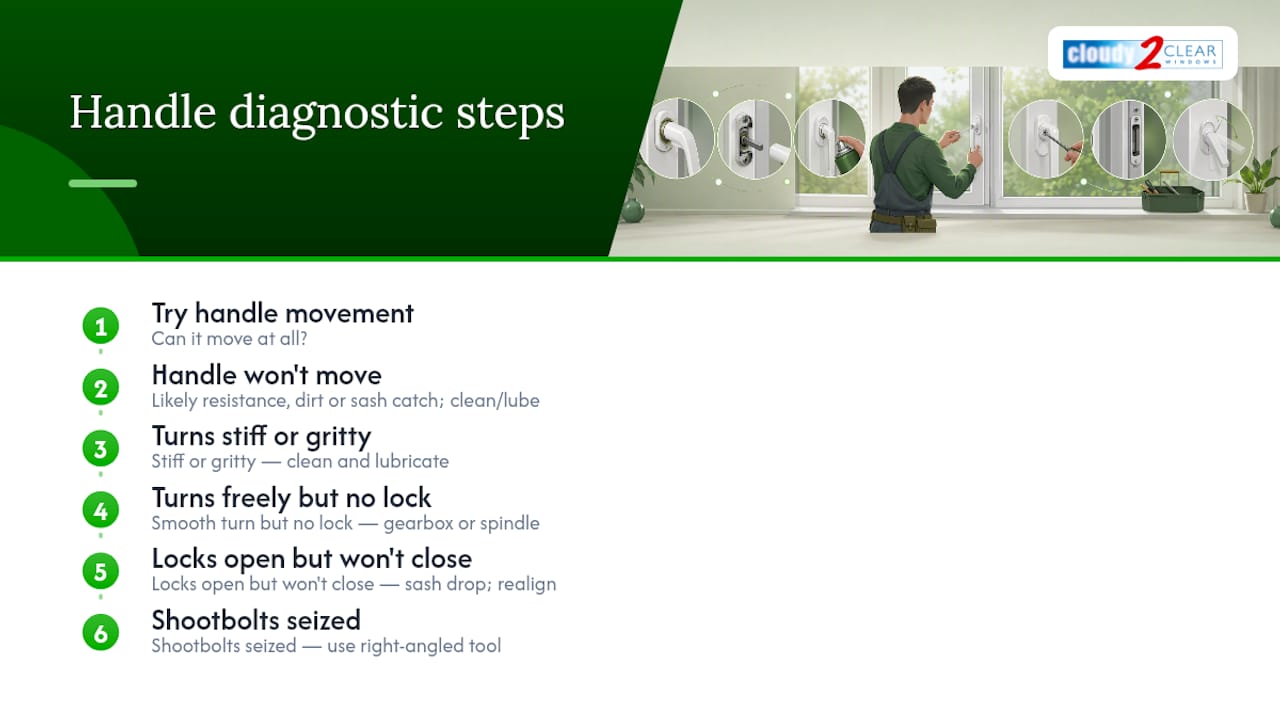
Start here: can you turn the handle at all?
If it won’t move even slightly, the issue is almost certainly mechanical resistance inside the frame, dirt, a dry mechanism, or a dropped sash catching on its keeps. Move to the cleaning and lubrication steps above before trying to force anything.
If the handle turns but feels stiff or gritty, that’s your dirt-and-lubrication signature too, just further along. Clean, dry, and lubricate before doing anything else.
If the handle turns smoothly with genuinely no resistance and nothing happens at the locks, stop diagnosing casually and treat it as a gearbox or spindle failure. Check for a visibly stripped spindle at the handle baseplate, since that’s sometimes the actual culprit rather than the gearbox itself, and a stripped spindle is a cheaper fix.
If the window locks fine when it’s already open but won’t pull shut and lock, look at the keeps along the frame edge. Sash drop is the likely cause, and you’re looking at realignment or a hinge adjustment rather than any part replacement.
If you’ve been through all of that and the shootbolts themselves seem physically seized in their housings, that’s when the right-angled tool method described earlier comes in, working the rollers free manually before you touch anything else.
How to remove the handle to inspect or replace parts inside
Getting the handle off cleanly gives you a proper look at the spindle and the top of the gearbox mechanism, and it’s simpler than most people expect.
Turn the handle to the position it would sit in when the window is unlocked, since most uPVC handles only release their fixing screws in this position. Look under the handle’s decorative baseplate, sometimes called the rose, for two small screws, usually a Phillips or a security Torx head. On some designs, you’ll need to lift or rotate the rose slightly first to expose them.
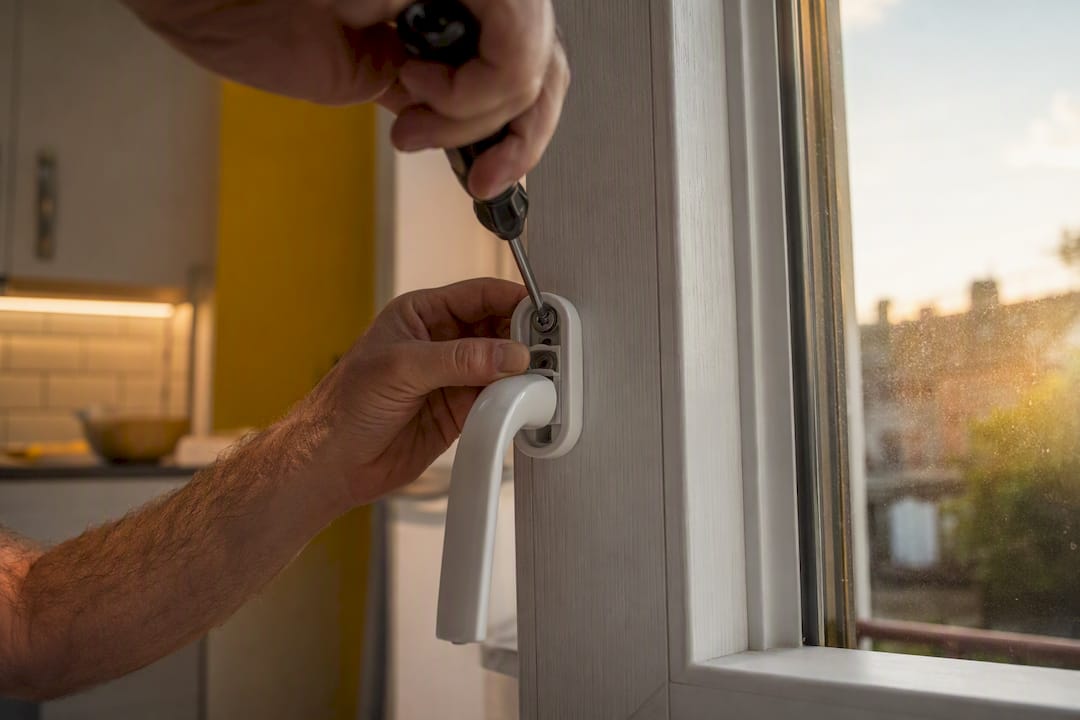
Undo both screws fully but keep them somewhere you won’t lose them, then lift the handle straight away from the spindle. The spindle itself, the square metal rod that runs into the gearbox, should come away with the handle on some models or stay in the frame on others. Check it for rounding at the corners, since a worn spindle is a common and cheap-to-fix cause of a handle that turns without engaging anything.
With the handle off, you can see the top of the gearbox faceplate and confirm whether it’s corroded, cracked, or simply gunked up with old grease. Refit by reversing the process, making sure the spindle seats fully into the gearbox before you tighten the screws, otherwise the handle will feel loose or fail to engage properly.
Maintenance tips to stop the handle jamming again
A handle that’s just been freed will seize again within a year or two without a bit of ongoing care, and the fixes are genuinely minor.
Regularly apply PTFE or silicone lubricant to the shootbolts, keeps, and hinges, ideally at seasonal changes when temperature swings affect the frame most. Wipe down the track and seals with warm soapy water first so you’re not just trapping grit under fresh grease. Check the handle screws for tightness at the same time, since a slightly loose baseplate puts uneven pressure on the spindle and speeds up wear.
Keep an eye on how the window closes through the year. If you notice the sash starting to catch or need extra force to lock, deal with the alignment straight away rather than waiting for it to seize completely, since a small adjustment now is far easier than a jammed handle later. Our guide on keeping uPVC frames clean without causing damage covers the cleaning side of this routine in more detail.
Our take: most stuck handles are simpler than homeowners assume
The conventional advice on stuck uPVC handles tends to jump straight to “call a professional,” which oversells the difficulty. Most cases genuinely are dirt, dry mechanisms, or minor misalignment, and a homeowner with a bent allen key and twenty minutes can resolve them without ever touching a gearbox.
Where we think people go wrong is the opposite mistake: forcing a handle that’s already telling them, through zero resistance, that the gearbox has failed. That’s not stubbornness paying off, that’s how a £15 part replacement becomes a broken handle and a call-out anyway. The behaviour of the handle is the diagnosis. Trust it.
Prioritise reading the symptom correctly before reaching for any tool. Clean and lubricate first, because that solves more cases than people expect. And treat a freely spinning handle as a stop sign, not a challenge.
If you’d rather leave it to a professional
If the handle spins freely, the shootbolts are out of reach, or the fault touches on window security for insurance purposes, this is exactly the point where a professional visit earns its cost. Cloudy2Clear Windows technicians carry common gearboxes and matched espagnolette strips, so most repairs are diagnosed and completed on the same visit rather than requiring a return trip.

On site, a technician checks the handle, spindle, gearbox, and keeps, confirms the exact part needed, and gives you a parts-and-labour price before starting work, rather than an open-ended estimate. That upfront pricing, and having the correct part on the van already, is the real difference between booking a professional and gambling on an online part order that might not match your frame profile. If you’re near Milton Keynes, you can check availability through our Milton Keynes branch page, or book directly through our window lock, hinge and handle repair service to get a technician out this week.
Sources
For diagrams and step photos, see the right-angled tool method and uPVC lock troubleshooting guides referenced throughout this article.
- How to Open a Jammed, Stuck, or Seized uPVC Window
- Jammed or broken UPVC window lock? – Ross-Dean Locksmiths
- Broken mechanism on UPVC window: what to do? | Checkatrade
FAQ
How do I open a window handle that’s stuck?
Turn the handle to the open position, then use a right-angled tool such as a bent allen key to hook and pull the shootbolt roller cams free from their housings.
Can you use WD-40 on a stuck window?
WD-40 can loosen an immediately stiff handle, but it’s not a good long-term lubricant since the solvent attracts grime; use PTFE or silicone lubricant for ongoing maintenance instead.
Why is my uPVC window handle not engaging?
A handle that turns but doesn’t move the locks almost always means the internal gearbox or spindle has failed, which typically needs a matched replacement part rather than a new window.
How do I fix a stuck uPVC window lock?
Clean out grit, lubricate the cams and keeps with silicone or PTFE spray, tighten the handle screws, and realign the keeps if the sash has dropped; call a professional if the handle spins freely.
When should I call a professional instead of fixing it myself?
Stop and call a professional if the handle spins with no resistance, the shootbolts are inaccessible, or the window’s security affects an insurance condition, since forcing it risks breaking the mechanism entirely.