Warm edge spacers are low-conductivity bars that separate the panes in an insulated glass unit, replacing the metal channel that used to sit at the glass edge. Made from foam, composite, or hybrid materials rather than solid aluminium, they cut the thermal bridge running around the perimeter of every double-glazed unit. The payoff is a lower whole-window U-value, warmer glass edges, and far less condensation forming on the inside pane during cold spells.
What are warm edge spacers and how do they work?
A spacer sits inside the sealed unit, holding the two (or three) panes of glass apart at a fixed distance and sealing the cavity that traps the insulating gas. On older aluminium units, that spacer is a highly conductive metal channel, which means heat inside your home finds the shortest route outside: straight through the edge of the glass. It is the reason old double glazing fogs up or grows a ring of condensation an inch or two in from the frame, even when the centre of the pane feels fine.
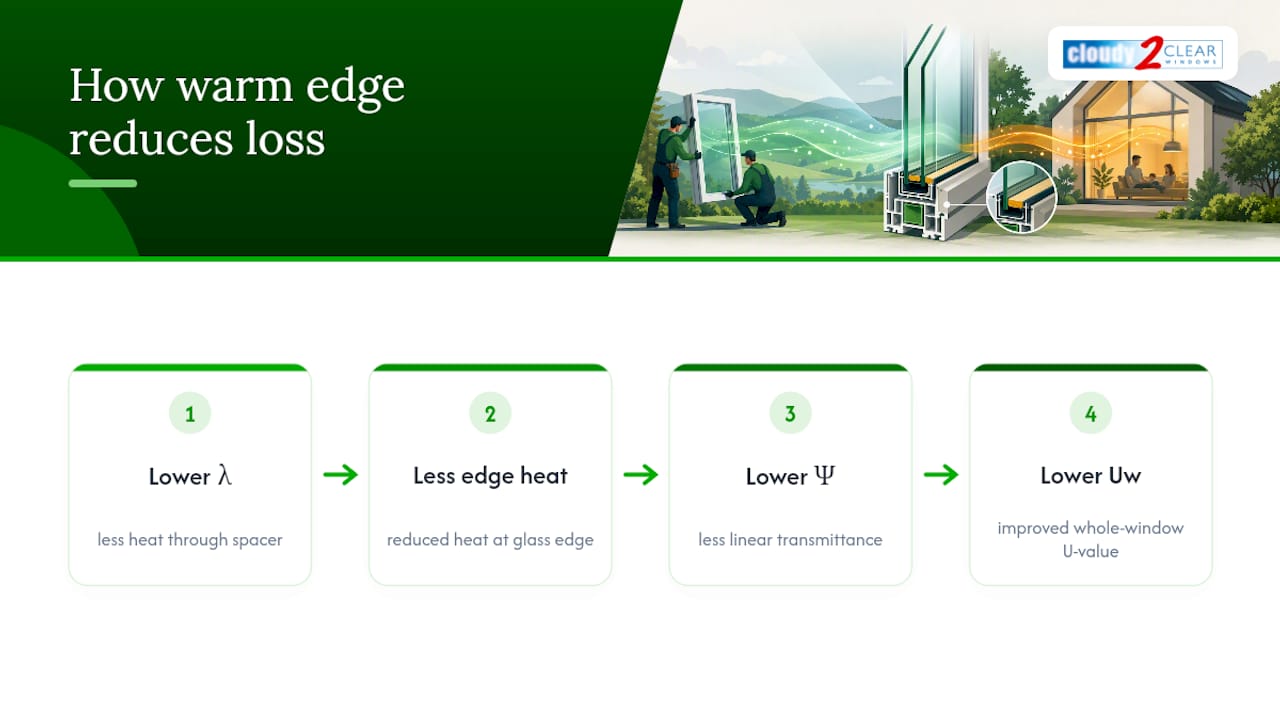
Warm edge systems replace that metal with materials that carry far less heat, measured by their thermal conductivity, written as λ (lambda) in W/mK. The lower the λ value, the less heat moves through the spacer. That single figure feeds into a wider calculation called linear thermal transmittance, or psi (Ψ), which quantifies heat loss specifically at the junction where glass, spacer, and frame meet. Lower Ψ values pull down the whole-window U-value, or Uw, the figure that actually determines how much energy a window loses over a year. Manufacturers and installers who understand how windows impact insulation for UK properties know that edge performance is not a footnote. On a standard-sized window, the edge zone can represent a meaningful share of the total glazed area, so a poor spacer choice drags down performance you might have assumed was locked in by the glass and gas fill alone.
Which materials are used to make warm edge spacers?
Manufacturers now offer several distinct families of warm edge spacer, each with different handling characteristics on the production line and different behaviour once installed.
- Rigid composite spacers are cold-bendable, fit onto existing aluminium production equipment with minor adjustment, and suit high-volume manufacturing without a major retooling cost.
- Flexible foam spacers, such as silicone-foam systems, carry integrated desiccant within the material itself and form a continuous seal with no corner keys, reducing one common failure point.
- Thermoplastic spacer (TPS) systems are applied as a hot-melt bead directly onto the glass, which suits automated production but needs dedicated equipment rather than a retrofit onto an aluminium line.
- Hybrid spacers combine a structural core with a low-conductivity outer layer, aiming for a middle ground between production compatibility and thermal performance.
Rigid composite tends to be the easiest option for factories converting from aluminium, while flexible foam and TPS systems generally demand different application methods and a bigger shift in workflow. None of that complexity should concern a homeowner directly, but it explains why not every installer offers every spacer type, and why lead times vary between suppliers.
How much better is a warm edge spacer than aluminium?
The conductivity gap between materials is substantial. Manufacturer data for flexible foam systems such as Super Spacer report thermal conductivity around 0.15 W/mK, claimed by the manufacturer to be roughly 950 times lower than standard aluminium, while rigid composite systems typically sit well under 1 W/mK. Aluminium, by contrast, conducts heat extremely efficiently, which is exactly the wrong property for something sitting at the coldest edge of your glazing.
That difference in the spacer material translates into real, measurable gains at the whole-window level. Trade modelling and manufacturer test data put the typical improvement at around 0.15 to 0.2 W/m²K on the whole-window U-value when swapping aluminium for warm edge in a standard argon-filled, low-E double-glazed unit. That is not a marginal rounding difference; on a home with a dozen or more windows, it compounds across the whole building envelope.
| Factor | Aluminium spacer | Warm edge spacer |
|---|---|---|
| Typical thermal conductivity | High (metal) | As low as ~0.15 W/mK (foam) to under 1 W/mK (composite) |
| Whole-window Uw impact | Baseline | Improvement of roughly 0.15–0.2 W/m²K |
| Edge condensation risk | Higher in cold weather | Substantially reduced |
A key figure to remember: independent modelling and comparative testing show that warm edge systems raise the edge glass temperature enough to meaningfully cut condensation occurrence in cold-climate conditions, compared with aluminium spacers at the same cavity width and gas fill.
Cavity width, argon or krypton fill, and low-E coatings all interact with spacer choice rather than acting in isolation. A wide gas-filled cavity with a good low-E coating still underperforms its potential if the edge is bridged by conductive metal, because heat escapes around the perimeter faster than the centre-pane figures suggest.
Which standards apply to warm edge spacer specification?
Two European standards govern how spacer performance and durability get verified, and any credible supplier should be able to speak to both without hesitation.
- EN ISO 10077 sets the calculation method for window thermal performance and defines the warm-edge classification threshold as Σ d·λ ≤ 0.007 W/K, a formula weighing spacer material thickness against conductivity.
- EN 1279 covers insulating glass unit durability, including gas retention over time and resistance to moisture ingress that causes internal fogging.
- Ask suppliers for declared λ values, the Ψ inputs used in their U-value calculations, and EN 1279 test reports covering the specific unit configuration you are buying, not a generic product range.
Primary references for both standards sit with the International Organization for Standardization, and any specifier working on a commercial project should treat those declared figures as non-negotiable line items in a tender, not optional extras.
Is a warm edge spacer worth the extra cost?
Run through this checklist before deciding, since the right answer depends on your specific building and budget rather than a blanket rule.
- What Uw target are you trying to hit? If building regulations or a personal efficiency goal set a demanding whole-window U-value, warm edge is often the difference between passing and falling short.
- How exposed is the property to condensation risk? Homes in colder, damper regions, or rooms with high humidity such as kitchens and bathrooms, see the biggest practical benefit from a warmer glass edge.
- What warranty and lifetime are you expecting? Reduced thermal cycling at the edge lowers stress on the seal, which can extend service life and reduce warranty claims over the years.
- Does your budget stretch to the marginal cost, and does production allow it? Not every existing frame or production run can accommodate every spacer type without adjustment.
Judge the cost against total lifecycle spend rather than the per-metre spacer price alone. Call-backs, early seal failures, and warranty claims all cost money too, and warm edge often wins that comparison even when the upfront material cost is higher. For a fuller breakdown of what drives glazing costs generally, see this guide to double glazing pricing factors.
Pro Tip: Ask any installer quoting a sealed-unit replacement to state the Uw figure for the whole window, not just the centre-pane U-value of the glass itself. The two numbers can differ significantly once the spacer’s edge performance is factored in.
What should installers check when fitting warm edge units?
Retrofitting warm edge spacers into an existing frame is usually straightforward, but a few practical checks separate a clean job from a comeback.
- Confirm the sightlines and cavity depth match the existing frame rebate before ordering, since spacer type can slightly affect unit thickness.
- Check bend radius tolerance for rigid composite spacers, and confirm corner-key quality on any spacer that uses mechanical corners rather than a continuous seal.
- Verify desiccant dosing and gas fill at manufacture, since underbilled argon cavities undermine the thermal benefit the spacer was meant to deliver.
- Allow correct sealant cure time before the unit is glazed into the frame, particularly in colder workshop conditions.
Reviewing broader window installation standards alongside spacer-specific checks helps catch problems before a unit ever reaches site.
What Cloudy2Clear Windows has learned fitting warm edge units
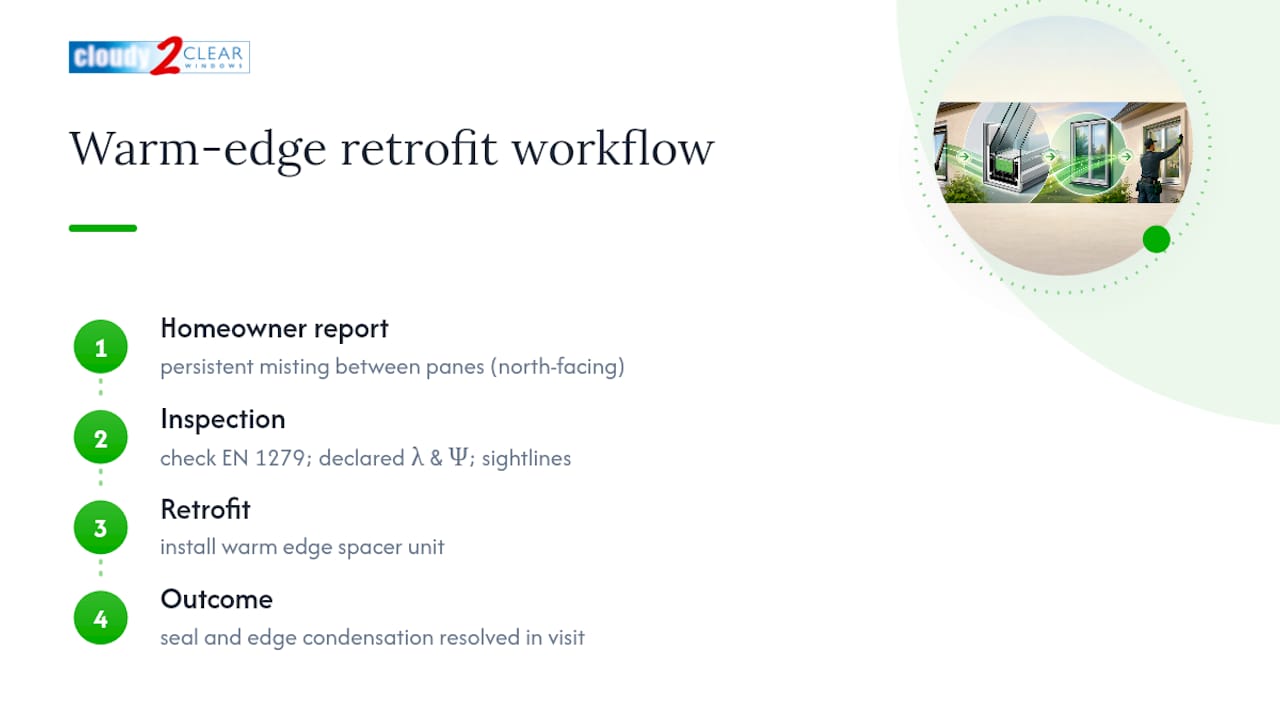
Cloudy2Clear Windows has been repairing and replacing double glazed units since 2005, and warm edge retrofits are now a routine part of solving stubborn condensation complaints on older properties. A common scenario: a homeowner reports persistent misting between the panes on a north-facing window, and swapping the failed unit for one with a warm edge spacer resolves both the seal failure and the edge condensation in one visit. Our team checks EN 1279 evidence, declared λ and Ψ figures, and sightline compatibility before recommending any replacement, so the new unit fits the existing frame without compromise.
Realistic benefits and where they stop
Warm edge spacers deliver a genuine, measurable thermal gain and cut condensation risk at the glass edge, but they are one input among several. Gas fill, coating quality, and frame material still shape the final Uw figure just as much. Always ask for whole-window modelling and EN 1279 evidence rather than taking a spacer’s marketing claim in isolation.
Upgrade your glazing without replacing the whole window
The glass unit itself can be repaired or replaced rather than the entire frame, which can keep costs down and avoid the disruption of a full window replacement. If your panes are misting, fogging at the edges, or simply underperforming against a modern warm edge specification, our insulating glass service can assess whether a warm edge retrofit solves the problem, backed by a 25-year guarantee on the work.

Work with homeowners, businesses, and housing associations may involve inspecting the existing frame and sightlines to confirm if a warm edge unit will fit cleanly. Get in touch through our double glazing replacement page to book an assessment and request a quote for your property.
Sources
For verification, consult the International Organization for Standardization for EN ISO 10077 and EN 1279 documentation, and the Wikipedia overview of warm edge technology for background and classification references.
- Are thermal spacer bars worth it? Expert insights — Edgetech
- Warm Edge vs Aluminum Spacer Bar: A Data-Driven Comparison for IG Manufacturers — Rockaluspacer
FAQ
What is a warm edge spacer?
A warm edge spacer is a low-conductivity bar fitted inside an insulated glass unit that separates the panes and reduces the thermal bridge that forms at the glazing edge, as detailed in the Wikipedia entry on warm edge technology.
Are warm edge spacers better than aluminium for energy efficiency?
Yes. Warm edge materials carry far less heat than aluminium, with some foam systems rated around 0.15 W/mK against aluminium’s high conductivity, and typically improve whole-window U-values by roughly 0.15 to 0.2 W/m²K.
What is the best gap for secondary glazing?
Secondary glazing performance depends on the air gap between the existing window and the new pane, with wider gaps generally improving both thermal and acoustic performance, though the spacer principle within a sealed double-glazed unit is a separate consideration from an open secondary glazing gap.
What is a thermal spacer?
A thermal spacer is another term for a warm edge spacer, referring to any low-conductivity bar used in place of a traditional metal spacer to reduce heat loss and condensation at the edge of an insulated glass unit.
Can Cloudy2Clear Windows fit warm edge spacers into my existing frames?
Yes, Cloudy2Clear Windows assesses your existing frame and sightlines before recommending a warm edge replacement unit, and current pricing is available by requesting a quote through our services page.