Float glass is flat glass made by floating molten glass on a bath of molten tin, producing a smooth, uniform ribbon with near-optical clarity. It is the standard material behind almost every window, mirror, and glass door you encounter. Three things define it:
- The process: molten glass poured onto molten tin spreads under gravity and surface tension into a perfectly flat ribbon, then passes through a controlled cooling tunnel called an annealing lehr.
- The benefits: exceptional optical clarity, consistent thickness, and a flat, workable surface that accepts coatings, cutting, and further processing.
- The uses: residential and commercial windows, shopfronts, mirrors, picture frames, glass doors, interior partitions, and as the base material for insulated glazing units (IGUs).
The sections below cover the manufacturing process; physical properties, sizes, finishes, applications, UK safety standards, fabrication, history, and practical buyer guidance.
How is float glass made?
The float glass manufacturing process runs continuously, often for 10–15 years without stopping, and delivers a ribbon of glass that is inspected and cut automatically.
- Batching: Raw materials (silica sand, soda ash, limestone, dolomite, and cullet — recycled glass) are weighed and blended precisely.
- Melting: The batch enters a furnace at around 1,550°C, where it melts into a homogeneous molten glass.
- Refining and homogenising: Bubbles and impurities are removed as the melt is held at high temperature and stirred.
- Floating on the tin bath: Molten glass flows onto a bath of molten tin at roughly 1,000°C. Because glass is less dense than tin, it floats and spreads into a flat ribbon. Thickness is controlled by the speed at which the ribbon is drawn forward and by mechanical edge rollers called top rolls.
- Ribbon formation: The ribbon cools gradually as it travels across the tin bath, becoming rigid enough to be lifted off.
- Annealing lehr: The ribbon passes through a long, temperature-controlled tunnel where it cools slowly and evenly, relieving internal stresses. This step is critical: glass that has not been properly annealed is prone to cracking during cutting or tempering.
- Inspection and cutting: On-line sensors and intelligent cutters locate tiny flaws and steer cuts around defects, minimising waste. The ribbon is then scored and snapped into stock sheets.
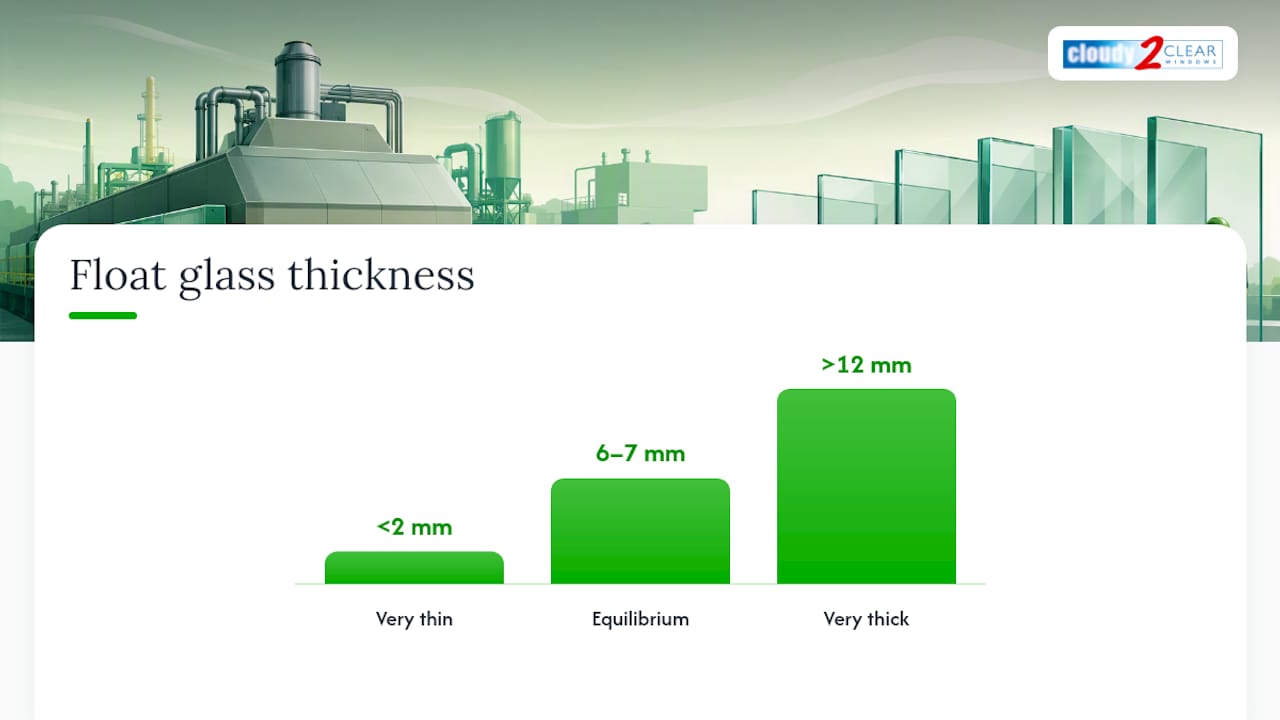
Producing very thin glass (below 2 mm) or very thick glass (above 12 mm) requires tighter mechanical control and is more costly, because the natural equilibrium thickness of the tin bath process is around 6–7 mm.
Pro Tip: Ask your supplier whether the glass has been properly annealed to the correct standard. Poorly annealed glass is harder to cut cleanly and can cause problems during tempering, leading to breakage and delays on site.
What are the key properties and benefits of float glass?
Float glass offers high light transmission and optical clarity and can be tempered, laminated, or coated to change its performance. The table below compares it with the two most common processed variants.
| Property | Float glass (annealed) | Toughened (tempered) glass | Laminated glass |
|---|---|---|---|
| Optical clarity | Excellent | Excellent | Very good (slight haze possible) |
| Can be cut on site | Yes | No | No |
| Breakage pattern | Large sharp shards | Small blunt cubes | Held together by interlayer |
| Safety rating | Not safety glass | Safety glass (BS EN 12150) | Safety glass (BS EN 14449) |
| Thermal treatment | None | Heat treated after cutting | Bonded interlayer after cutting |
| Accepts CVD coatings | Yes (on float line) | After coating only | After lamination only |
| Typical use | Windows, mirrors, IGU base | Doors, low-level glazing | Rooflights, balustrades |
Standard float glass carries a slight green tint at the edge, caused by iron content in the raw materials. For applications where colour neutrality matters, such as display cases or high-end facades, low-iron glass is available and gives a noticeably clearer appearance.
What thicknesses and sheet sizes does float glass come in?
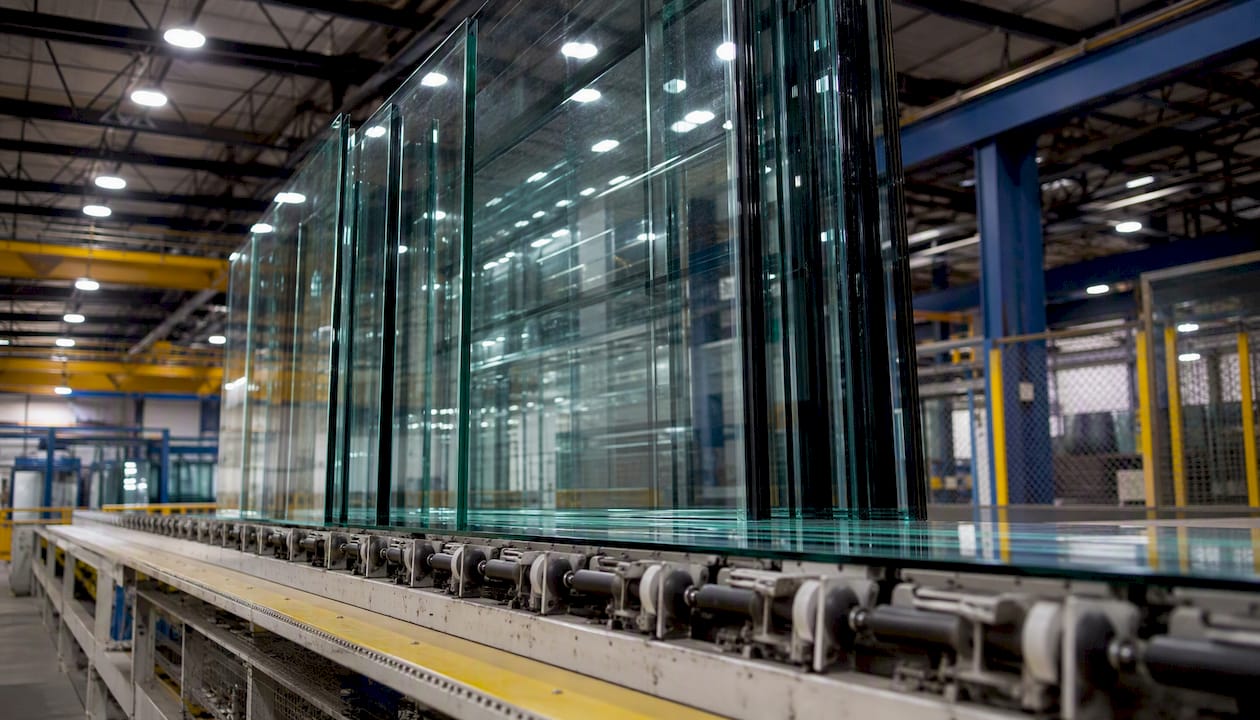
The float process now produces glass from roughly 0.4 mm up to 25 mm, though the most widely stocked thicknesses in the UK fall within a narrower range. Thinner and thicker sheets are available but carry longer lead times and higher costs.
| Thickness | Common uses |
|---|---|
| 2–3 mm | Picture frames, small decorative panels |
| 4 mm | Single-glazed windows, cabinet doors, mirrors |
| 6 mm | Tabletops, internal partitions, shopfront infill panels |
| 8–10 mm | Structural glass shelving, heavier doors, some balustrade infill |
| 12 mm | Thick structural panels, some frameless applications |
| 15–25 mm | Specialist structural or architectural use |
Maximum practical sheet widths from a standard float line are typically around 3.21 m, though jumbo sizes up to 6 m long are produced by some manufacturers. For large facade projects, always confirm maximum sheet dimensions with your supplier before finalising the design, as transport constraints often limit what can be delivered to site in one piece.
What finishes, coatings, and colours are available?
Float glass leaves the factory as clear, polished sheet, but a wide range of finishes and coatings can be applied either during manufacture or afterwards.
On-line coatings (applied during the float process)
Chemical vapour deposition (CVD) allows thin coatings to be applied directly to the ribbon as it passes through the float line. Low-emissivity (low-e) coatings are the most common result: they reduce heat loss through the glass and are the basis of most energy-efficient IGUs used in UK homes today. Solar control coatings work similarly, reflecting a portion of solar radiation to reduce summer overheating.
Off-line finishes (applied after manufacture)
- Acid etching: Creates a translucent, satin surface for privacy screens, bathroom glass, and decorative panels.
- Silk-screen printing and ceramic frit: Fired-on patterns or solid colours, used for spandrel panels, manifestation markings, and decorative facades.
- Paint and film: Applied for colour, privacy, or solar control where a factory coating is not specified.
- Sandblasting: Produces a textured, diffuse surface similar to acid etching but with more variation in depth.
Colour options in the float process itself are limited to body-tinted glass (bronze, grey, blue, green), achieved by adding metal oxides to the batch. These tints reduce solar transmission and are common in commercial glazing.
Where is float glass typically used?
Float glass is the baseline material for windows, mirrors, and shopfronts, and further processing expands its applications considerably. Common uses include:
- Residential window panes within double or triple-glazed IGUs
- Commercial shopfronts and curtain walling (usually as processed or coated glass)
- Mirrors (float glass silvered on the reverse)
- Picture frames and display cases
- Glass tabletops and shelving
- Internal partitions and office glazing
- Glass interior doors, where toughened or laminated variants are required
Plain annealed float glass is not suitable for every application. Safety glass is mandatory or strongly advisable in doors, low-level glazing below 800 mm from floor level, side panels adjacent to doors, rooflights, and balustrades. In those locations, toughened or laminated glass must be specified instead.
For thermal performance in modern UK buildings, a single float pane has a U-value of around 5.0–5.8 W/m²K, which falls well short of current Building Regulations requirements. Float glass is therefore almost always used as a component within a sealed IGU, combined with a low-e coating and an argon or krypton gas fill to achieve the required thermal performance.
What UK safety standards apply to glass?
Safety glass in the UK is governed by a set of EN and BS standards that specify how glass must behave on breakage and how it must be marked.
- BS EN 12150 covers thermally toughened soda lime silicate safety glass. Toughened glass breaks into small, blunt fragments rather than large shards, reducing the risk of serious injury.
- BS EN 14449 covers laminated safety glass, which holds together after breakage because the fragments bond to a polyvinyl butyral (PVB) or similar interlayer.
- BS EN 12600 is the pendulum impact test used to classify glass for use in critical locations.
Certified safety glass must carry a permanent mark (typically etched or sandblasted into a corner) showing the standard, the manufacturer, and the safety class. When you commission a glazier, ask to see the conformity documentation and check that the glass mark matches the specification. For commercial properties and housing associations, a written inspection record is good practice and may be required under your maintenance obligations.
How do fabricators process float glass?
Between leaving the float line as a stock sheet and arriving on your site as a finished unit, glass goes through several fabrication steps.
- Trimming the selvedge: The rough edges of the ribbon are removed to give clean, straight margins.
- Scoring and cutting: A tungsten carbide or diamond wheel scores the surface; the sheet is then snapped along the score line. This must be done before tempering.
- Edgework: Edges are ground, polished, or bevelled depending on the application. Exposed edges on frameless glass or shelving are typically polished to remove sharpness and improve appearance.
- Tempering: The cut and edged pane is heated to around 620°C and then rapidly quenched with air jets. Once tempered, the glass cannot be cut or drilled.
- Laminating: Two or more panes are bonded with an interlayer under heat and pressure in an autoclave.
- Assembly into IGUs: Panes are separated by a spacer bar, sealed at the edges, and the cavity is filled with argon or krypton gas.
- Final inspection: Finished units are checked for optical distortion, seal integrity, and correct marking before despatch.
Lead times vary: standard cut-to-size float glass is often available within a few days, while toughened or laminated units typically take one to two weeks. Confirm with your supplier before committing to an installation date, and check whether they deliver to site or require collection, as large sheets need specialist transport.
A brief history: Pilkington and the float process
Sir Alastair Pilkington developed the float glass process in the 1950s, and Pilkington first produced commercial float glass in 1959. Before that, flat glass was made by grinding and polishing cast plate glass, a slow and expensive process that limited both quality and scale. The float method replaced it almost entirely within two decades because it produced glass of equivalent optical quality at a fraction of the cost and with far greater consistency.
The core principle has not changed: molten glass still floats on molten tin. What has changed is the precision of the process. Modern lines, operated by manufacturers including Pilkington and Guardian Glass, produce a much wider thickness range, apply on-line coatings during manufacture, and use automated inspection to maintain quality across a ribbon that may run for over a decade without interruption.
Practical buyer guidance for float glass in the UK
Whether you are replacing a cracked pane or specifying glass for a new installation, a short checklist will save you time and avoid costly mistakes.
- Measure carefully: Width and height to the nearest millimetre, and note the rebate depth so the replacement pane fits the frame correctly.
- Confirm the thickness: Match the existing glass thickness unless you are upgrading; mismatched thickness can affect how the unit sits in the frame.
- Specify safety glass where required: Check whether the location falls within a critical zone (doors, low-level, rooflights). If in doubt, specify toughened or laminated glass.
- Ask about energy coatings: For IGU replacements, confirm whether the unit includes a low-e coating and what gas fill is used.
- Check lead times: Toughened and laminated units take longer than plain cut glass. Build this into your schedule.
- Request certification: Ask for the glass mark and conformity documentation, particularly for safety glass.
- Confirm delivery logistics: Large sheets need specialist vehicles and handling. Agree this before ordering.
For double glazing maintenance and care tips once your glass is installed, keeping seals clean and checking for early signs of misting will extend the life of your IGUs considerably.
An installer’s perspective on float glass
Most homeowners who contact us about a failed or cracked pane have not thought about glass specification at all, which is entirely understandable. The mistake we see most often is assuming that any replacement pane will do. Thickness matters, coating matters, and in certain locations the law requires safety glass whether you know it or not.
Site measurements are the other common source of problems. Glass cut to the wrong size cannot be re-cut once tempered, and a pane that is even a few millimetres too large will not fit without forcing the frame. Take measurements twice, in at least two places across the opening, because frames are rarely perfectly square.
For safety glazing, structural glass, or anything involving a large facade, please consult a qualified glazier rather than attempting to specify it yourself. The standards exist for good reason, and the consequences of getting it wrong go beyond inconvenience.
Glass repairs and replacements from Cloudy2Clear Windows
Replacing a misted, cracked, or failed pane is straightforward when you have the right team behind you. Cloudy2Clear Windows has been repairing and replacing double glazed glass across residential and commercial properties since 2005, working with float glass, toughened units, laminated panels, and energy-efficient IGUs.
Whether you need a single broken window repaired, a full double glazing replacement, or a commercial glazing inspection, our local teams are ready to help. We operate Monday to Friday, 8:30am to 6:30pm. Find your nearest branch or request a quote at Cloudy2Clear Windows.
Sources
- Float glass – Wikipedia
- The Float Process Step by Step
- Float glass: clear glass sheet manufacturer & supplier | Guardian Glass
- Glass Types for Windows UK 2026 Guide | Axiom Eco Homes
- Float Glass – UKO Glass
FAQ
What is float glass in simple terms?
Float glass is flat glass made by floating molten glass on molten tin, producing a smooth, uniform sheet with excellent optical clarity. It is the standard glass used in windows, mirrors, and shopfronts.
Can float glass be used as safety glass?
Standard annealed float glass is not classified as safety glass. It must be thermally toughened (to BS EN 12150) or laminated (to BS EN 14449) before it qualifies for use in doors, low-level glazing, or balustrades.
What thickness of float glass do I need for a window?
Most residential double-glazed units use common float glass thicknesses with standard overall IGU thickness including spacer and gas cavity. Confirm the existing thickness before ordering a replacement.
How does float glass differ from tempered glass?
Float glass is annealed (slowly cooled) and can be cut on site. Tempered glass has been heat-treated after cutting, making it roughly four times stronger and causing it to break into small blunt fragments rather than sharp shards. Tempering cannot be reversed or applied after installation.
Is float glass energy efficient on its own?
No. A single float pane has a U-value of around 5.0–5.8 W/m²K, which does not meet current UK Building Regulations for new or replacement glazing. Float glass achieves the required thermal performance only when assembled into a sealed IGU with a low-e coating and an inert gas fill.