Window hardware is the collection of components, including handles, locks, hinges, and compression seals, that enables your windows to open, close, seal, and secure properly. Understanding why window hardware matters is the difference between a window that performs as intended for decades and one that quietly drains your energy budget and compromises your security. The hardware on your windows is not decorative. It is functional, and when it fails, everything from your heating bills to your peace of mind suffers. Brands such as Amesbury Truth produce hardware specifically engineered to maintain sealing pressure and locking integrity over thousands of operating cycles.
Why window hardware matters for energy efficiency
Windows account for 25% to 30% of residential heating and cooling energy use, making the components that maintain sealing pressure and locking compression critical to your energy bills. That figure means a poorly sealed window is not a minor inconvenience. It is a measurable, ongoing cost.
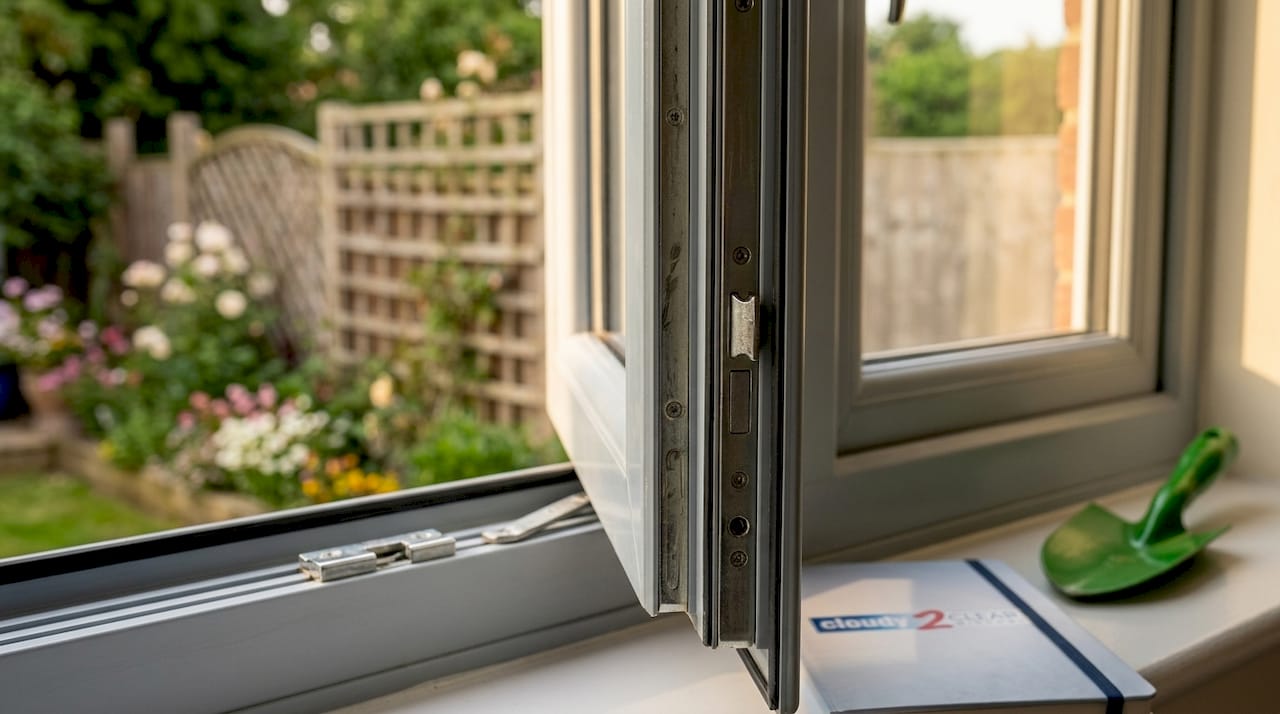
Hardware directly controls how tightly your window closes. Compression seals, hinges, and locking points work together to press the frame against the weatherstripping and hold it there. When any one of these components wears, corrodes, or distorts, the seal weakens. Poor compression seals and distorted hinges can make a window’s rated energy performance irrelevant by allowing drafts to bypass even high-quality double glazing. In practical terms, you could have an A-rated window unit that still lets cold air in because the hardware no longer pulls the sash tight.
The ENERGY STAR programme in the United States and equivalent UK Building Regulations Part L both set performance thresholds that assume hardware is functioning correctly. If your locks no longer engage fully or your hinges have developed play, your window is no longer performing to the standard it was installed to meet. Our guide to energy efficient window upgrades explains how hardware improvements sit alongside glazing choices in reducing heat loss.
Pro Tip: If you notice a cold draught near a closed window, check the locking points before assuming the glazing unit has failed. Tightening or replacing the lock mechanism often resolves the issue at a fraction of the cost of a full replacement.
What are the security benefits of high-quality window hardware?
Window hardware is your first physical line of defence against intrusion. Locks, hinges, bolts, and multi-point locking systems all contribute to how difficult it is to force a window open from the outside. The quality of that hardware, not just its presence, determines how effective that defence actually is.
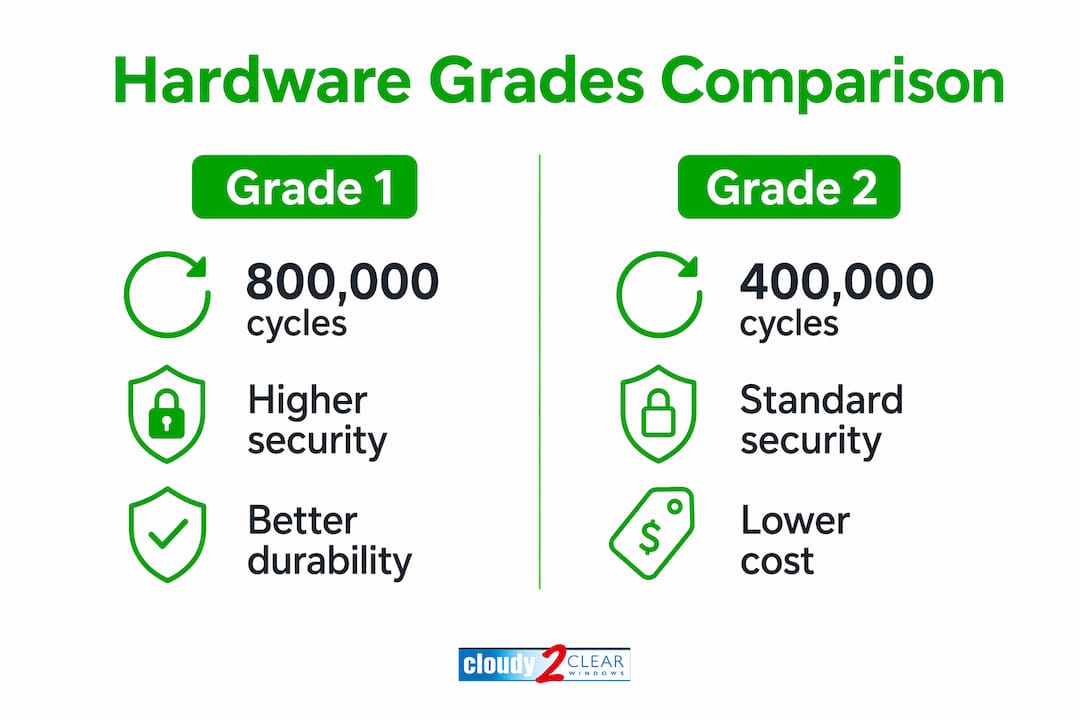
Hardware is graded by cycle performance. Grade 1 hardware supports 800,000 operating cycles compared to 400,000 for Grade 2. For a domestic property, Grade 2 may be adequate. For a commercial building with high footfall or windows that are opened and closed multiple times daily, Grade 1 is the correct specification. Choosing the lower grade to save money upfront leads to premature failure and higher long-term costs.
The table below compares the two grades across the factors most relevant to UK homeowners and business owners.
| Factor | Grade 1 hardware | Grade 2 hardware |
|---|---|---|
| Cycle rating | 800,000 cycles | 400,000 cycles |
| Best suited to | Commercial, high-traffic | Domestic, low-traffic |
| Long-term cost | Lower (fewer replacements) | Higher (earlier failure) |
| Security performance | Higher resistance to force | Adequate for standard use |
| Typical application | Offices, retail, schools | Houses, flats |
Security hardware also needs to balance safety with usability. Windows in bedrooms and upper floors must be openable from the inside in an emergency, so hardware that locks securely from the outside but releases quickly from the inside is a legal and practical requirement. Restrictors and egress hinges serve this dual purpose and are worth specifying when you are choosing hardware for any sleeping area.
Pro Tip: When replacing window locks, check that the new lock engages fully with the existing keep or striker plate. A lock that does not seat correctly offers little more resistance than no lock at all.
Which maintenance mistakes damage window hardware most?
The most common maintenance mistake is reaching for a can of WD-40. Oil-based lubricants attract dirt, which builds up inside hinges and gearboxes and accelerates wear rather than preventing it. Silicone-based lubricants are the industry standard for window hardware in the UK, resisting grime and performing reliably through cold, damp winters. Graphite powder is the correct choice for lock cylinders where liquid lubricants can cause sticking.
Beyond lubrication, these are the maintenance errors that cause the most damage over time:
- Ignoring early warning signs. Visible corrosion, loose locks, and difficulty operating windows are signals of failing hardware. Catching these early prevents energy loss and security risks from developing.
- Replacing one part without assessing the system. Hardware failure is often misdiagnosed by swapping a single component without checking whether the frame or track is also damaged. A new handle fitted to a distorted frame will fail again quickly.
- Skipping seasonal checks. Hinges and seals expand and contract with temperature changes. A window that closes perfectly in summer may not seal in winter if the hardware has not been inspected and adjusted.
- Using the wrong replacement parts. Fitting a handle or gearbox that is not matched to the original specification changes the load on surrounding components and can cause premature failure elsewhere in the system.
Our article on common window and door faults covers the early signs of hardware deterioration in more detail, including what to look for during a seasonal inspection.
Pro Tip: Twice a year, in spring and autumn, wipe down all exposed hardware with a dry cloth, apply silicone lubricant to hinges and friction stays, and test every lock point for full engagement. This takes under ten minutes per window and extends hardware life significantly.
How to choose window hardware that matches your window type
Choosing window hardware is not simply a matter of finding something that fits. The hardware must be matched to the window style, the weight of the sash or panel, the frequency of use, and the security level required. Getting this wrong means the hardware either fails early or never performs correctly from the start.
The table below outlines the key hardware considerations by window type.
| Window type | Key hardware required | Weight consideration | Security priority |
|---|---|---|---|
| Casement | Friction stays, espagnolette locks | Medium | Multi-point locking |
| Sash (vertical sliding) | Sash balances, sash locks | High | Dual sash locks |
| Tilt and turn | Tilt and turn handles, multi-point locks | Medium to high | Full perimeter locking |
| Sliding | Sliding locks, anti-lift blocks | Low to medium | Anti-lift and deadbolts |
| Fixed light | Restrictors only | N/A | Frame fixings |
Hardware interfaces, such as the handle-to-gearbox fit and the lock-to-keeper engagement, determine sealing and mechanical function more than individual parts alone. This means buying a high-quality handle and pairing it with a mismatched gearbox produces a system that underperforms. Always assess the full hardware chain before purchasing any single component.
For traditional properties with timber sash windows, matching the original hardware style is not just an aesthetic choice. Original hardware dimensions and fixing patterns are often specific to the window frame, and fitting modern equivalents without checking compatibility can cause frame damage. A well-designed multi-point lock with proper engagement consistently outperforms more complex systems that bind or require excessive force to operate. Simplicity and fit matter more than specification on paper.
Selecting hardware based on lifecycle cost rather than unit price is the most reliable approach for both homeowners and commercial property managers. A component that costs twice as much but lasts three times longer, with no mid-cycle failures, is the better investment by any measure.
What we have learned from 20 years of window hardware repairs
After two decades of repairing and replacing window hardware across homes and commercial buildings throughout the UK, the pattern we see most often is this: the hardware was never the priority. Homeowners invest in new glazing, new frames, even new window boards, but the locks, hinges, and seals are left as they are. Then, two or three years later, the window starts to feel draughty, the lock is stiff, and the energy savings they expected never materialised.
The uncomfortable truth is that a well-glazed window with failing hardware performs worse in real-world conditions than a modest window with hardware that is correctly specified and properly maintained. We have seen A-rated double glazed units in properties where the hinges had so much play that the sash was visibly rocking in the frame. The glass was fine. The hardware was not.
Our advice, based on what we see every week, is to treat hardware as part of the window system, not an afterthought. Before you decide that a window needs replacing, have the hardware assessed. In many cases, a lock mechanism, a set of friction stays, or a new compression seal is all that stands between a window that works and one that does not. Knowing how to spot signs of window damage early gives you the information to make that call before the problem becomes expensive.
— Cloudy2Clear Windows
How Cloudy2Clear Windows can help with your window hardware

Cloudy2Clear Windows has been repairing and upgrading window hardware across the UK since 2005, working with both homeowners and commercial property managers. Whether your locks are stiff, your hinges have developed play, or your windows are no longer sealing as they should, our experienced technicians assess the full hardware system before recommending any work. We cover a wide range of locations, including double glazing repairs in Milton Keynes, Oxford, Leicester, and many more. For businesses, our commercial window repair service covers hardware upgrades that meet security and energy performance requirements. Our lock, hinge, and handle repair service is the practical next step if your windows are showing any of the signs discussed in this article.
FAQ
What does window hardware actually include?
Window hardware includes handles, locks, hinges, friction stays, compression seals, espagnolette gearboxes, and keeps. These components work together to enable a window to open, close, seal, and lock correctly.
How does window hardware affect my energy bills?
Windows account for 25% to 30% of residential heating and cooling energy use, and hardware that fails to maintain sealing pressure allows drafts to bypass even high-quality glazing. Replacing worn locks and hinges is often the most cost-effective way to restore a window’s thermal performance.
How often should window hardware be serviced?
Window hardware should be inspected and lubricated twice a year, ideally in spring and autumn. Use silicone-based lubricants on hinges and stays, and graphite powder for lock cylinders.
When should I replace rather than repair window hardware?
Visible corrosion, locks that no longer engage fully, and windows that are difficult to operate are all signs that hardware needs attention. If frame or track damage is also present, a full system assessment is needed before replacing individual parts.
Is Grade 1 or Grade 2 hardware better for my home?
Grade 2 hardware is adequate for most domestic properties with standard usage. Grade 1 hardware, rated to 800,000 operating cycles, is the correct specification for commercial buildings or any window subject to frequent daily use.