What are energy ratings for windows?
The Window Energy Rating (WER) is a standardised score that tells you how efficiently a window performs overall, combining heat loss, solar gain, and air leakage into a single figure expressed in kWh/m²/year. The British Fenestration Rating Council (BFRC) administers the UK’s most widely used scheme, rating windows on a scale from A++ (most efficient) to E (least efficient). Windows rated A or above are classed as “energy positive,” meaning they contribute more heat through solar gain than they lose through the glass and frame.
Why does this matter for your home? Poorly rated windows are one of the biggest sources of heat loss in UK properties, and replacing them with higher-rated alternatives directly reduces your heating bills. Under UK Building Regulations, replacement windows installed in 2026 must meet at least a C rating or a whole-window U-value of 1.4 W/m²K.
Key facts at a glance:
- The BFRC scale runs from A++ (best) to E (worst).
- Ratings of A and above are energy positive, delivering a net heat gain.
- The WER score is measured in kWh/m²/year; a higher positive number means better performance.
- Building Regulations set a minimum C rating for all replacement windows in England and Wales.
- WER labels are voluntary but independently verified by BFRC, unlike manufacturers’ own claims.
What determines a window’s energy rating?
Three measurable factors feed into the WER calculation, each assessed against EN and ISO standards.
- U-value (thermal transmittance): Measures how quickly heat escapes through the whole window assembly, frame included. A lower U-value means less heat loss. The whole-window U-value always differs from the glass-only figure, so never compare the two directly.
- g-value (solar factor): Measures how much of the sun’s heat passes through the glass into your home. This is a positive contribution to the energy balance.
- L-value (effective air leakage): Measures uncontrolled airflow through gaps in the window unit. Draughts carry warm air out, so a lower L-value improves the overall rating.
The WER is essentially an energy balance: solar gain minus heat loss and air leakage. Crucially, the rating covers the entire window unit, including the frame, glass, and hardware. Swapping the glass alone does not change the certified rating without retesting the full assembly.
How to read a BFRC window energy rating label
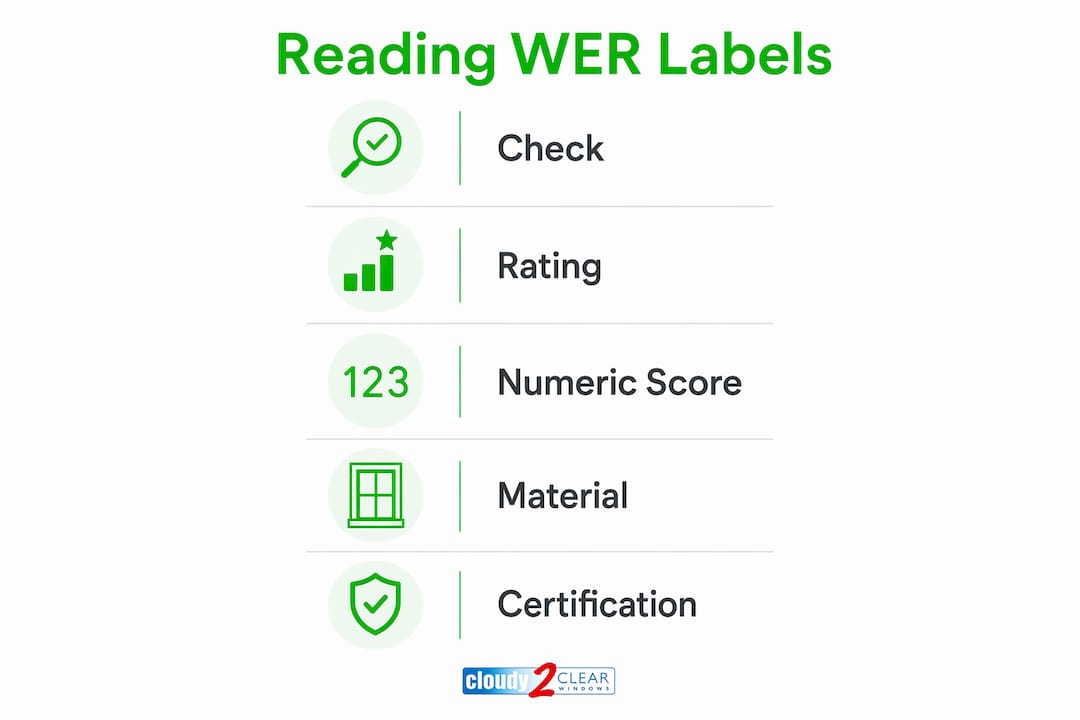
The official BFRC label is designed to be read at a glance, but there is more detail on it than most people realise.
- Letter rating and colour band: The large letter at the top (A++ to E) sits within a rainbow colour band, similar to the labels you see on white goods or car tyres.
- Energy Index score: A numeric figure in kWh/m²/year sits below the letter. Two windows can share the same letter band yet carry different numeric scores; the higher number indicates the better performer.
- Whole-window U-value: Listed separately on the label. This is the figure that matters for Building Regulations compliance, not the glass-only U-value sometimes quoted in brochures.
- Solar factor and air leakage values: Both are printed on the label, giving you the raw data behind the overall rating.
Spotting a genuine label is straightforward once you know what to look for. Genuine BFRC-certified products carry a small official sticker on the inside of the frame, alongside the larger rainbow label. Some manufacturers use lookalike labels without third-party verification. If you are unsure, you can check live licences directly on the BFRC website before you buy.
Pro Tip: Always ask your installer for the numeric WER score, not just the letter grade. Two A-rated windows can perform quite differently depending on their actual kWh/m²/year figure.
What are the real benefits of choosing energy-efficient windows?
Higher-rated windows deliver savings you can feel and measure. A-rated windows typically save £100–£150 per year compared with older single glazing, while triple-glazed A++ rated windows can offer greater savings in particularly exposed or cold locations.
The comfort gains are just as tangible. Better-insulated windows reduce cold spots and draughts near the glass, leading to more consistent indoor temperatures. Homes in regions with longer heating seasons tend to see the sharpest improvements. Pairing energy-efficient windows with an efficient heating system compounds the savings further.
There is also an environmental dimension. Lower heat loss means less fuel burned, which directly reduces your home’s carbon emissions. For property managers with multiple units, upgrading to A-rated or above across a portfolio can make a measurable difference to an EPC score, which in turn affects rental value and compliance with minimum energy efficiency standards.
Key figure: A-rated windows save £100–£150 annually versus single glazing, with A++ triple-glazed units offering further gains in colder or more exposed properties.
Expert advice on navigating the UK window energy rating system
The WER scheme is voluntary, not statutory. That distinction matters when you are shopping. A window without a BFRC label is not necessarily poor quality, but you have no independent verification of its performance. The Glass and Glazing Federation recommends explicitly requesting BFRC-labelled products when obtaining quotes, rather than assuming all suppliers will offer them.
Comparing windows by letter band alone can mislead you. Two products both labelled “A” may have meaningfully different WER scores. Always ask for the numeric figure. Similarly, a glass-only U-value quoted in a sales brochure is not the same as the whole-window U-value on the BFRC label; the frame and hardware affect the final number.
- Check that the BFRC sticker is on the inside of the frame, not just a printed label on the glass.
- Verify the product’s licence on the BFRC website using the manufacturer’s name or membership number.
- Confirm the whole-window U-value meets the 1.4 W/m²K threshold required by Building Regulations.
- Ask whether the installer is a BFRC Approved Installer, which adds a further layer of accountability.
- Explore whether you qualify for any government grant or energy efficiency scheme before committing to a purchase.
Pro Tip: The BFRC product search lets you look up any registered window by manufacturer. Use it before signing a contract to confirm the rating is genuine and current.
How UK window energy rating standards have evolved
The BFRC was founded in 1997 specifically to establish a window energy rating system for the UK, at a time when the industry had no consistent way to compare products on energy performance. The early scheme focused primarily on U-values, but it became clear that heat loss alone did not capture the full picture. Solar gain and air leakage were incorporated into the WER formula to create a more complete energy balance.
Building Regulations have tightened progressively since then. The minimum standard for replacement windows has moved upward over successive revisions, reaching the current C-rating threshold. The 2026 regulations reflect a broader government push to improve the energy performance of the existing housing stock, aligned with net-zero commitments. For homeowners, this means that windows installed even a decade ago may now fall below the legal minimum for replacement units.
How do UK window ratings compare with international standards?
The BFRC system is specific to the UK and uses a formula calibrated to British climate conditions, standard building occupancy, and average solar exposure. That makes direct comparisons with overseas schemes imprecise.
In the United States, the ENERGY STAR programme rates windows using U-factor and Solar Heat Gain Coefficient (SHGC), with regional climate zones determining the qualifying thresholds. The underlying physics are the same, but the rating boundaries differ because US climate zones range from hot-humid to cold-continental, requiring different trade-offs between solar gain and heat retention.
European standards use the EN 14351 framework, which specifies U-values and other performance characteristics but does not produce a single consumer-facing letter rating in the way BFRC does. If you are importing windows from a European supplier, ask for the whole-window U-value and cross-reference it against the UK Building Regulations threshold of 1.4 W/m²K. A European product with a strong U-value may still perform differently in a UK context once solar gain and air leakage are factored into the WER calculation.
How to compare window products using energy ratings when shopping

Start with the letter band as a filter, then drill into the numbers. Any window below a C rating fails the Building Regulations minimum, so you can rule those out immediately. From C upward, the WER numeric score is your primary comparison tool.
| Rating band | WER score (kWh/m²/year) | Typical use case |
|---|---|---|
| A++ | Highest positive score | Exposed or cold locations, maximum savings |
| A+ | High positive score | Most UK homes seeking best value |
| A | Positive score | Good all-round performance, meets regulations comfortably |
| B | Near-zero or slightly positive | Acceptable mid-range option |
| C | Meets minimum legal threshold | Regulatory compliance only |
When selecting glazing options, also consider the frame material, as uPVC, timber, and aluminium frames all affect the whole-window U-value and therefore the final WER score. A high-performance glass unit in a poorly insulating frame will not achieve the rating you expect. Pairing your window choice with an efficient heating system maximises the overall benefit to your home’s energy performance.
Real-life impacts of window ratings on bills and comfort
Consider a typical semi-detached house in the Midlands with original single-glazed windows. Replacing all windows with C-rated double glazing meets the legal minimum and reduces draughts noticeably, but the energy savings are modest. Upgrading to A-rated units on the same property delivers the £100–£150 annual saving noted earlier, with a warmer feel near the glass during winter months.
For a property manager running a block of flats in Norwich, the calculation shifts. Upgrading from D-rated to A-rated windows across multiple units improves each flat’s EPC rating, potentially moving properties from band D to band C. That shift can affect compliance with minimum energy efficiency standards for rented properties and may reduce tenant complaints about cold rooms or condensation. The impact on insulation is particularly pronounced in older buildings where windows are a primary source of heat loss.
A homeowner in Scotland fitting A++ triple-glazed units in a north-facing extension reported a marked reduction in condensation and a more consistent room temperature throughout winter, without increasing boiler output. The longer heating season in Scotland means the payback period on the higher upfront cost is shorter than in southern England.
How Cloudy2Clear Windows can help
If your windows are underperforming or you are planning an upgrade to meet 2026 Building Regulations, Cloudy2Clear Windows has been helping homeowners and property managers across the UK since 2005. Whether you need a double glazing replacement to hit the A-rating threshold or a repair to restore an existing unit’s performance, the team can advise on the right solution for your property and budget.

Cloudy2Clear Windows covers a wide area, with local teams in Oxford, Leicester and Loughborough, and Norwich, among many other locations. Get in touch to discuss your requirements.
FAQ
What is a good energy rating for windows in the UK?
A rating of A or above is considered good, as these windows are energy positive, meaning they gain more heat from solar energy than they lose through the frame and glass. For most UK homes, an A or A+ rating offers the best balance of performance and cost.
Which energy rating is best, A or G?
A is best. The BFRC scale runs from A++ (most efficient) to E, so A sits near the top. G does not exist within the current UK scheme. The higher the letter, the better the window performs.
Is energy rating D or E better for windows?
D is better than E. Both fall below the minimum C rating required by UK Building Regulations for replacement windows, so neither would be acceptable for a new installation in a standard residential property.
What is the U-value of an A-rated window?
An A-rated window typically carries a whole-window U-value well below 1.4 W/m²K, which is the maximum permitted under Building Regulations for replacement windows. The exact figure varies by product; always check the whole-window U-value on the BFRC label rather than any glass-only figure quoted separately.