Glass thickness is the measurement, in millimetres, that determines a pane’s structural strength, safety rating, and suitability for any given application. Whether you are replacing a window at home or specifying glazing for a commercial premises, getting this measurement right is not optional. Glass thickness ranges from as little as 2mm for decorative picture frames up to 19mm for heavy structural floors and staircases. The wrong choice can mean failed building inspections, safety hazards, and costly rework. This guide covers the full glass thickness explanation you need, from standard ranges and technical factors through to measurement techniques and building code compliance.
What glass thickness ranges are used for home and business applications?
Understanding the standard thickness categories is the most practical starting point for any glazing decision. Glass thickness standards follow a clear hierarchy based on application, and knowing where your project sits within that hierarchy saves time and money.
| Application | Typical thickness | Glass type |
|---|---|---|
| Picture frames and decorative panels | 2mm or less | Annealed |
| Standard residential windows | 4mm to 6mm | Annealed or toughened |
| Double glazing panes | 3mm to 4mm per pane | Annealed or low-e coated |
| Commercial storefronts | 10mm to 12mm | Toughened or laminated |
| Balustrades and structural floors | 15mm to 19mm | Laminated toughened |

Double-pane residential windows use 3 to 4mm glass per layer, which means the glass itself is relatively thin. The insulation performance of a double glazed unit comes primarily from the sealed air or gas cavity between the panes, not from the glass thickness alone. This is a point many homeowners misunderstand when comparing units.
For commercial applications, the requirements shift considerably. Shopfronts and office facades regularly specify 10mm to 12mm toughened glass to handle wind loads, accidental impact, and the structural demands of large unsupported spans. Moving up to structural glazing, such as glass floors, walkways, or stair treads, requires 15mm to 19mm laminated panels to meet both load-bearing and safety fragmentation requirements.
Key thickness categories at a glance:
- 2mm or less: Decorative glass, picture frames, cabinet inserts
- 4mm to 6mm: Residential windows, internal doors, conservatory roofs
- 3mm to 4mm per pane: Double and triple glazed units
- 10mm to 12mm: Commercial facades, large shopfronts, partitions
- 15mm to 19mm: Structural glass floors, balustrades, stair treads
Safety mandates also influence minimum thickness in certain settings. Low-level glazing below 500mm from floor level, shower enclosures, and balustrades all carry specific requirements that override general thickness guidance. These are covered in detail in the compliance section below.
How do support systems and load affect required glass thickness?
Two panes of identical size can require very different thicknesses depending entirely on how they are supported and what loads they must carry. This is the part of the glass thickness explanation that surprises most people, and it is where under-specification most commonly occurs.
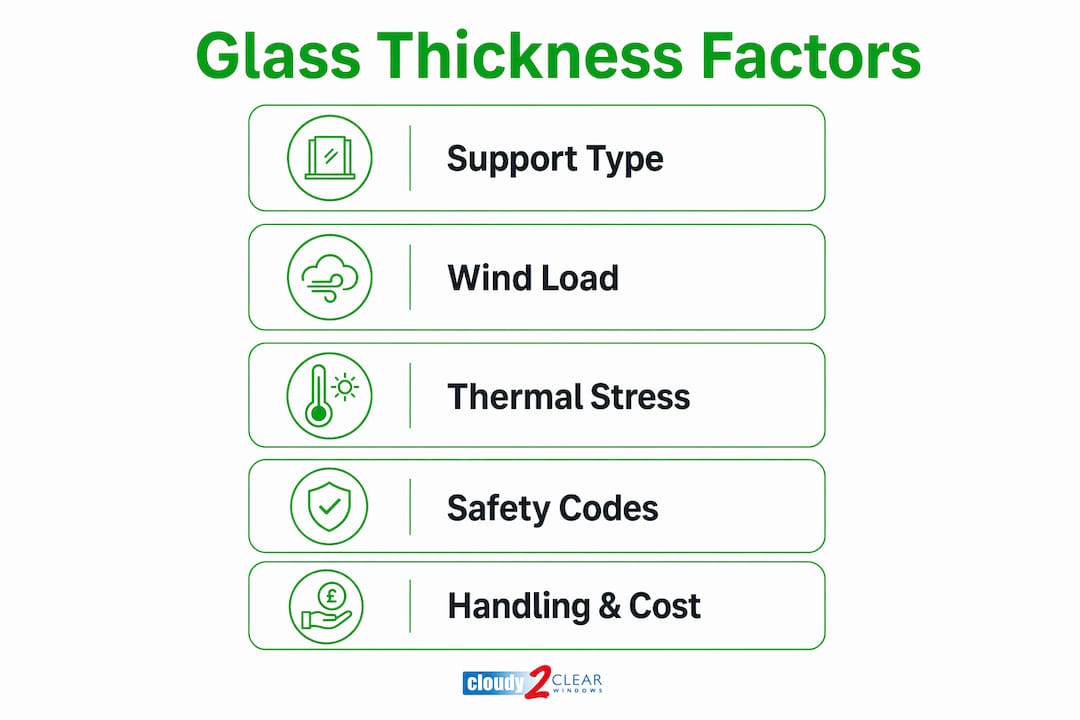
Support conditions fall into three main categories. Four-sided support, where the glass is held in a frame on all edges, distributes stress most efficiently and allows for thinner glass. Two-sided support, common in sliding doors or some curtain walling systems, concentrates stress along two edges and demands greater thickness. Point-supported or frameless systems, used in structural glazing and glass balustrades, place the highest demands on the glass and require the thickest, strongest panels.
Wind load is the other critical variable for exterior glazing. The L/175 deflection limit governs how much a pane can bend under load before it risks cracking or causing discomfort. For a 2100mm span, the maximum permitted deflection is just 12mm. This rule directly dictates minimum thickness based on the span and the expected wind pressure at the installation site.
Thermal stress is a less obvious but equally real factor. Large panes in south-facing elevations can experience significant temperature differentials between the centre and the edges, particularly when partially shaded. At certain thicknesses and sizes, heat-strengthened or toughened glass becomes necessary to prevent spontaneous thermal fracture.
Pro Tip: If you are specifying glass for a frameless or point-supported installation, always consult a structural engineer or glazing specialist before ordering. The thickness required for these systems is rarely intuitive, and the consequences of under-specification are serious.
Factors that increase the required thickness:
- Larger unsupported spans
- Frameless or point-supported fixing methods
- High wind exposure zones
- South-facing elevations with significant shading
- Balustrade or overhead glazing applications
How to measure glass thickness accurately and safely
Measuring glass thickness correctly matters whether you are ordering a replacement pane, verifying a supplier’s specification, or checking compliance. Proper measuring tools include glazing gauges and digital calipers. A standard ruler can give a rough indication on exposed edges but lacks the precision needed for compliance purposes.
Follow these steps to measure a double glazed unit accurately:
- Identify an exposed edge. On a sealed double glazed unit, the edge spacer bar is usually visible. This is where you take your measurement.
- Use a glazing gauge or digital caliper. Place the U-shaped jaw of a glazing gauge around the edge of the glass. Read the measurement directly from the scale.
- Account for the full unit depth. A double glazed unit measurement includes both glass panes and the cavity. For example, a 4mm pane, a 16mm cavity, and a second 4mm pane gives a total unit depth of 24mm.
- Check the spacer bar markings. Many manufacturers stamp the cavity width on the spacer bar itself. Combined with the pane thickness, this gives you the full specification.
- Read laminated glass notation carefully. A specification written as 6+1.52+6 means two 6mm panes bonded with a 1.52mm PVB interlayer, giving a total thickness of 13.52mm. The interlayer contributes to both safety performance and sound insulation.
When glass is fully framed and the edge is inaccessible, a glazing gauge with a magnetic or ultrasonic sensor is the most reliable option. These tools are available from glazing suppliers and are worth using if you need a precise reading for compliance or replacement purposes.
Pro Tip: The tap test, gently tapping the glass and listening for a dull thud versus a ringing tone, can give a rough indication of whether glass is toughened or annealed. It is not a substitute for measurement, but it is a useful first check before calling in a specialist.
Common mistakes to avoid:
- Measuring only the glass pane and forgetting the cavity depth in a double glazed unit
- Confusing the unit depth with the individual pane thickness
- Assuming all glass of the same visual appearance is the same thickness
- Ordering replacement glass based on frame size alone without measuring the existing unit
How do safety and building codes affect glass thickness requirements?
Building regulations in the UK set minimum standards for glass thickness and type in specific locations. Incorrect glass thickness is a common cause of failed building inspections and installation rework, and the consequences extend beyond inconvenience. Using under-specified glass in a regulated location can result in enforcement notices, liability for injuries, and the cost of complete replacement.
The key regulatory areas to understand are:
- Low-level glazing: Any glazing with its lowest edge within 800mm of floor level in a domestic setting, or 1500mm in a non-domestic setting, must use safety glass. This applies to patio doors, French doors, and full-height windows.
- Shower enclosures: All glass used in shower doors and screens must be toughened or laminated safety glass, regardless of thickness.
- Balustrades and barriers: Monolithic tempered glass alone is prohibited for balustrades in most applications. Laminated glass is required to retain fragments if the pane breaks, preventing falls through the opening.
- Overhead glazing: Any glass installed overhead, such as in a glass roof or canopy, must be laminated to retain fragments on breakage.
The distinction between glass types matters as much as thickness in these contexts. Tempered glass is approximately four times stronger than annealed glass at the same thickness, which means a 6mm toughened pane outperforms a 12mm annealed pane in impact resistance. However, toughened glass shatters into small granular pieces on breakage, which can still allow a person to fall through a balustrade opening. Laminated glass, by contrast, holds together when broken, which is why it is mandated for barrier applications.
Always confirm your local building regulations before ordering glass for any regulated location. Requirements can vary between England, Scotland, Wales, and Northern Ireland, and commercial premises carry additional obligations under workplace safety legislation.
For guidance on types of safety glass and which applications require them, it is worth reviewing the specific mandates that apply to your property type before specifying any glazing.
What are the effects of glass thickness on insulation, cost, and handling?
Thickness affects more than strength. It has a direct bearing on thermal performance, project cost, and the practicalities of getting glass onto site and into a frame.
Thicker glass does improve sound insulation, but its effect on thermal performance is more limited than most people expect. The primary driver of thermal efficiency in a double or triple glazed unit is the gas-filled cavity and the low-emissivity coating on the glass surface, not the glass thickness itself. Choosing triple glazing adds a third pane and cavity, which improves insulation significantly, but the individual pane thickness remains in the 3mm to 4mm range.
Weight is where thickness has its most immediate practical impact. Glass weighs approximately 2.5kg per square metre per millimetre of thickness. Moving from 10mm to 12mm glass across a 1000 square metre commercial installation adds 5000kg to the total weight. That figure affects crane requirements, delivery logistics, frame load ratings, and fixing hardware specifications. For homeowners, even moving from 4mm to 6mm panes in a large window can require heavier hinges and a stronger frame rebate.
Cost does not scale linearly with thickness. The glass material itself costs more per square metre as thickness increases, but the associated costs, including heavier delivery vehicles, specialist lifting equipment, and compatible hardware, often represent a larger proportion of the total project cost than the glass price difference alone.
Practical considerations when specifying thicker glass:
- Verify that existing frames have sufficient rebate depth to accommodate the new unit
- Confirm that hinges, locks, and handles are rated for the additional weight
- Check that delivery access allows for the size and weight of panels being ordered
- Avoid over-specifying thickness where a thinner, stronger glass type such as toughened or laminated would meet the requirement at lower weight and cost
What we have learned from two decades of glazing installations
At Cloudy2Clear Windows, we have been specifying and installing glass since 2005, and the most consistent mistake we see is treating thickness as the primary measure of quality. Homeowners often request thicker glass believing it will perform better, when in reality the glass type, coating, and cavity specification matter far more for insulation and safety in most residential applications.
The opposite error occurs in commercial projects, where cost pressure leads to under-specification. Skipping the structural calculation and ordering based on a previous project’s specification is a risk that regularly results in failed inspections and expensive remedial work. Every project has different span dimensions, support conditions, and wind exposure, and those variables change the required thickness more than most people realise.
Our advice, based on what we have seen across thousands of installations, is straightforward. Get the support conditions and span dimensions confirmed before you approach a supplier. Check your local building regulations for the specific location where the glass will be installed. And treat glazing thickness as one part of a wider specification that includes glass type, coating, and cavity design. Thickness alone does not make glass safe, efficient, or compliant. The full specification does.
How Cloudy2Clear Windows can help with your glazing needs
If this glass thickness explanation has raised questions about your own windows or commercial glazing, Cloudy2Clear Windows is here to help.

Cloudy2Clear Windows has been repairing and replacing double glazed units across the UK since 2005, working with both homeowners and commercial clients. Our teams specify glass thickness to meet local building regulations and your property’s exact requirements, whether that is a straightforward double glazing replacement for a residential window or a full commercial window repair programme for a business premises. We cover multiple regions including Milton Keynes, Watford, and beyond. Contact your nearest branch to get expert advice on the right glass specification for your property.
FAQ
What is the standard glass thickness for a home window?
Standard residential windows use 4mm to 6mm glass, while double glazed units typically contain two panes of 3mm to 4mm each with a sealed cavity between them. The total unit depth is usually 20mm to 28mm depending on the cavity width.
How do I measure glass thickness on a sealed double glazed unit?
Use a glazing gauge or digital caliper on the exposed edge of the unit, measuring the full depth including both panes and the cavity. The individual pane thickness is typically marked on the spacer bar or included in the manufacturer’s specification.
Why is laminated glass required for balustrades?
Monolithic tempered glass is prohibited for most balustrade applications because it shatters completely on breakage, creating a fall risk. Laminated glass holds together when broken, retaining the barrier function and preventing injury.
Does thicker glass always mean better insulation?
No. Thermal performance in double and triple glazed units is driven primarily by the gas-filled cavity and low-emissivity coatings, not glass thickness. Increasing pane thickness beyond the standard 3mm to 4mm range adds weight and cost without a proportional improvement in insulation.
What happens if I use the wrong glass thickness?
Using under-specified glass in a regulated location can result in failed building inspections, enforcement action, and liability for any injuries that occur. Replacement is required at the owner’s cost, making correct specification from the outset the more economical and safer choice.