Most windows do not need replacing. If the frame is sound, the window refurbishment process, repairing the sash or casement, re-glazing failed sealed units, draught-proofing and adding secondary glazing, will usually restore performance and appearance for a fraction of a full replacement cost. Replacement only becomes the right call when the frame itself is structurally compromised: soft, rotten timber, warped sections, or corrosion so severe that hardware will not hold.
Before you call anyone, run three quick checks yourself:
- Misting between the panes means the sealed unit has failed; the frame may still be perfectly sound.
- Soft or crumbling timber around the joints signals rot, which changes the calculation towards replacement.
- Sticking or dropped sashes often point to worn hardware or packing issues, not a dying frame.
These checks mirror the guidance from Historic England, which favours conserving original windows wherever practical, and the Glass and Glazing Federation, which recommends weighing your long-term plans before deciding. Cloudy2Clear Windows sees this pattern daily: glass fails long before frames do, and treating the two as separate decisions saves homeowners a surprising amount of money.
When should you repair, refurbish or replace a window?
The frame decides everything. If the timber or metal frame is sound, structurally straight and free of rot, repair or refurbishment is nearly always the sensible route. If the frame has failed, replacement stops being optional. This is the same triage logic used across the industry: assess the glazing first, then the frame, and let the frame’s condition set the ceiling on what is worth spending.
WindowCost’s triage matrix puts it plainly: a structurally compromised frame is the primary trigger for replacement, while a sound frame with failed glazing is a straightforward re-glaze. That single distinction resolves most of the confusion homeowners feel when a window “looks bad” but might still be fixable.
Your timeline matters too. If you are planning to sell within two years, the GGF notes that replacement can simplify your EPC trail and present better to buyers who want a clean paper history. Long-term owners usually get more value from targeted repair, because a well-maintained timber window can outlast several generations of budget replacement units.
Run this checklist on each window before you commit to a plan:
- Does the frame flex, crack, or show soft patches when pressed with a screwdriver?
- Is the sealed unit visibly misted or does moisture collect between the panes?
- Do handles, hinges, and locks operate smoothly, or is there resistance and play?
- Is the property listed, or in a conservation area, where replacement may need consent?
If the property sits in a conservation area or carries listed status, Historic England’s retrofit guidance strongly favours repair and secondary glazing over wholesale replacement, both for cost and for preserving character.
Pro Tip: Press a flat-head screwdriver gently into the timber at the bottom rail and the sill joints. If it sinks in without resistance, you are looking at rot, not a cosmetic issue, and that changes your whole plan.
What does the window refurbishment process actually involve, step by step?
A proper refurbishment follows a staged survey approach rather than a single quick look. This is the same three-stage method referenced in the SCCAN quick-start guide for retrofitting historic windows: survey, repair, then upgrade.
- Initial visual check. A quick walk-round to spot obvious misting, rot, or hardware failure and rule out anything needing urgent attention.
- Measured survey. Precise measurements of each opening, photographs of joints, beads, and putty lines, and notes on frame material and glazing type.
- Detailed specification. A written scope covering exactly which sashes get re-glazed, which need joinery repair, and what hardware needs replacing, plus a quote.
- Workshop or on-site works. Sealed units are re-glazed, timber sections are spliced where needed, and hardware is overhauled or replaced.
- Quality checks and sign-off. Operation, seals, and finish are checked against the specification before the job is signed off.
At each stage, record photographs of the frame joints, close-up shots of any rot or timber decay, and the condition of the glazing beads and putty. This paper trail protects you if a dispute arises later and gives any contractor a clear reference point.
| Stage | Typical duration |
|---|---|
| Initial survey visit | 30 minutes |
| Measured survey and specification | 1 to 3 working days |
| Sealed-unit re-glaze (per window) | 1 to 2 hours on site |
| Joinery repair (per window) | Half a day to 2 days |
| Full window replacement (per window) | 1 day, plus lead time for manufacture |
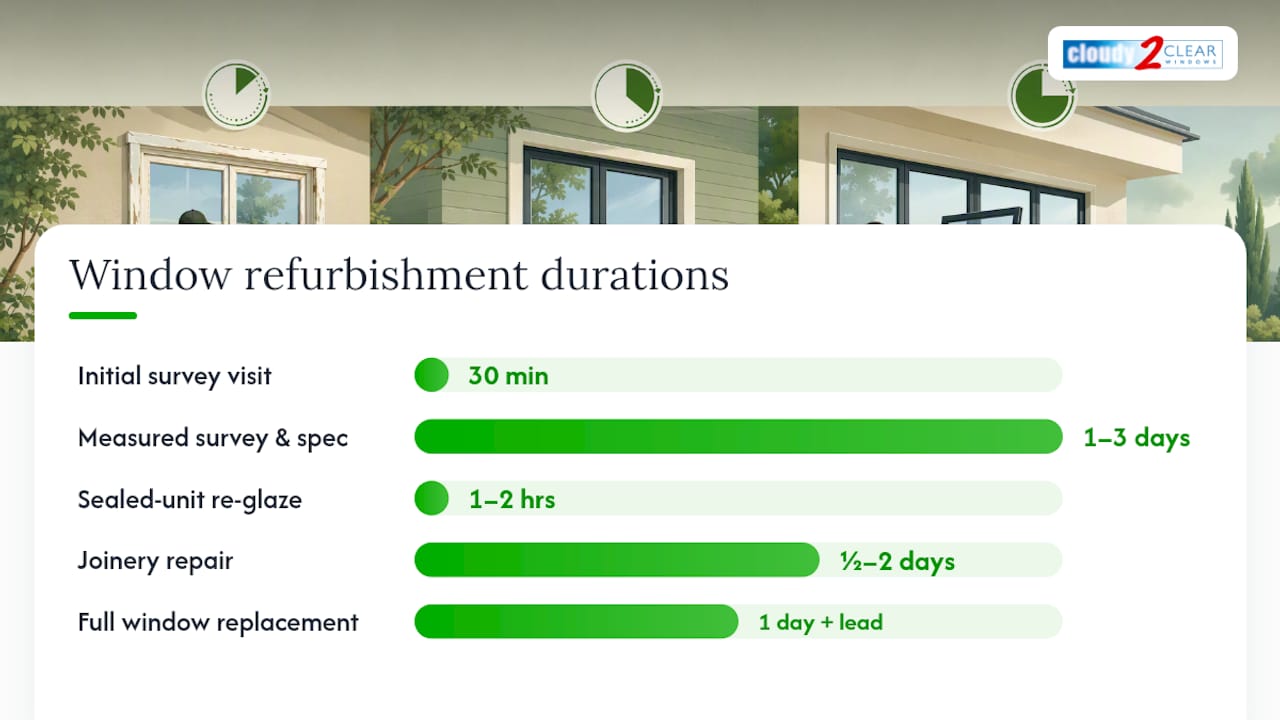
Before the surveyor arrives, have the following ready: clear access to each window inside and out, any known issues with damp or condensation, existing measurements if you have them, and details of nearby services like alarm sensors or fitted blinds that might affect the work. A well-prepared site visit shortens the whole window refurbishment process considerably.
Which refurbishment methods work best for your windows?
Several distinct techniques sit under the refurbishment umbrella, and most projects combine two or three rather than relying on one alone.
Draught-proofing seals gaps around the sash without touching the glass, and Historic England lists it as the most cost-effective first measure for older properties. Secondary glazing adds a second pane, usually on the room side, which improves both thermal and acoustic performance without altering the original window’s appearance. It is a favourite for listed buildings because it is fully reversible.
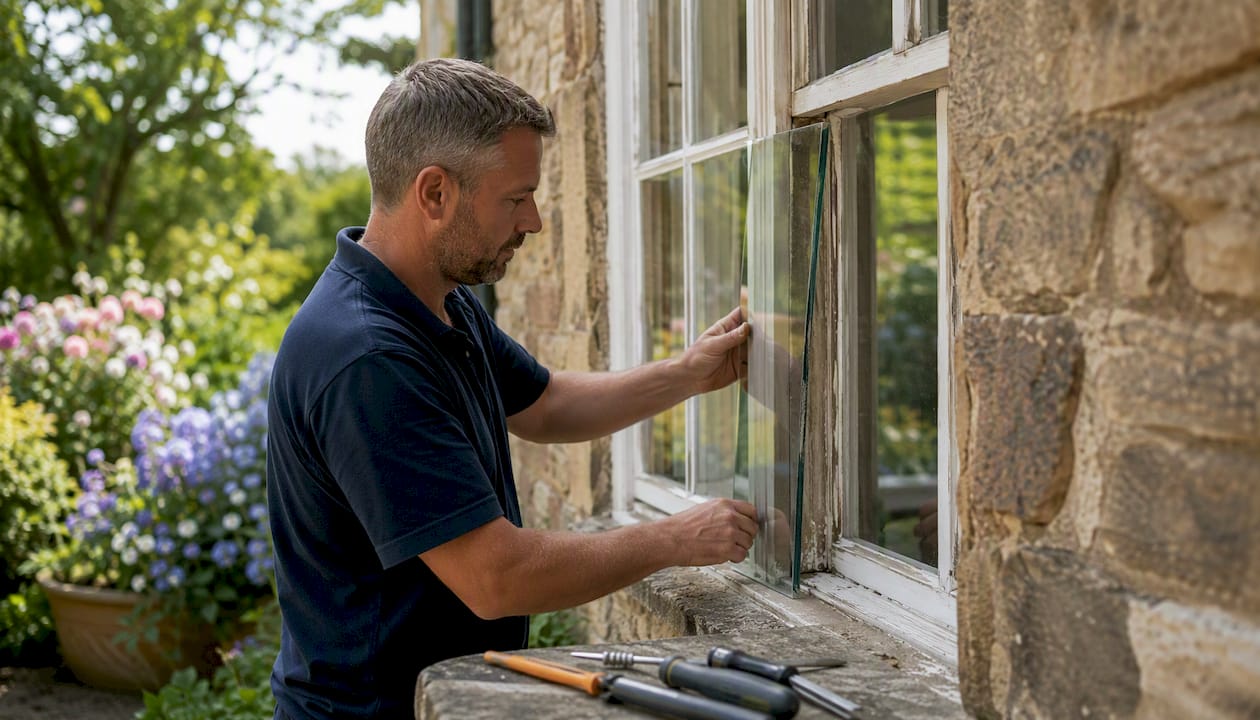
Sealed-unit replacement swaps a failed double-glazed unit for a new one within the existing frame, restoring clarity and thermal performance without disturbing the joinery at all. Slim-profile double glazing and vacuum glazing are newer options that fit into narrower historic sightlines than standard double glazing, though they carry a higher unit cost and are still less widely available than conventional units. Joinery and metalwork repairs, splicing in new timber sections or repairing steel casements, extend the life of a frame that would otherwise need replacing entirely.
A well-timed combination gets the best value: draught-proofing while a sash is already out for repair, or a sealed-unit re-glaze paired with a hardware overhaul during the same visit. Refurbishing a double-glazed unit rather than replacing the whole window can cost roughly half as much while restoring most of the thermal benefit, which is why glass-only work is usually the first thing worth pricing up.
Do you need permission before refurbishing a window?
Not every job needs a permission slip, but some do, and getting this wrong is expensive to unwind.
- Full window replacement in a conservation area or on a listed building typically needs consent before work starts.
- Inserting double or triple glazing into original historic frames on a listed building almost always requires listed building consent, even if the frame itself stays untouched.
- Any structural alteration to the opening, widening it, changing its shape, or removing a mullion, needs planning permission regardless of listing status.
- Repair and like-for-like maintenance, including draught-proofing and secondary glazing, generally does not need consent because nothing visible changes from the outside.
Before committing to any work beyond straightforward repair, ring your local planning authority and ask specifically about your property. If you are in a conservation area, contact the council’s conservation officer directly, and check whether an Article 4 direction removes your permitted development rights for window changes. These directions are common in conservation areas and easy to miss.
Proceeding without consent when it was required can mean enforcement action and a costly requirement to reverse the work. Staging your paperwork, applying for consent before ordering materials, and keeping written confirmation from the planning authority, removes almost all of that risk.
What does window refurbishment cost and how long does it take?
Costs vary by job type far more than most homeowners expect, and the gap between repair and replacement is often the single biggest factor in the decision.
| Job type | Typical cost range | Typical time |
|---|---|---|
| Draught-proofing (per window) | Low cost | Half a day for a full house |
| Sealed-unit re-glaze (per window) | A fraction of full replacement cost | 1 to 2 hours per window |
| Secondary glazing (per window) | Mid-range, varies with size and glass spec | 1 day for installation |
| Joinery repair (per window) | Moderate, scales with extent of decay | Half a day to 2 days |
| Full window replacement (per window) | Highest of all options | 1 day fitting, plus manufacturing lead time |
Axiom Eco Homes notes that sealed-unit replacement and targeted repairs typically fall in a much lower price band than full replacement, which is precisely why a glass-only assessment is worth getting before you assume the whole window needs to go.
Phasing matters as much as pricing. If a sash has to come out for a sealed-unit swap, that is the moment to fit draught-proofing at the same time, since the labour to remove and refit the sash is already being paid for. Bundling jobs this way usually cuts total disruption to a single visit rather than several separate call-outs spread across weeks.
How do you choose a reliable window refurbishment contractor?
A strong contractor answers these questions without hesitation, and a weak one dodges them.
- Ask whether the firm carries public liability insurance and can show proof on request.
- Ask which trade registers they belong to, such as FENSA, CERTASS, or TrustMark, and check the register yourself rather than taking their word for it.
- Ask for a written guarantee on both the glass and the installation labour, with clear terms on what it covers.
- Ask to see examples of previous like-for-like repair work, particularly on period properties if yours is one.
- Ask how they handle access, mess, and old materials on the day, so there are no surprises.
Prioritise firms who can show a public register listing, offer a written guarantee before you sign anything, and have demonstrable experience with heritage-sensitive repair rather than only new-build replacement. Correct setting-block and packer placement during re-glazing, transferring the glass weight properly into the frame corners, is a detail worth asking about directly, since poor packing is a common cause of sash drop and recurring lock problems after a supposedly finished job.
Treat these as red flags: a hard sell pushing full replacement before a proper survey, reluctance to show past work, no written guarantee offered upfront, and vague or absent answers about trade registration.
Which window repairs can you do yourself?
Some jobs are genuinely safe for a competent DIYer. Others need a professional every time.
Cleaning frames, oiling hinges, replacing worn draught-strips, and swapping a tired handle for a new one are all reasonable weekend jobs. Sash-cord replacement is borderline: doable with patience and the right tools, but fiddly enough that many homeowners hand it to a joiner after one attempt. A related caution applies to interior doors and frames too, where DIY replacement carries its own common pitfalls worth knowing before you start.
Sealed-unit replacement and structural joinery repair are professional-only tasks. Handling large panes of glass safely requires proper suction lifting equipment and two trained people, and getting the packing wrong inside the frame causes exactly the sash-drop and lock-alignment problems described above. If your property was built before 1960, old paintwork may contain lead, and anything that disturbs it, sanding, scraping, or heat stripping, needs careful handling rather than a quick DIY fix. Stop and call a professional the moment you find flaking paint on pre-1960 joinery, or any material that might be asbestos-containing, such as older putty compounds.
Pro Tip: If you are ever unsure whether a task is “DIY-safe”, ask yourself whether a mistake would need a professional to fix anyway. If the answer is yes, book the professional first and save the repeat call-out fee.
How do you look after refurbished windows long term?
A refurbished window rewards a small amount of annual attention with a much longer working life.
- Inspect seals, hardware, and paintwork every spring and autumn for early signs of wear.
- Lubricate hinges, locks, and sash mechanisms once a year to keep operation smooth.
- Repaint timber frames roughly every five to seven years, sooner in exposed, south or west-facing positions.
- Check sealed units for early misting so a small repair does not turn into a full frame problem.
- Keep drainage channels and weep holes clear so water does not sit against the frame.
Expect a re-glazed sealed unit to perform well for 15 to 20 years under normal conditions, similar to a new unit, since the glass itself is new even though the frame is original. Secondary glazing units typically last as long as the property is maintained, with occasional seal replacement. Full replacement windows commonly carry manufacturer guarantees of 10 years or more, though actual service life often runs longer with reasonable care.
Keep photographs, invoices, and any written guarantees from every piece of work in one folder. This record supports warranty claims if something fails early, and it is genuinely useful evidence for buyers if you sell the property later.
What do tradespeople actually check when they survey a window?
Survey visits tend to reveal the same handful of issues again and again: a sealed unit that misted months before anyone noticed, a sash that has been painted shut one too many times, or hardware that was never adjusted correctly when it was last fitted. The gap between what a homeowner assumes is wrong and what is actually wrong is often bigger than expected.
Cloudy2Clear Windows works within a clear scope: glass-only repairs and replacements for misted or cracked panes, sealed-unit swaps, and hardware fixes for handles, hinges, and locks, across domestic, commercial, and conservatory glazing. Where a survey uncovers structural timber decay or metalwork that needs specialist splicing, that work sits with a joiner or metalworker, and a straightforward glass-only job stays exactly that.
If you are unsure which category your window falls into, a written survey settles the question quickly rather than guessing from the outside.
How Cloudy2Clear Windows can help with your refurbishment
If the checks above point to failed sealed units, tired hardware, or misted panes rather than a structurally compromised frame, you are looking at a job that is usually quicker and considerably cheaper to fix than a full window replacement. Cloudy2Clear Windows handles exactly that kind of work: misted and cracked pane replacement, door glass and hardware repairs, and conservatory, commercial, and housing association glazing.

Booking starts with a survey visit to confirm what your window actually needs, followed by a written quote and a guarantee on the completed work, so you know exactly what you are paying for before anything is scheduled. Enquiries are handled Monday to Friday, 8:30am to 6:30pm. If you are in the Milton Keynes area, you can check availability and book a survey for glass repairs directly, or get in touch for a quote wherever your property is based.
Sources
- Modifying historic windows as part of retrofitting energy-saving measures | Historic England
- When to repair or replace your windows | Glass and Glazing Federation (GGF)
- Retrofitting Historic Sash and Case Windows: A Quick Start Guide for Homeowners | SCCAN
- When to replace vs repair windows: A triage matrix | WindowCost
FAQ
Is window refurbishment cheaper than full replacement?
Yes, in most cases. Sealed-unit refurbishment can cost roughly half of full window replacement while restoring most of the thermal performance.
Do I need planning permission to refurbish my windows?
Straightforward repair, draught-proofing, and secondary glazing usually need no permission, but full replacement on listed or conservation-area properties typically does. Always confirm with your local planning authority first.
How long does a typical window refurbishment take?
A sealed-unit re-glaze usually takes 1 to 2 hours per window on site, while joinery repairs can take half a day to two days depending on the extent of decay.
Can I replace a misted sealed unit myself?
No. Sealed-unit replacement needs proper glass-handling equipment and correct packer placement, and it is a professional-only task.
How do I know if my window needs replacing rather than repairing?
If the frame is structurally sound, repair or refurbishment usually works. If the timber or metal frame is rotten, warped, or structurally compromised, replacement becomes the safer route.