If you rent from a housing association, your landlord is normally responsible for fixing windows, frames and hardware. For urgent hazards, Awaab’s Law sets strict timeframes your landlord must follow. Report the fault in writing straight away and keep a copy for your own records.
What your housing association must fix
Under Section 11 of the Landlord and Tenant Act 1985, social landlords must maintain the structure and exterior of your home. This duty covers window frames, glazing, sills and external door hardware, and it applies whatever your tenancy agreement says. According to the Housing Ombudsman’s repairs guidance, landlords remain responsible for these elements even where a tenancy document tries to narrow that duty.
Your tenancy agreement may list specific repair responsibilities, but it cannot override your statutory rights. Always check your agreement first, since it may describe how to report issues or which contractor your landlord uses, but treat the legal minimum as your baseline.
Typical responsibilities split like this:
- Landlord: window frames, glass units, external hinges, locks fitted as part of the original installation and structural seals.
- Tenant: everyday care such as cleaning tracks, reporting damage promptly and not causing damage through misuse.
- Shared grey area: internal condensation caused by poor ventilation, which often needs a joint conversation about lifestyle factors and building fabric.
A landlord’s duty to maintain the structure and exterior of a property includes windows and doors, according to Housing Ombudsman guidance, which means a broken pane or failed frame is very rarely something you are expected to fix yourself.
How to report a window repair correctly
A clear, written report gives you a paper trail and makes it harder for a repair to be forgotten or delayed. Follow these steps every time you report a fault:
- Contact your landlord in writing, using email or your tenant portal rather than a phone call alone, so there is a timestamped record.
- Describe the fault precisely: which window, which room, whether glass is cracked, whether the frame is loose, and whether draughts or water are getting in.
- State the safety risk clearly, for example a shattered pane near a child’s bedroom or a window that will not close in cold weather.
- Mark the report as an emergency hazard where it genuinely is one, and reference Awaab’s Law by name so your housing association’s repairs team logs it correctly.
- Note the date, time and any reference number given by the landlord, and follow up in writing if you hear nothing within a few days.
Keep photographs of the damage, save every email, and record the date each communication was sent. This becomes essential if the repair drags on and you need to escalate later.
Pro Tip: Send your report by email even if you first phone it in, so the written record starts on day one.
Official timescales for window hazards
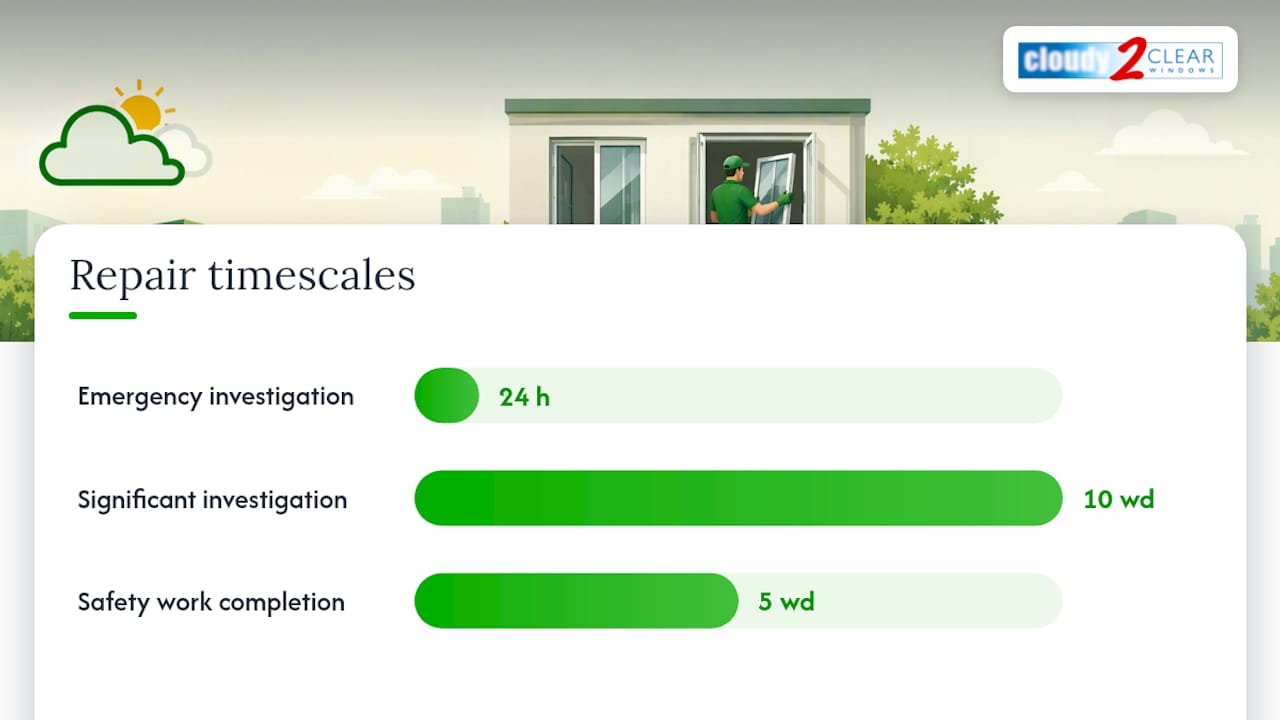
Awaab’s Law sets out fixed deadlines that social landlords must meet once a hazard is reported.
- Emergency hazards must be investigated within 24 hours of being reported.
- Significant hazards must have an investigation concluded within 10 working days.
- Required safety work must be completed within 5 working days of that investigation concluding.
Emergency hazards must be investigated within 24 hours, according to Awaab’s Law guidance, which includes a real example of a broken downstairs window being treated as an emergency with a contractor arranged the same day.
These deadlines are counted in working days, so a report made on a Friday afternoon may not restart the clock until Monday. Some landlords quote their own response windows in repairs policies, which can be faster than the legal minimum but never slower. A temporary “make safe” measure, such as boarding a broken pane, is not the same as the full repair, and your landlord should tell you clearly which stage you are at.
If the landlord delays: how to escalate
If the timescales above pass without action, you have a formal route to push things forward.
- Raise a formal complaint rather than a repeat service request, since this triggers your landlord’s complaints procedure and, eventually, a Stage 2 final response.
- Wait for the Stage 2 response or the landlord’s stated timescale before referring the matter onward.
- Refer to the Housing Ombudsman if the repair remains unresolved after the complaints procedure is exhausted.
The Housing Ombudsman’s windows guidance advises landlords to carry out an individual risk assessment for every window complaint and to explain clearly what action they are taking and when. Casework often finds that poor communication and unreasonable deferral, particularly where repairs are pushed back to await planned cyclical works, cause real detriment to tenants.
Before referring a case, gather:
- Copies of every report, complaint and response, with dates.
- Photographs showing the fault and any deterioration over time.
- The Stage 2 final response letter or written confirmation the complaint was not resolved.
For genuine emergencies, such as a window that will not close in freezing weather or one that poses an immediate safety risk, contact your local authority’s environmental health team or, where there is a risk to life, the emergency services. If a landlord repeatedly ignores its duties, it is worth getting independent legal advice on your options.
Your responsibilities while you wait
While a repair is pending, you are expected to take sensible, safe precautions, but nothing that puts you at risk or amounts to structural work.
- Keep the affected room secure by closing curtains or blinds if glass is missing.
- Use tape and a sturdy board to cover a broken pane temporarily, if it is safe to do so.
- Avoid attempting to remove or replace glass, refit a frame, or force a jammed window shut.
- Call 999 if there is an immediate danger, such as broken glass in a shared area or a fire risk, and call the police if the damage resulted from a break-in.
Routine upkeep, like keeping tracks clean and reporting faults promptly, is reasonably yours. Anything involving glass, frames or structural hardware belongs to your landlord.
How Cloudy2Clear Windows approaches social housing repairs
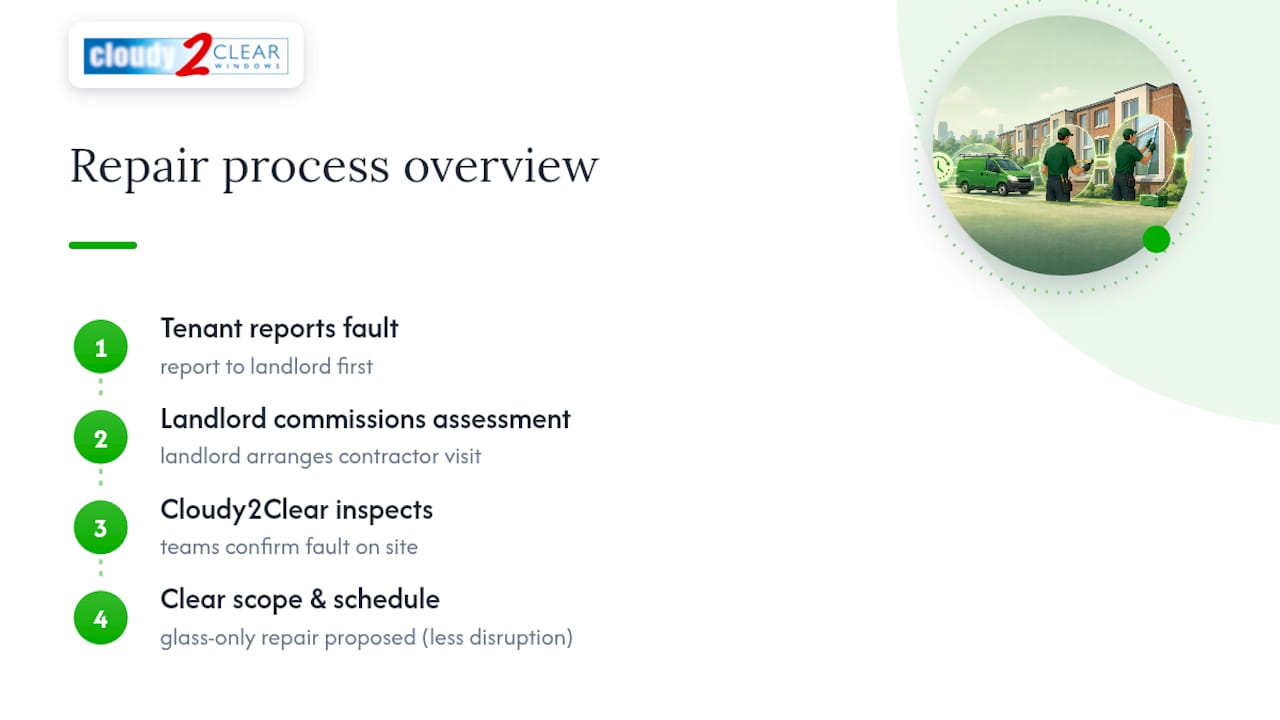
Cloudy2Clear Windows works with housing association properties on glass-only repairs, covering cracked panes, failed seals and misted units without replacing the whole frame. This keeps costs down and disruption to a minimum compared with a full unit replacement, and it is usually quicker to schedule. Where a landlord commissions an assessment, our broken window repairs and lock, hinge and handle repairs teams can attend, confirm the fault and give a clear scope before work begins. Tenants should still report faults to their landlord first, since commissioning a contractor is the landlord’s responsibility.
A practical view on getting windows fixed
Tenants who keep clear written records and quote the right timescales tend to get faster action than those who rely on phone calls alone. Insist on dates, reference numbers and written confirmation at every stage, and do not be afraid to escalate when a landlord goes quiet.
Cloudy2Clear Windows: how we can help
When a housing association is slow to act or you simply want a professional opinion on the fault, a straightforward, glass-only route exists to get your windows fixed properly. They replace only the glass, not the whole frame, which keeps costs lower and gets the job done faster than a full replacement.
Relevant services include:
- Broken window repairs for cracked or shattered panes.
- Locks, handles and hinges repairs for security faults on windows and doors.
- Conservatory window repair for damaged conservatory glazing.
- Inspection and compliance services, useful when a housing association manager needs an independent assessment.
If your landlord will not act, or you want a quote before raising the issue, get in touch through our contact page. Our team is available Monday to Friday, 8:30am to 6:30pm.
Sources
- Awaab’s Law: guidance for social landlords — timeframes for repairs in the social rented sector
- Getting repairs done if you rent from a council or housing association — Citizens Advice
FAQ
How often should a housing association replace windows?
There is no fixed replacement schedule in law. Housing associations must keep windows in safe, functional repair under their Section 11 duty, and replacement usually happens when repair is no longer practical rather than on a set cycle.
How long does my landlord have to fix my windows?
Under Awaab’s Law, emergency hazards must be investigated within 24 hours, and significant hazards must have their investigation concluded within 10 working days, with safety work completed within 5 working days of that. Your landlord’s own repairs policy may set faster timescales for non-urgent faults.
Will the council fix my broken window?
If you rent from a council or housing association, the landlord, not the council in a general sense, is responsible for fixing structural and exterior faults including windows. Citizens Advice explains how to report the fault and what to do if it is not actioned.
Am I responsible for seals on windows in a housing association flat?
Structural seals and glazing units are generally the landlord’s responsibility, since they form part of the exterior and structure of the property. You are expected to report failed seals promptly rather than attempt to fix them yourself.
What counts as an emergency window hazard?
A window is usually treated as an emergency hazard if it cannot be secured, lets in water or poses an immediate safety risk, such as broken glass in a frequently used room. Awaab’s Law guidance gives an example of a broken downstairs window handled as an emergency with same-day contractor attendance.