Regulation 14 applies to almost every UK workplace with glazed doors, windows, or partitions, and it creates an immediate duty wherever that glazing presents a foreseeable risk to people. Glass in those “critical locations” must be made of safety material, protected against breakage, or marked so people notice it. The practical starting point is a documented glazing risk assessment, followed by temporary safeguards where risk is high and a scheduled programme of permanent remediation.
What does workplace Regulation 14 glass actually require?
Regulation 14 of the Workplace (Health, Safety and Welfare) Regulations 1992 sets out two connected duties for every transparent or translucent surface in a window, door, gate, or partition. The regulation came into force on 1 January 1993, with full implementation required by 1 January 1996, and it still underpins how enforcement officers judge glazing safety today.
The two duties are straightforward to state, harder to apply consistently across a real building:
- Where glazing presents a foreseeable risk of injury, it must be made of a safety material, or be adequately protected against breakage.
- Where breakage risk exists, but full replacement is not the answer, the glazing must be marked so people can see it is there and avoid walking into it.
The phrase doing the legal heavy lifting is “where necessary for reasons of health or safety”. HSE’s guidance for managers frames this as a judgement call resting on a documented assessment, not a blanket rule that every pane in the building needs upgrading. You are expected to show you considered the risk and took reasonably practicable steps, and that evidence trail matters far more in an inspection or a claim than most facilities teams assume.
For the full statutory wording alongside HSE’s own commentary, the Approved Code of Practice L24 is the reference document most enforcement officers work from, and it is worth keeping a copy in your safety file rather than relying on secondhand summaries.
How do you identify critical locations and run a glazing risk assessment?
A critical location is any glazed area where someone could plausibly walk, fall, or be pushed into the glass during normal use of the building. That typically includes glazed doors and door side panels, glazing next to doors within roughly 300mm, low-level glazing below 800mm from floor level in walkways, and glass partitions in corridors or stairwells where people move at pace. HSE’s INDG244 guidance gives worked examples of exactly these zones.
One rule catches out more facilities managers than any other: the partial-unit rule. If any part of a glazing unit falls within a critical zone, industry guidance treats the whole unit as needing to meet the safety standard, not just the section at risk height. A tall internal screen that dips into the 800mm zone at its base cannot be “half compliant”.
A workable assessment follows five steps:
- Walk the site and log every glazed opening, noting location, size, and current glass type.
- Record who uses the area and how — staff only, visitors, children in a school setting, wheelchair users, or high foot traffic.
- Check incident history for the location, including any near-misses reported informally.
- Rate the outcome against the critical-location criteria: does it fall wholly or partly within a shaded zone?
- Decide the action — leave as is, mark, film, or replace — and date the decision.
Document location, glass type found, assessed risk, chosen action, and the name of whoever signed it off. Keep photographs alongside the written record.
Pro Tip: Photograph every critical location before and after remedial work. A dated photo alongside your written assessment is often the single most persuasive piece of evidence if an incident is ever investigated.
Which British Standards and glass types satisfy Regulation 14?
Two British Standards do most of the practical work behind Regulation 14 compliance. BS 6262-4 is the code of practice for glazing safety related to human impact, and it is the document most risk assessments reference when deciding what “safety material” means in practice. BS 6206 covers impact performance requirements for safety glass more specifically, setting out the test classifications manufacturers use.
The choice in critical locations usually comes down to two materials:
- Toughened glass breaks into small, relatively blunt fragments rather than sharp shards, and suits doors, low-level windows, and areas where impact is likely but glass needs replacing quickly if it fails.
- Laminated glass holds together on impact because of its interlayer, which makes it the stronger option for overhead glazing, balustrades, or anywhere a falling shard would be dangerous even after breakage.
Marking glass with manifestation strips or decals satisfies the second Regulation 14 duty, but it is not a substitute for safety material in genuinely high-risk locations. A marked pane of ordinary annealed glass in a busy doorway still shatters into dangerous shards on impact. Under the Workplace Regulations themselves, marking supplements protection against breakage; it does not replace it where the foreseeable risk is severe.
Turning your survey into an action plan: priorities, temporary fixes, and permanent solutions
Not every critical location needs attention on the same day, but every one on your list needs a decision date. Prioritise by combining severity of likely injury with footfall: a low-level glazed partition on a busy stairwell used by hundreds of staff daily ranks well above a rarely used store cupboard door with the same glass specification.
Where full replacement cannot happen immediately, temporary mitigations buy time but only if you record their limits:
- Safety film applied to existing glass adds a degree of impact resistance and can be a defensible interim measure, though it does not carry the same test classification as laminated or toughened glass manufactured to standard.
- Manifestation markings or decals address the “apparent” duty quickly and cheaply, ideal for glass that is not itself high risk but could be walked into.
- Physical barriers or signage reduce the chance of contact altogether while permanent works are scheduled.
None of these should sit on your action list indefinitely. Set a target date for permanent remediation when you log the temporary fix, and treat that date as a commitment, not an aspiration.
When specifying permanent replacement, ask installers for a manufacturer’s declaration of conformity confirming the unit meets the relevant BS test, plus an installation sign-off sheet. Both belong in your safety file next to the original risk assessment, so anyone auditing the building later can trace the decision from identified risk through to certified fix.
Pro Tip: Ask any installer for written certification before work starts, not after. It is far harder to chase paperwork once the job is finished and the van has left site.
A practical inspection checklist and maintenance schedule
Cloudy2Clear Windows has worked on enough commercial and housing association properties to know that most Regulation 14 problems are not new failures. They are old risks nobody re-checked after the building layout changed. A working checklist needs to cover the physical glass and the paperwork behind it.
For each critical location, verify and record:
- Glass type and marking — confirm toughened or laminated glass is fitted where required, and check for the etched kite mark or manufacturer stamp confirming the BS test standard.
- Physical condition — look for chips, cracks, or delamination at the edges of laminated units.
- Manifestation visibility — check decals or frosted strips remain visible and are not obscured by posters or signage.
- Certification on file — match each location against its installer certificate or declaration of conformity.
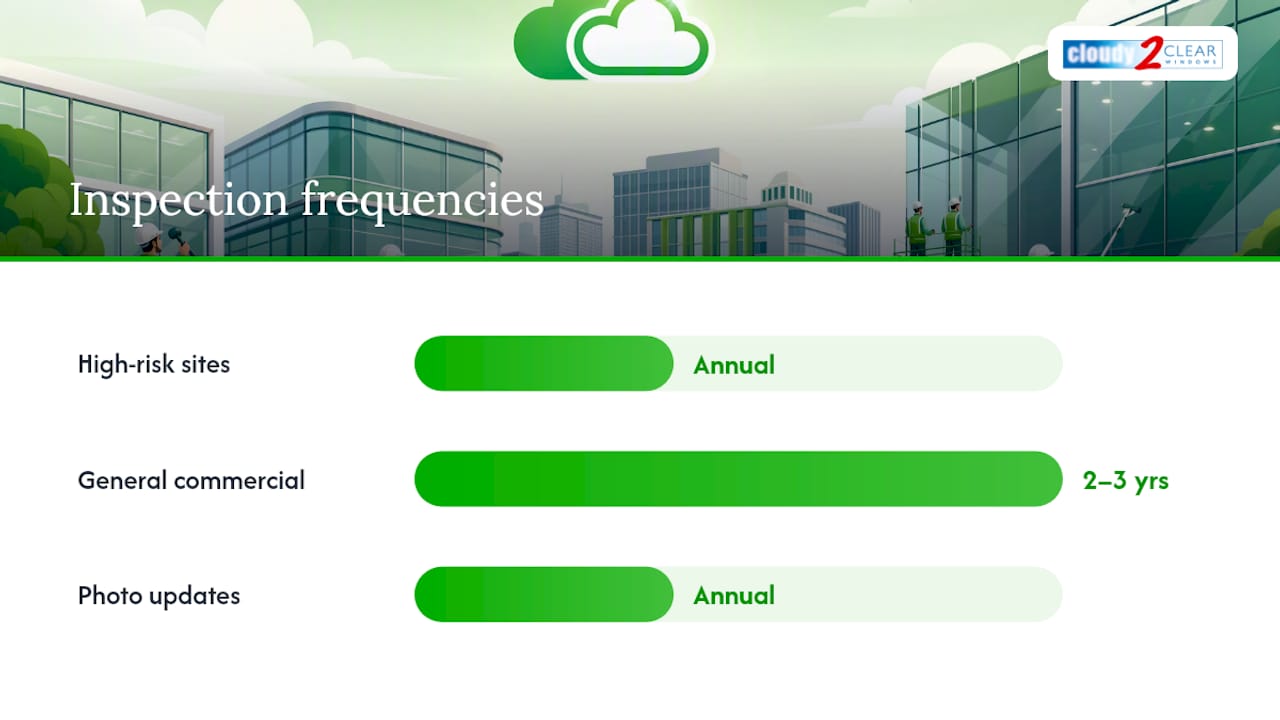
- Photographic evidence — update photos annually or after any incident.
Recommended frequency depends on building use. Schools and premises with high footfall or vulnerable users, including school glazing safety checks, warrant at least an annual review; general commercial premises can usually work to a two to three-year cycle. Any building reconfiguration, new fit-out, or reported incident should trigger an immediate reassessment regardless of the calendar, because moving a desk or partition can turn a previously safe pane into a fresh critical location overnight.
If glazing breaks, clear the area, avoid direct contact with the glass, and refer to safe glass removal guidance before attempting to clean up loose shards yourself. Call a specialist where the break involves laminated units, high-level glazing, or any doubt about structural stability.
Pro Tip: Keep a simple spreadsheet mapping each critical location to its last inspection date, certificate reference, and next review date. It turns a legal duty into a five-minute monthly check rather than an annual scramble.
Why glazing safety needs ongoing governance, not a one-off tick-box
Too many buildings treat Regulation 14 as something ticked off once, filed, and forgotten. Every reconfiguration, new partition, or change in foot traffic can quietly create a fresh critical location that nobody assessed. Bathrooms fitted out years ago, for instance, often get overlooked entirely for safety glass in bathrooms UK requirements once the original fit-out sign-off is filed away.
The fix is not more paperwork for its own sake. It is folding glazing checks into audits you already run, alongside fire-escape drills and seasonal maintenance, so a reconfigured office automatically triggers a fresh look at the glass. Retaining installer certificates and dated photographs matters more than any single spreadsheet entry, because that evidence is what actually stands up if a claim or inspection ever tests your decisions.
How Cloudy2Clear Windows supports your Regulation 14 compliance
Replacing only the glass rather than the entire frame can keep compliance work faster and less disruptive than a full window replacement when a critical location needs upgrading to toughened or laminated glass, which can help facilities teams managing occupied buildings, tight budgets, and a backlog of remedial works.
Our inspection service covers commercial and housing association properties, and a typical visit produces a risk assessment summary, a prioritised schedule of works, and completion certificates you can file directly against each critical location on your register. Where a pane needs upgrading, our commercial window repair team can specify and fit the correct safety glass without replacing the surrounding frame, and every job comes with the documentation your safety file needs. For general glass repairs and replacements across a wider estate, our double glazing replacement service covers standalone units too.
If you have a critical location flagged on your last audit, or you are not yet sure which panes in your building qualify, get in touch to book an inspection and get a written schedule of works back in your hands.
Sources
Keep these sources bookmarked alongside your own risk assessment file:
- The Workplace (Health, Safety and Welfare) Regulations 1992 — Regulation 14
- Workplace health, safety and welfare: a short guide for managers (INDG244)
- BSI: Glazing for buildings — code of practice for safety related to human impact
Save copies of your assessment reports and installer certificates alongside these references, since a complete safety file is worth far more than any single document on its own.
FAQ
What are the regulations for window glass in the UK?
Workplace glazing is governed by Regulation 14 of the Workplace (Health, Safety and Welfare) Regulations 1992, which requires safety material or protection against breakage in critical locations, plus marking where relevant. Domestic and building-wide glazing standards also draw on British Standards such as BS 6206 for impact performance.
What is the British Standard for safety glass?
BS 6206 sets the impact performance test classifications for safety glass, while BS 6262-4 provides the code of practice for glazing safety related to human impact in buildings. Installers should be able to certify which classification a fitted unit meets.
What are the main workplace regulations in the UK?
The core framework sits in the Workplace (Health, Safety and Welfare) Regulations 1992, covering ventilation, temperature, lighting, cleanliness, and glazing safety under Regulation 14. HSE’s Approved Code of Practice L24 sets out how employers are expected to meet these duties in practice.
Does Regulation 14 apply to bathroom windows and partitions?
Yes, if a glazed bathroom partition or window falls within a critical location, such as being at low level near a walkway, the same safety material and marking duties apply as anywhere else in the building. Safety glass in bathrooms UK settings is frequently overlooked because these areas are refitted less often than main circulation routes.
How much does a Regulation 14 glazing inspection cost?
Pricing depends on the size and complexity of the site, so current costs are available directly from Cloudy2Clear Windows on request. You can book an inspection to get a schedule of works and a quote specific to your property.