A thermal stress crack forms when one part of a glass pane heats up faster than another, creating tension that the edge cannot absorb. It is rarely a sign of imminent collapse, but it always needs a professional look. If you spot one, take a photograph, avoid pressing on the glass, and book a glazing inspection before the crack spreads further.
How to spot a thermal stress crack
Thermal cracks follow a distinct pattern that sets them apart from a stone chip or a slammed door. They begin at the edge of the pane, almost always the section hidden beneath the frame beading, and run perpendicular to that edge before curving or branching further into the glass. There is no visible point of impact, no starburst, and no obvious dent, which is exactly what marks it out from mechanical damage.
You will often notice the crack has appeared overnight or after a sudden change in weather, most commonly on a bright morning following a cold night. Large single panes and south or west-facing windows are the usual suspects. Before you call anyone, gather a few details:
- Photograph the full pane and a close-up of where the crack starts at the edge.
- Note the time of day and recent weather, including whether the sun had just hit the glass.
- Check whether anything close to the glass, such as a blind or a radiator, changed position recently.
- Listen for a faint crack or tick, which some homeowners hear at the moment of failure.
This information helps a glazing specialist confirm the cause quickly rather than treating your window as a mystery on arrival.
Why thermal stress cracks occur: the physics explained simply
Glass expands when it warms and contracts when it cools, and that alone is harmless. The problem starts when different parts of the same pane are forced to expand at different rates. The centre of a window, exposed directly to sunlight, heats up and tries to stretch. The edges, shaded by the frame and often several degrees cooler, resist that stretch. The mismatch creates tensile stress concentrated exactly where the glass is weakest: the edge.
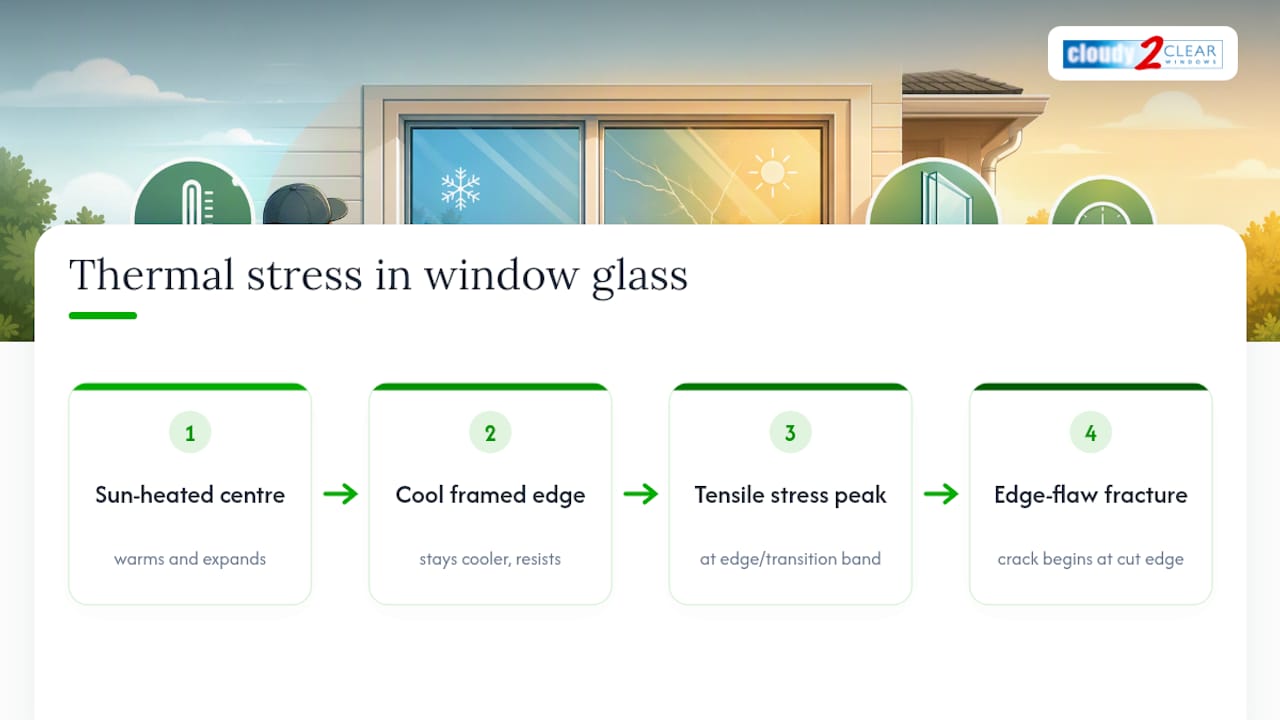
Every pane has microscopic flaws along its cut edge from manufacturing or installation, and these tiny imperfections are usually where the fracture actually begins, not the middle of the glass. Modelling of thermal shock has shown that peak stress builds in the narrow transition band between the heated and shaded portions of a pane, which is precisely why edge condition matters so much.
Spring and autumn make things worse. Low sun angles push direct heat further into a room and onto glass that was shaded in summer, while sharp day to night temperature swings widen the gap between the warmest and coldest points on the same pane. That combination is why thermal stress peaks in these transitional seasons rather than in the depths of winter or height of summer.
Which glass types and treatments raise or lower the risk
Not all glass handles a temperature gradient equally. Ordinary annealed glass, the type found in many older windows, has the lowest tolerance and is the most likely to fracture under an uneven temperature load. Heat-strengthened glass copes with a noticeably wider temperature differential before failing, and toughened glass goes further still, tolerating an even greater gradient while also breaking safely into small fragments rather than sharp shards.
A few other factors shift the risk in either direction:
- Tints and solar control coatings absorb more heat at the surface, which can raise stress unless the glass has been specified with that load in mind.
- Low-E coatings improve energy efficiency but can increase mid-pane absorption, so coated units benefit from a proper thermal assessment.
- A clean, polished edge with no chips resists stress far better than a rough or damaged cut.
- Warm-edge spacer bars, used in double glazing, reduce the temperature swing right at the vulnerable edge zone.
Choosing heat-strengthened or toughened glass for large or exposed panes removes most of this risk from the outset.
Everyday triggers around the home that create dangerous temperature swings
Most thermal fractures trace back to something ordinary sitting too close to the glass. Recognising these triggers lets you fix the problem before it fixes itself the expensive way.
- Partial shading from outside. Eaves, fences, trees, or a neighbouring building that shade part of a window while the rest sits in full sun create the exact hot and cold split that drives fracture.
- Blinds and curtains fitted too close to the glass. They trap warm air against the pane, and reflective or metallic blinds bounce heat straight back onto the surface.
- Heaters and appliances aimed at the glass. A radiator beneath a window or a cooker vent nearby can heat one section far faster than the rest.
- Reflective surfaces nearby. Mirrors, foil-backed insulation, or even a shiny worktop can direct concentrated sunlight onto a small patch of a pane.
- Thin frames and large single panes. Bigger sheets of glass have more room for temperature variation across their surface, and lightweight frames offer less buffering at the edge.
- Installation faults. A nicked or chipped edge from a poor fit is often the actual starting point once heat stress is applied.
Practical steps to reduce the risk now and safer replacement options
You can cut the risk today without spending anything. Move blinds and curtains a few extra centimetres from the glass to let air circulate, redirect radiators and heater vents away from the pane, and shift reflective objects such as mirrors or foil insulation out of direct sunlight’s path.
For anything you are replacing or specifying new, plan further ahead:
- Ask for heat-strengthened or toughened glass on large panes or south-facing windows.
- Specify polished, chip-free edges and warm-edge spacers on any double glazed unit.
- Request a thermal risk check from your installer if you are fitting extensive glazing or heavily tinted units.
- Avoid combining dark tints or reflective coatings with thin, unshaded frames unless the glass has been rated for it.
Heat soaking, a factory process that pre-stresses toughened glass to expose hidden flaws before installation, is most relevant to manufacturers and large commercial glazing rather than something a homeowner arranges directly.
Pro Tip: If a single window has cracked more than once in the same spot, check what changed nearby, a new blind, a repositioned heater, or a fence extension, before you replace the glass again. Fixing the trigger matters as much as fixing the pane.
What happens next: inspection, repair choices, and insurance
A proper inspection starts at the edge. A glazing specialist will look for where the crack originates, check whether it runs perpendicular before branching, and rule out impact damage or inclusions in the glass. This confirms whether you are dealing with a genuine thermal fracture rather than accidental breakage.
Once confirmed, glass-only replacement is almost always the sensible route rather than replacing the whole window unit.
- The frame is typically undamaged, so there is no reason to disturb it.
- Swapping just the pane is faster and causes far less disruption to the room.
- It gives you the chance to upgrade to heat-strengthened or toughened glass at the same time, cutting the odds of a repeat failure.
Before you assume cover, check the paperwork. Manufacturer warranties frequently exclude thermal fractures, since they are usually treated as a consequence of exposure rather than a manufacturing fault. Photograph the damage as soon as you see it and notify your home insurer promptly, since some policies do cover accidental glass breakage even when the manufacturer will not.
Cloudy2Clear Windows’ field checklist for thermal cracks
Cloudy2Clear Windows has spent decades assessing broken and failing glazing across homes and commercial premises, and thermal cracks follow a pattern engineers see again and again on-site. Our inspectors work through a short checklist on every callout: does the crack originate at the edge, does it run perpendicular before branching, and has anything nearby, a blind, a heater, new fencing, changed recently? Investigation reports consistently link edge flaws and shading geometry to this exact failure pattern, and our own site visits reflect the same story time and again: a slightly chipped edge sitting under a blind fitted too close to the glass.
The typical resolution is straightforward. Once thermal fracture is confirmed, we recommend glass-only replacement, restoring both safety and energy efficiency without the cost or mess of a full frame swap. Book an inspection at the first sign of a crack rather than waiting for it to spread.
Our take: stop treating thermal cracks as a mystery
Too much advice on this topic reads like a physics lecture aimed at architects specifying glass for skyscrapers, full of stress modelling and finite element analysis that means nothing to someone standing in front of a cracked lounge window. For an ordinary home, that depth is overkill. The fix rarely requires a structural engineer; it requires someone to notice the blind sitting too close to the glass, or the chip on the edge that has been there since installation.
What we think gets underweighted is how often the trigger is something the homeowner can fix themselves in an afternoon, moving a blind, repositioning a heater, before any glass gets replaced at all. Replacing the pane without addressing the shading or heat source nearby just resets the clock on the same failure. Our honest priority order: check the edge, check what is nearby, then decide on glass. Heat-strengthened or toughened glass matters most on large or exposed panes, not on every window in the house. Spend the budget where the risk actually concentrates.
Get your cracked glass assessed and replaced properly
Glass-only replacement keeps costs down and cuts the disruption of a full window replacement, with many services offering long-term guarantees. That matters most with thermal cracks, because the frame is almost never the problem; the pane is.

If you have spotted a crack that starts at the edge and runs into the pane, our double glazing replacement service covers exactly this scenario, and we can advise on heat-strengthened or toughened glass if your window sits in a high-exposure spot. Homeowners weighing up a full unit swap versus a targeted fix should also read our guide on choosing the right glass replacement service before booking anyone. Get in touch through our contact page to arrange an inspection and a quote for your specific pane.
Sources
- Glass break patterns technical note (Arnold Glas / GLASS BREAK)
- 1003 – Thermal stress breakage (AGG technical bulletin)
- Understanding the cause of thermal stress breaks in glazing systems (Patrick Ryan Associates)
FAQ
What does a thermal stress crack look like?
It starts at the edge of the pane, hidden under the frame, and runs perpendicular into the glass before sometimes branching. There is no impact point or starburst pattern, which is what separates it from a knock or a stone strike.
Can thermal stress cracks be repaired?
No, a genuine crack in glass cannot be repaired safely once it has formed; the pane needs replacing rather than patching. In most cases, glass-only replacement restores the window fully while leaving the existing frame in place.
What causes thermal stress cracks in windows?
They form when one part of a pane heats faster than another, usually because of partial shading, a nearby heat source, or a blind fitted too close to the glass. The uneven expansion puts pressure on the edge, where flaws in the cut or fit are the common starting point.
Is a thermal stress crack dangerous?
It is not usually an immediate safety hazard, but it will continue to spread and should always be inspected. Left unaddressed, the crack widens over time and can compromise the seal on a double glazed unit.
Will insurance cover a thermal stress crack?
Manufacturer warranties often exclude thermal fractures since they are treated as a result of exposure rather than a fault in the glass. Home insurance policies vary, so photograph the damage straight away and check your specific policy for accidental glass breakage cover.