The most reliable way to cut office window noise is to upgrade the glass and keep the window sealed. Acoustic or laminated glazing, a wider air gap between the panes and well-fitted seals all reduce the sound that reaches your desks. Curtains, foam and blinds do very little against traffic or trains. This guide explains what works, how to judge what level of noise is acceptable in a UK office, and how to plan an upgrade without a full window replacement.
Why windows are usually the weak point
Glass is the thinnest part of most office façades. Walls are heavy and dense, so sound travels through the window and its edges far more easily than through the brickwork around it. British Standard BS 8233:2014 notes that sound insulation is significantly reduced by weaknesses in the building envelope, such as ventilation openings, thin glazing and doorways. That is particularly true when windows are open.
In practice, office window noise tends to come from four places:
- Thin or single-glazed panes, common in older commercial buildings.
- Failed or worn seals, where gaps let sound leak straight through.
- Blown or misted sealed units, where the double glazing has lost its seal and performs below its original standard.
- Open or trickle-vent windows, which let sound in directly.
It helps to know which of these applies before you spend anything. A window that is simply worn out can often be fixed by replacing the glass unit, while a window that was never designed for noise needs a different specification.
What noise level is acceptable in a UK office?
There are two different questions here, and they have different answers.
Legal limits are about hearing damage
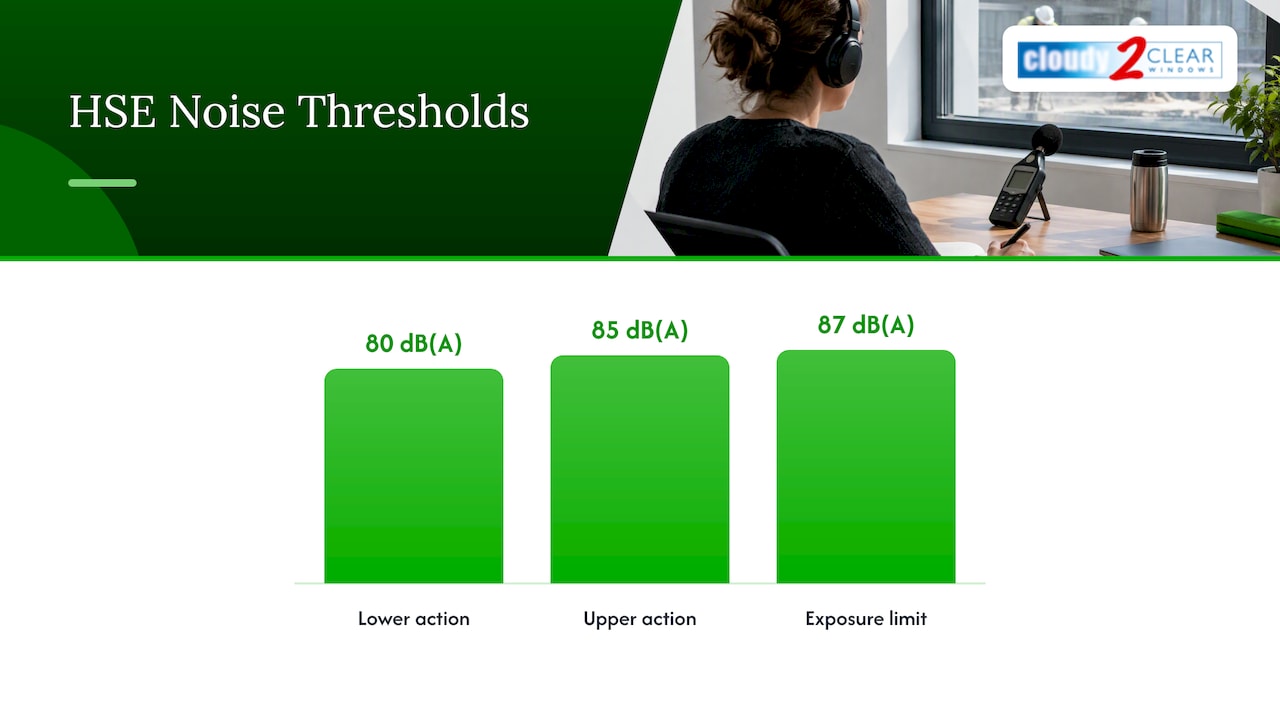
Under the Control of Noise at Work Regulations 2005, employers must assess noise risks and act to reduce exposure. The HSE sets the lower and upper action values at 80 and 85 dB(A), with an exposure limit of 87 dB(A). Those figures protect hearing. A typical office with noisy traffic outside sits far below them, so the law will rarely be what pushes you to act.
Comfort targets are much lower
For comfort and concentration, the relevant guidance is BS 8233:2014, which covers controlling noise in and around buildings and designing internal spaces that suit their purpose. According to a summary of its criteria, indoor ambient noise should sit around 35 to 40 dB LAeq for private offices and 40 to 45 dB LAeq for open-plan offices.
The standard also makes a point that surprises many managers. Where internal noise is very low, higher insulation may be needed for privacy, because moderate background sound helps mask conversations. A meeting room that is too quiet can leak confidential speech as easily as a noisy one.
So the practical question is not whether you are breaking a rule. It is whether the noise coming through your windows is pushing your rooms above the comfort range for the work done in them.
Which glazing reduces noise most?
Not all double glazing performs the same. Sound reduction depends on the complete window system: glass, frame, seals and the way it is fitted. The main factors are well established:
- Glass thickness. Heavier glass blocks more sound.
- Laminated acoustic glass. A plastic interlayer between two sheets of glass damps vibration, which is why it handles voices and traffic better than ordinary glass.
- Different pane thicknesses. Using two panes of unequal thickness stops both from vibrating at the same frequency.
- Air gap. The GGF explains that a larger gap between panes typically improves noise insulation.
Manchester City Council’s noise guidance gives a useful benchmark: standard double glazing typically provides a reduction of about 30 dB when closed. Specialist acoustic glazing and secondary systems can go well beyond that, in some cases to 50 dB or more, depending on the design and the existing structure.
A quick comparison of options
| Option | How it helps | Best suited to | Main limit |
|---|---|---|---|
| Replacement sealed units with thicker or laminated glass | Raises the performance of the existing frame | Offices with sound frames but failed or thin glass | Frame and seals must be in good condition |
| Acoustic laminated glass units | Damps vibration across speech and traffic frequencies | Roads, rail lines, busy town centres | Needs the window kept closed |
| Secondary glazing | Adds a second pane with a wide, separate air gap | Older buildings, listed frames, heavy noise | Takes up some sill space |
| Replacing worn seals | Closes gaps that leak sound | Windows that rattle or whistle | Does not help thin glass |
| Curtains, blinds, foam | Soften echo inside the room | Rooms with hard, reflective surfaces | Little effect on outside noise |
The right choice depends on the noise you are fighting. Low-frequency rumble from lorries and trains needs more mass and a wider cavity. Higher-pitched noise such as voices and sirens responds well to laminated glass.
For a deeper look at how glass choice changes results, read our guide to acoustic glazing and what it can achieve, and our article on reducing traffic noise through windows.
Windows closed or open: the ventilation question
This is the part most offices overlook. Acoustic glass only works when the window is shut. Manchester City Council points out that opening a window even partially can cut acoustic performance by 10 to 15 dB, which makes expensive acoustic glazing ineffective.
The same guidance says that if closed windows are relied upon to meet noise targets, you need an alternative ventilation route that does not weaken the façade. For an office, that usually means one of the following:
- Mechanical ventilation or air conditioning already in the building.
- Acoustic trickle vents or attenuated wall vents designed for the purpose.
- A mixed approach, with sealed acoustic glazing on the noisy side and openable windows on a quieter elevation.
BS 8233 describes a pragmatic way to think about this, according to AcousPlan’s explanation: design for the desirable criteria with windows closed, accept a reasonable upper limit with windows partly open, or provide alternative ventilation so nobody needs to open them.
Talk to your building manager or landlord before you change anything that affects ventilation. Fresh air provision in workplaces is a separate requirement from noise control, and the two need to be planned together.
Secondary glazing, seals and soft furnishings
You do not always need to replace the whole window. Secondary glazing and improved seals act as additional barriers. The Furniture Information Service’s office acoustics guide and the GGF both describe how a separate pane with its own wide air cavity can significantly outperform standard double glazing. That makes it a good fit where a frame cannot be changed, for example in a period or listed building.
There are two things to keep in mind.
- The window is only one path. Better glass will not reduce noise transmitted through walls, floors or ceilings. The GGF says plainly that upgrading glazing may not be a single solution. If you can hear a neighbouring tenant through the partition, glass is not your problem.
- Soft furnishings are not a substitute. Curtains and blinds reduce echo and reflections inside a room, which makes it feel calmer, but they provide limited blocking of external noise. Use them as a finishing touch, not as the fix.
BS 8233 also reminds designers that cutting noise at its source should always be considered, because it can benefit many people. If a loading bay, a plant room or a delivery route is the cause, a conversation with the neighbour or the landlord may help alongside any glazing work.
Our perspective on office window noise
At Cloudy2Clear Windows we see the same pattern in offices again and again. A business assumes it needs new frames, a long project and a lot of disruption, when the real problem is the glass. Failed sealed units, thin panes and tired seals are far more common than frames that are beyond saving.
That is why we replace the glass only, not the whole window. Keeping a sound frame means less disruption to your staff, a faster job and less waste. Where noise is the concern, we can fit upgraded glass units designed for sound reduction in the same frame, and our insulating glass options also help with energy efficiency.
We back our glass work with a 25-year guarantee, and we have been repairing and installing double glazing for homes and businesses since 2005. Our advice is simple: find out what is actually letting the noise in, then fix that, rather than replacing everything on the assumption that more is better.
Cloudy2Clear
A practical plan for a quieter office
Follow these steps in order. Each one stops you paying for work you do not need.
- Listen at different times. Note when the noise is worst: rush hour, lunchtime, overnight deliveries. The pattern tells you whether you are dealing with traffic, trains or something local.
- Check the windows themselves. Look for misting between panes, which shows a failed sealed unit, plus worn gaskets, damaged frames and gaps you can feel air through.
- Identify other noise routes. Check vents, doors, letterboxes and partitions. Sound will find the weakest point.
- Decide how the room is ventilated. If staff need to open windows to stay comfortable, acoustic glass alone will disappoint. Plan the ventilation first.
- Choose the specification. For a sound frame with failed or thin glass, replacement units with laminated or thicker glass are often the neatest answer. For heavy noise or a frame you cannot alter, add secondary glazing.
- Get a survey. A professional can assess your frames, seals and glass and tell you what each change should realistically deliver.
- Confirm the details in writing. Check the glass specification, the guarantee and any access arrangements, especially if you rent. Leased premises usually need the landlord’s consent for changes to the façade.
If you manage several buildings, such as a housing association or a commercial portfolio, a condition survey across all of them can show where noise, draughts and failed units overlap, so you can plan the work in sensible phases. Our commercial fenestration inspection service is built for that kind of review.
Different premises, different priorities
A few common situations show how the same principles apply.
Ground-floor offices on a busy road
Traffic noise dominates and reaches the glass directly. Laminated acoustic units, good seals and a closed-window ventilation plan make the biggest difference. Our guide to reducing traffic noise through windows covers this in more detail.
Open-plan offices
BS 8233 allows a slightly higher ambient level for open-plan space than for private offices, but the noise inside the room often matters more than the noise outside. Window upgrades deal with the outside. Ceiling panels, desk screens and zoning deal with the inside. Treat them as two jobs.
Shops and customer-facing premises
Large shopfront panes can let in a lot of street noise. It is often possible to improve them without a full refit, as explained in our piece on shopfront acoustic glass upgrades.
Older buildings
Original frames can be part of a building’s character. Where changing them is not an option, a secondary system behind the existing window is a common route, and sealed units can often be upgraded within the existing frames where these are in good condition.
How Cloudy2Clear Windows can help
If your office windows are letting in noise, we can look at the glass, seals and frames and recommend a glass-only upgrade where it makes sense. We work with homeowners, business owners and housing associations across the UK, and our range includes double glazing for sound proofing, commercial window repair and full replacements where a frame has reached the end of its life.
To discuss your premises, see our commercial window repair page or get in touch through our website. Our hours are Monday to Friday, 8:30am to 6:30pm.
Frequently asked questions
How do I reduce noise coming through an office window?
Start by making sure the window is sealed properly and the glass unit has not failed. Then consider thicker or laminated acoustic glass, a wider air gap or secondary glazing. Keep the windows closed, and provide alternative ventilation so staff are not tempted to open them.
What is the acceptable noise level in a UK office?
The law sets action values for hearing protection at 80 and 85 dB(A), which an ordinary office will not approach. For comfort, BS 8233:2014 criteria suggest around 35 to 40 dB LAeq in private offices and 40 to 45 dB LAeq in open-plan offices.
What type of window is most soundproof?
The best performers combine laminated acoustic glass, panes of different thicknesses and a large air gap, or add a secondary pane with its own cavity. Standard double glazing gives roughly 30 dB when closed, and specialist systems can go much higher depending on design.
Will curtains or blinds stop window noise?
They help with echo inside the room but do little to block outside noise. For traffic or train noise, the glass and seals do the real work.
Do I need to replace the whole window?
Not always. If the frame is sound, replacing only the glass unit with an upgraded specification can improve sound performance with less disruption. A survey will confirm whether your frames are suitable.
Sources
- Manchester City Council, assessment and prediction of noise (planning guidance)
- BS 8233:2014, guidance on sound insulation and noise reduction for buildings
- AcousPlan, BS 8233:2014 explained
- GGF, sound proof windows and window acoustics
- FIS, a guide to office acoustics
- HSE, employers’ responsibilities and legal duties on noise