Knowing how to identify window issues early is the single most effective way to protect your property from heat loss, water ingress, and costly structural damage. Window faults fall into four main categories: condensation and seal failure, operational problems, physical frame and glass damage, and cracks near the window opening. Each category has distinct, recognisable symptoms. Cloudy2Clear Windows has been diagnosing and repairing double-glazed windows across the UK since 2005, and the patterns we see repeatedly confirm one truth: most expensive repairs begin as small, overlooked signs.
How to identify window issues: condensation and seal failure
Condensation between the panes of a double-glazed window is the clearest sign of sealed unit failure. This is not surface moisture you can wipe away. It sits permanently inside the sealed insulated glass unit, appearing as a persistent fog, haze, or droplets between the two panes of glass.
The diagnostic test is straightforward. Run a dry cloth across both the inside and outside surfaces of the glass. If the misting remains after wiping, the seal has failed and moisture is trapped within the unit itself. This is a product failure, not a ventilation problem. Opening windows or using a dehumidifier will not resolve it.
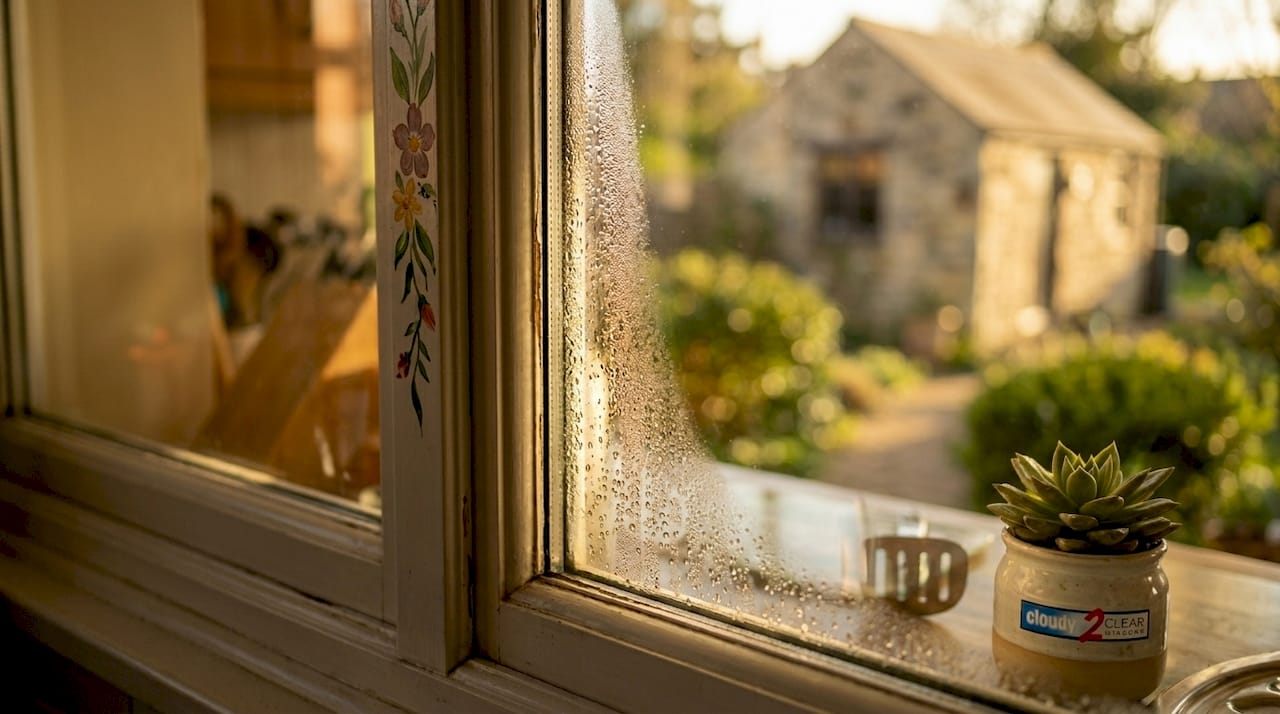
Condensation between panes cannot be fixed by any surface treatment or repair to the existing unit. The sealed glass unit must be replaced entirely to restore insulation and stop moisture ingress. The Glass and Glazing Federation (GGF) and manufacturers such as Dekko confirm this position. Replacing just the sealed unit within an intact frame costs between £150 and £350 per window, which is considerably less than a full window replacement.
Pro Tip: Check your windows on a cold morning when the temperature difference between inside and outside is greatest. Seal failures that are hard to spot in mild weather become obvious when condensation is at its peak.
Signs of seal failure to look for include:
- Persistent fogging or haze between the panes that does not clear
- Water droplets or streaks visible inside the sealed unit
- A white or grey mineral residue left on the inner glass surfaces after moisture evaporates
- Noticeably colder glass compared to other windows in the same room
- A visible gap or distortion in the spacer bar running around the edge of the unit
For more detail on diagnosing misty windows, Cloudy2Clear Windows has a dedicated guide covering the full range of causes and remedies.
Are your windows sticking, jamming, or hard to open?
Windows that stick or jam are among the most common window issues reported by homeowners, yet they are frequently misdiagnosed as a dirt problem when the real cause is mechanical or structural. Misalignment, frame swelling due to humidity, and damaged or corroded hardware are the three primary causes.
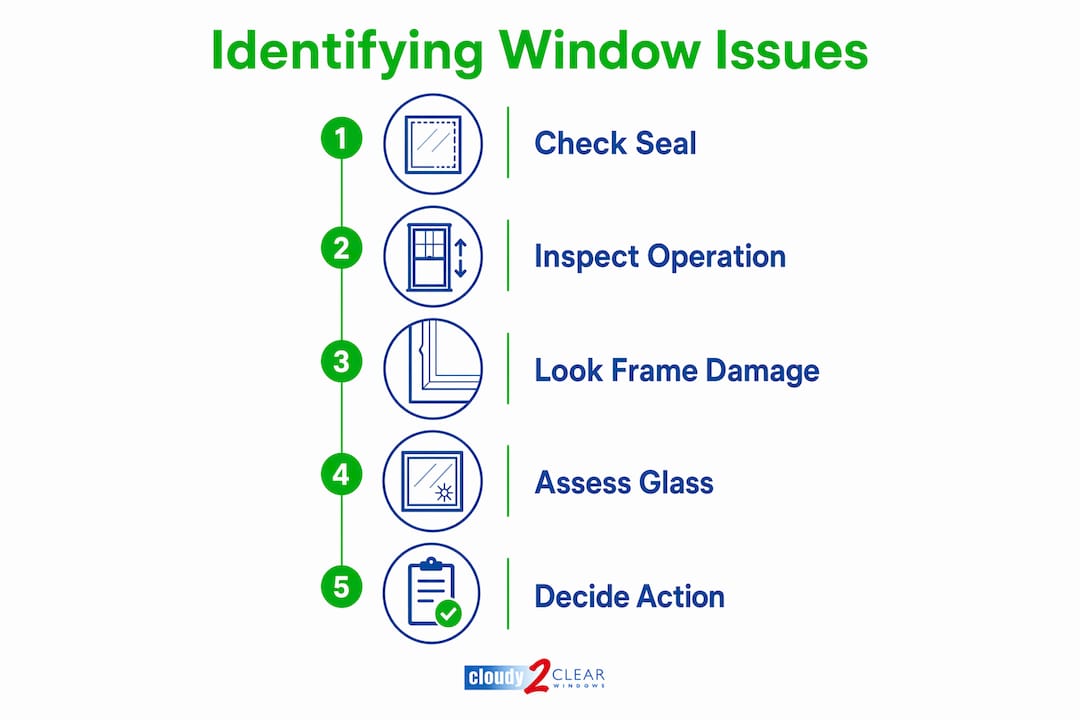
Diagnosing the fault correctly determines whether you need a simple clean or a hardware replacement. Follow these steps in order:
- Inspect the frame visually. Look for warping, bowing, or any visible gap between the frame and the wall. A frame that has moved out of square will cause the sash or casement to bind.
- Clean the tracks and hinges. Use a soft brush and a mild detergent to remove dirt, paint flakes, and debris from all moving parts. Lubricate hinges and friction stays with a silicone-based spray.
- Test the operation slowly. Open and close the window deliberately, feeling for the exact point where resistance begins. This locates the fault precisely.
- Check the hardware condition. Examine hinges, handles, espagnolette locks, and friction stays for corrosion, cracking, or deformation. Damaged hardware often requires direct replacement rather than adjustment.
- Assess seasonal behaviour. If the window sticks only in summer or after prolonged rain, timber frame swelling is the likely cause. If it sticks year-round, misalignment or hardware failure is more probable.
Pro Tip: Never force a stiff window open or closed. Forcing it accelerates wear on hinges and locks, and can crack the glass or split the frame. Identify the cause first, then address it.
Worn or broken locking mechanisms also reduce security significantly. Checking window locks during any operational assessment is not optional. A window that closes but does not lock properly is a security risk regardless of its visual condition.
What are the signs of physical damage to frames and glass?
Physical deterioration in window frames and glass is often visible to the naked eye, but the implications of what you see are not always obvious. Knowing what each sign means helps you decide whether a repair will suffice or whether replacement is the right course of action.
Identifying frame rot and moisture damage
Timber frames are particularly vulnerable to rot when paint or sealant fails and moisture penetrates the wood. Rotting frames show soft, crumbly, or discoloured wood, often with a spongy texture when pressed with a screwdriver. Minor surface rot can be cut back, treated with a wood hardener, filled with an exterior-grade filler, and repainted. Extensive rot that has reached the structural core of the frame requires full frame replacement.
uPVC and aluminium frames do not rot, but they do deteriorate. Look for discolouration, chalking, warping, or cracking along the profile. Yellowing uPVC is a sign of UV degradation and, while cosmetic at first, it indicates the material is becoming brittle.
Recognising glass damage and cracks near windows
| Damage type | Likely cause | Recommended action |
|---|---|---|
| Single crack across pane | Impact or thermal stress | Replace the glass pane promptly |
| Spider-web cracking | Severe impact | Replace immediately for safety |
| Diagonal crack from corner | Lintel stress or settlement | Inspect structure; replace glass |
| Chips or edge damage | Handling or installation fault | Monitor or replace depending on size |
| Scratches on surface | Abrasion | Polishing compound or replacement |
Diagonal cracks from window corners are a particular concern because they can indicate lintel weakness or differential settlement in the surrounding structure rather than a simple glass fault. Stress concentrates at window corners, and a crack that widens over weeks or months signals active structural movement.
Key signs of physical damage to check during any inspection:
- Soft, discoloured, or crumbly timber at frame corners and sill joints
- Visible gaps between the frame and the surrounding masonry or plasterwork
- Paint that is peeling, blistering, or flaking from the frame surface
- Cracked or missing external sealant around the frame perimeter
- Any crack in the glass, regardless of size, in a sealed double-glazed unit
Photographing cracks and monitoring them over four to six weeks is the most reliable way to distinguish stable historic cracking from active movement that needs urgent professional attention.
How do you decide between window repair and replacement?
Once you have identified the fault, the next decision is whether to repair or replace. The answer depends on the severity of the damage, the condition of the surrounding frame, and the age of the window.
| Fault type | Frame condition | Recommended action |
|---|---|---|
| Seal failure (misting) | Frame sound and square | Replace sealed unit only |
| Seal failure (misting) | Frame warped or rotten | Full window replacement |
| Hardware failure | Frame sound | Replace hardware components |
| Extensive frame rot | Structural compromise | Full window replacement |
| Minor surface rot | Localised only | Fill, treat, and repaint |
| Cracked glass (single pane) | Frame sound | Replace glass pane |
| Multiple faults combined | Any condition | Full window replacement |
Significant or multiple window faults justify full replacement because the cumulative effect on thermal performance and security outweighs the cost of piecemeal repairs. A window with a failed seal, stiff operation, and deteriorating frame is not worth repairing in stages.
Pro Tip: Before calling a professional, write down every symptom you have noticed and when it first appeared. This saves time during assessment and helps the engineer identify the root cause rather than just the visible symptom.
For guidance on when replacement is the right call, Cloudy2Clear Windows has a dedicated homeowner’s guide covering the key indicators.
What we have learnt from 20 years of window assessments
The most consistent mistake we see from homeowners and business owners is treating window faults as cosmetic until they become structural. A failed seal gets ignored because the window still opens. A stiff handle gets forced rather than inspected. Surface rot gets painted over rather than treated.
The second most common mistake is assuming that condensation between the panes is caused by poor ventilation inside the property. We have visited properties where owners have installed extractor fans, bought dehumidifiers, and redecorated, all because they believed the misting was their fault. It is not. Seal failure is a product fault, and no amount of ventilation will resolve it.
What we have found genuinely useful over the years is a simple seasonal inspection routine. Walk around your property twice a year, once in autumn before the cold sets in and once in spring after the wet months. Look at every window from the outside and the inside. Check the sealant lines, the frame condition, the glass clarity, and the hardware operation. The faults that cost the most to fix are always the ones that were visible months or years before anyone acted on them. Early identification is not just good maintenance practice. It is the difference between a £200 sealed unit replacement and a £1,500 full window installation.
— Cloudy2Clear Windows
Get expert help from Cloudy2Clear Windows
If your inspection has revealed signs of seal failure, frame damage, or operational faults, Cloudy2Clear Windows can assess and resolve them quickly.

Cloudy2Clear Windows has been repairing and replacing double-glazed windows across the UK since 2005, serving both homeowners and commercial properties. Whether you need a sealed unit replacement or a full window assessment, our local engineers cover areas including Milton Keynes, Watford, Oxford, and Leicester. Contact your nearest branch for a no-obligation assessment and get the right fix, at the right price, from a team with two decades of experience behind them.
FAQ
What is the quickest way to check for a failed window seal?
Run a dry cloth across both surfaces of the glass. If the misting or fogging remains after wiping, the seal has failed and the insulated glass unit needs replacing.
Can a sticking window be fixed without replacing it?
In most cases, yes. Cleaning the tracks, lubricating the hinges, and adjusting or replacing the hardware resolves the majority of operational faults without needing a new window.
How do I know if a crack near my window is structural?
Photograph the crack and monitor it over four to six weeks. A crack that widens or extends, particularly a diagonal crack from a window corner, may indicate lintel stress or settlement and requires a structural assessment.
Is condensation between window panes my fault?
No. Condensation trapped between the panes of a double-glazed unit is a sign of seal failure within the window itself. It cannot be resolved through ventilation or heating and requires sealed unit replacement.
When does a window need full replacement rather than repair?
Full replacement is the right choice when the frame is structurally compromised, when multiple faults are present at the same time, or when the window is old enough that repair costs approach the price of a new installation.