Vented windows are defined as window units fitted with trickle vents, small openings built into the frame that allow a controlled flow of fresh air into a building without the window being opened. The industry term for these openings is trickle vents, and understanding their role is central to managing indoor air quality, condensation, and energy efficiency in any UK property. UK Part F Building Regulations now require background ventilation using trickle vents in new and replacement windows, making them a legal requirement rather than an optional upgrade. Whether you own a home or manage a commercial property, knowing how vented windows work will help you make better decisions about installation, compliance, and long-term comfort.
What is the role of vented windows in improving air quality?
Vented windows provide continuous background ventilation by allowing fresh outdoor air to pass through small frame openings while the window remains closed. This passive process requires no electricity and no mechanical components. The result is a steady, low-level exchange of indoor and outdoor air that prevents stale air and moisture from building up inside a room.

The mechanism is straightforward. As warm, humid air rises inside a room, it creates a slight pressure difference that draws cooler, drier air in through the trickle vent. This is called stack effect ventilation, and it works around the clock without any input from you. The vent opening is small enough to prevent draughts but large enough to maintain meaningful airflow.
Properly specified trickle vents significantly reduce condensation and mould risk by lowering indoor humidity and promoting steady air circulation. This matters because mould growth is not just a cosmetic problem. It can trigger respiratory issues, damage plaster and timber, and reduce the value of a property. Consistent airflow through vented windows addresses the root cause rather than the symptom.
Key ways vented windows improve indoor conditions:
- Moisture control: Humid air from cooking, bathing, and breathing is diluted and replaced with drier outdoor air.
- CO2 reduction: Occupied rooms accumulate carbon dioxide quickly. Background ventilation keeps levels lower without you needing to open a window.
- Odour management: Persistent indoor odours from cleaning products, pets, or cooking dissipate faster with continuous airflow.
- Temperature stability: Because the vent opening is small, indoor temperatures remain more consistent than when a window is fully open.
Pro Tip: If you notice condensation forming on your window glass overnight, check whether your trickle vents are open. Many homeowners close them in winter to stay warm, but this traps moisture and makes condensation worse, not better.
How do vented windows compare to other ventilation methods?
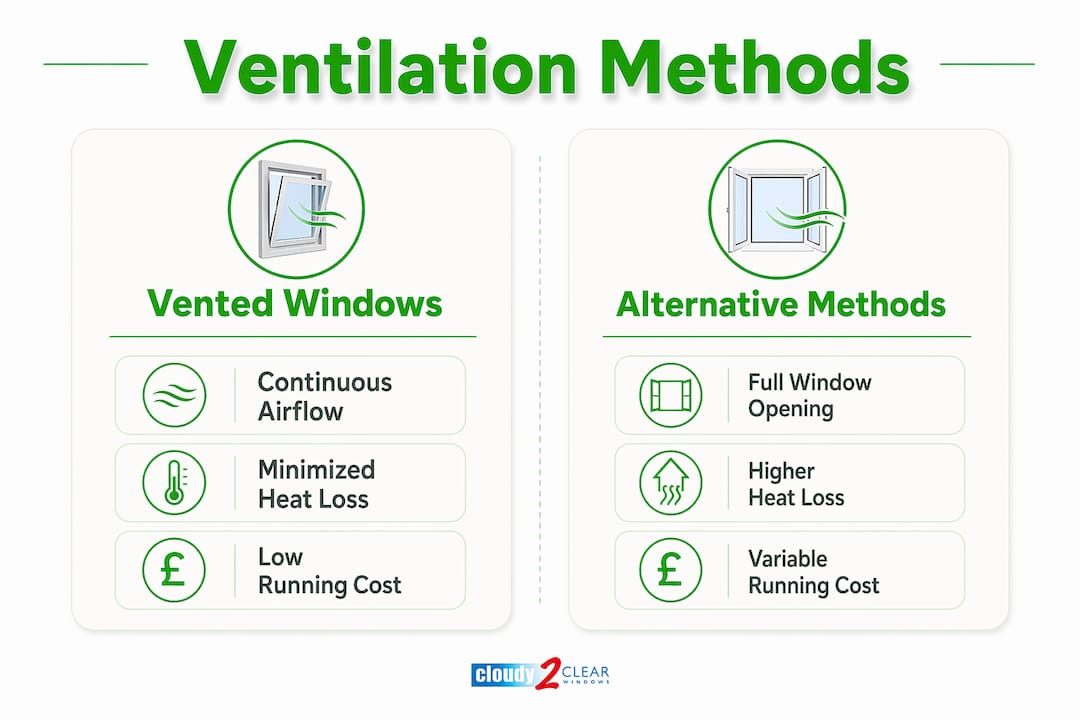
The benefits of vented windows become clearest when you set them against the alternatives. Opening a window fully provides excellent ventilation but causes significant heat loss, particularly in winter. Mechanical extractor fans in kitchens and bathrooms are effective but only operate intermittently and cover a limited area. Vented windows sit between these two options, offering continuous, low-level airflow without the energy penalty of an open window.
| Ventilation method | Continuous airflow | Heat loss | Running cost | Regulatory compliance |
|---|---|---|---|---|
| Trickle vents | Yes | Minimal | None | Part F compliant |
| Open windows | Yes (when open) | High | None | Not compliant alone |
| Extractor fans | No (intermittent) | Low | Electricity cost | Compliant in wet rooms |
| MVHR systems | Yes | Very low | Electricity cost | Compliant |
Vents minimise draughts and preserve thermal comfort during ventilation, unlike fully open windows that cause heat loss. This makes vented windows particularly valuable in winter, when you need fresh air but cannot afford to lose heat. For a typical UK home, this balance between airflow and thermal retention is one of the strongest practical arguments for fitting trickle vents.
That said, trickle vents are not a complete ventilation solution. They work best when combined with mechanical extraction in high-moisture areas such as kitchens and bathrooms. Think of them as the baseline layer of a ventilation strategy, not the whole answer.
Pro Tip: In rooms with high moisture output, such as bathrooms without windows, pair your trickle vents in adjacent rooms with a humidity-controlled extractor fan. The fan pulls air through the building, and the trickle vents supply the replacement air, making the whole system work more effectively.
For further guidance on improving home ventilation, Cloudy2Clear Windows has published practical advice covering the full range of options available to UK homeowners.
How do UK building regulations affect vented window installation?
UK Part F Building Regulations set out the legal requirements for ventilation in dwellings, and trickle vents are central to meeting them. The regulations apply to new builds and, critically, to replacement windows in existing properties. If you are replacing old windows, you cannot simply omit trickle vents because your original windows did not have them.
Here is what the regulations require in practice:
- Background ventilation is mandatory. Any new or replacement window without qualifying mechanical ventilation must include trickle vents to provide background ventilation.
- Sizing is based on Equivalent Area, not slot length. The vent must meet or exceed the Equivalent Area (EA) of the ventilation provided by the previous window frame. EA measures the effective airflow capacity of the vent, not just its physical dimensions.
- Existing EA must be matched or exceeded. When replacing windows, the new trickle vent must provide at least as much ventilation as the old one. Downsizing is not permitted.
- Room type affects the required EA. Living rooms, bedrooms, and kitchens each have different minimum EA requirements. Your installer should calculate these before specifying the vent.
- Listed buildings and conservation areas are not exempt. Modern trickle vents are designed to be discreet and unobtrusive, blending into window frames, making them suitable even for properties with architectural restrictions.
Many homeowners mistakenly omit vents in replacement windows because their old windows lacked them. This is a compliance failure that can affect building insurance, property sales, and planning permissions. Specifications must be based on Equivalent Area, not just physical vent slot size, to comply with UK regulations.
For a detailed look at how building regulations affect windows and the energy savings they can deliver, Cloudy2Clear Windows has produced a dedicated compliance guide worth reading before you commission any window replacement work.
Choosing, installing, and maintaining vented windows
Selecting the right vented windows involves more than picking a style you like. The vent design, its position in the frame, and the quality of the seal around it all affect how well it performs over time.
Choosing the right vent design
Look for trickle vents with a closable cover so you can reduce airflow during very cold or noisy periods without blocking ventilation entirely. Acoustic trickle vents are available for properties near busy roads or flight paths. Advanced vent designs maintain thermal and acoustic integrity while accelerating indoor air exchange, so you do not have to choose between comfort and ventilation.
Installation considerations
Correct installation is where many problems begin. A poorly fitted trickle vent can create gaps that allow uncontrolled air infiltration, reducing both thermal performance and sound insulation. Proper installation and maintenance ensure vented windows maintain airtightness while providing necessary ventilation. This requires professional expertise, particularly when retrofitting vents into existing frames. For guidance on how airtightness and window design interact, it is worth reviewing the latest UK standards before specifying your installation.
Maintenance tips to keep vents working
Trickle vents are low maintenance but not zero maintenance. Follow these steps to keep them functioning properly:
- Clean the vent cover monthly. Dust and debris accumulate quickly, especially in urban areas. A soft brush or damp cloth is sufficient.
- Check the filter if fitted. Some vents include a small filter to keep insects and particles out. Replace it annually or when visibly blocked.
- Test the sliding mechanism. Open and close the vent cover twice a year to confirm it moves freely and seals correctly when closed.
- Inspect the frame seal. Look for gaps between the vent body and the window frame. Any visible gap should be addressed by a professional.
Pro Tip: Set a reminder every six months to check all trickle vents in your property. It takes less than ten minutes and prevents the kind of slow moisture buildup that leads to costly window condensation problems down the line.
When to call a professional
If your existing windows have no trickle vents, or if the vents are blocked, damaged, or undersized, contact a qualified window installer. Retrofitting vents into existing double glazed frames is possible but requires precise cutting and sealing to avoid compromising the unit. Cloudy2Clear Windows has been carrying out this type of work since 2005 and can assess whether your current windows meet Part F requirements.
What we have learned about vented windows after two decades of installations
After nearly twenty years of fitting, replacing, and repairing double glazed windows across the UK, the team at Cloudy2Clear Windows has seen the same misunderstanding come up repeatedly. Homeowners assume that trickle vents will make their home cold. They close them in October and open them in April, wondering why condensation appears on their walls every winter.
The reality is the opposite. A closed trickle vent traps warm, humid air inside. That air hits the cold glass and condenses. The vent is not the cause of the cold feeling. It is the solution to the damp one.
We have also seen a shift since 2020. With more people spending time at home, indoor air quality has become a genuine concern rather than a technical footnote. Customers now ask about CO2 levels, humidity readings, and ventilation rates in a way they simply did not before. Vented windows are part of that conversation in a way they were not five years ago.
The future of window ventilation in the UK will involve trickle vents working alongside mechanical ventilation heat recovery (MVHR) systems and, increasingly, smart sensors that adjust airflow based on real-time humidity and CO2 data. Trickle vents will not be replaced by these technologies. They will be integrated with them. The passive, always-on nature of a trickle vent makes it the ideal baseline layer in any ventilation strategy, whether you are retrofitting a Victorian terrace or fitting out a new commercial unit.
Our advice is straightforward. Do not treat vented windows as a compliance checkbox. Treat them as a long-term investment in the comfort, health, and efficiency of your building.
How Cloudy2Clear Windows can help with vented window solutions
If you are unsure whether your current windows meet Part F requirements, or if you want to upgrade to properly vented double glazing, Cloudy2Clear Windows is ready to help.

Established in 2005, Cloudy2Clear Windows has been installing and repairing double glazed windows across the UK for both residential and commercial clients. Our team understands the compliance requirements, the practical installation challenges, and the maintenance needs that come with vented windows. We offer commercial window repair and replacement as well as residential services, all carried out to current UK building regulations. Whether you need a single vent retrofitted or a full window replacement programme, contact Cloudy2Clear Windows for a no-obligation assessment and quote.
FAQ
What is a window trickle vent?
A trickle vent is a small ventilation opening built into a window or door frame that allows controlled fresh air into a building without the window being opened. It operates passively, requiring no electricity or mechanical components.
Can vented windows reduce humidity indoors?
Yes. Trickle vents allow humid indoor air to be replaced by drier outdoor air, which lowers indoor humidity levels and reduces the risk of condensation and mould growth.
Are trickle vents required by UK law?
UK Part F Building Regulations require trickle vents in new and replacement windows where qualifying mechanical ventilation is not present. Omitting them during a window replacement is a compliance failure.
Do trickle vents make a room cold?
Trickle vents cause minimal heat loss because the opening is small and airflow is controlled. Fully open windows cause far greater heat loss. Closing trickle vents in winter actually increases condensation risk rather than improving warmth.
How do I know if my trickle vents are the right size?
Vent sizing is based on Equivalent Area (EA), not the physical slot size. A qualified installer can measure your existing vents and confirm whether they meet the minimum EA required for each room type under Part F regulations.