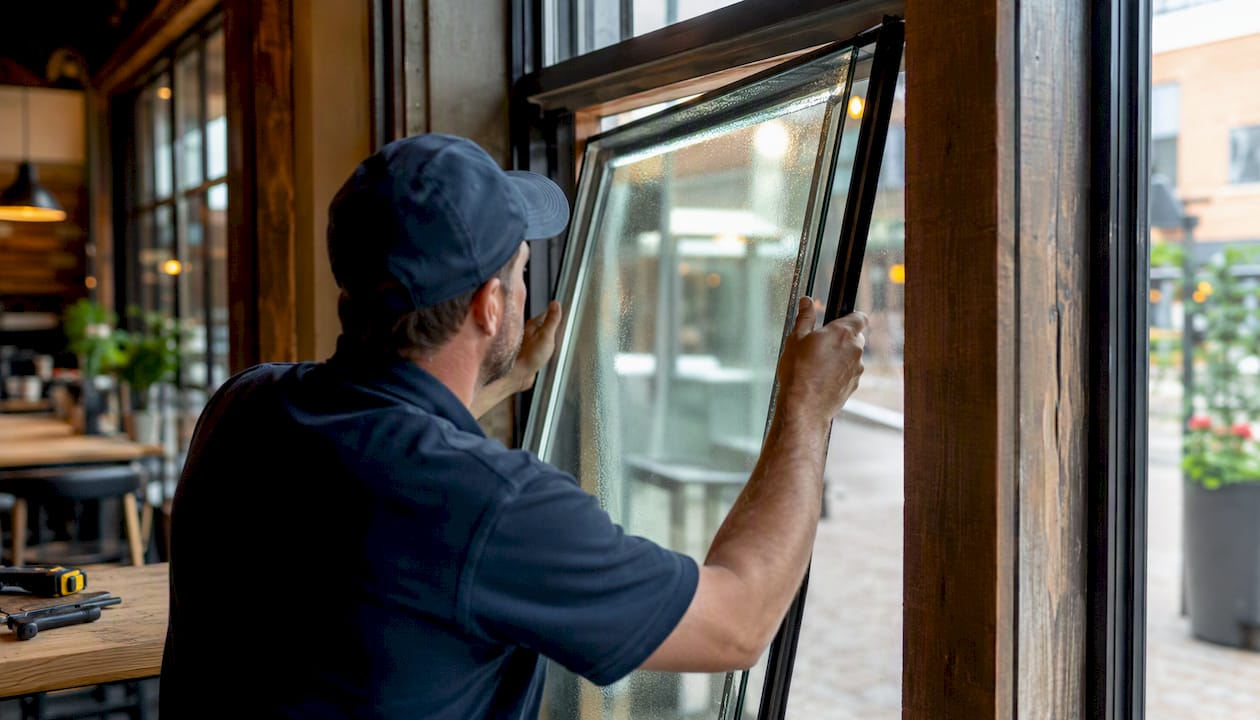
The quickest, highest-impact first step for most small businesses is to check seal integrity and frame condition, then prioritise a targeted insulated glass unit (IGU) swap wherever the frame is still sound. Replacing glass alone is faster, cheaper, and far less disruptive than a full frame change, provided the frame itself is straight and free from corrosion.
Before you plan anything, triage three things:
- Fogging or misting between the panes
- Visible rot, rust, or corrosion around the frame
- Persistent draughts even with windows shut
If two or more of these show up on the same window, treat it as urgent. Fogging especially is a performance warning, not just an eyesore.
Tips for small business upgrades: building a low-disruption plan
Not every window needs the same urgency. Start with safety and thermal failures (cracked panes, failed seals letting in draughts), then move to your most visible elevation, the shopfront or main entrance customers actually see, before tackling back-of-house glazing.
A sensible order of operations looks like this:
- Document every window and door with a photo and a one-line condition note
- Measure openings so quotes come back accurate first time
- Apply temporary fixes (draught strips, sealant) to buy time on lower-priority units
- Schedule IGU swaps or staged frame replacement by elevation, not by building
Pro Tip: Book glazing work around your quietest trading hours or a scheduled closure day. Most commercial IGU swaps take under a day per unit, so staggering by elevation means you’re never fully closed.
How do you know whether to repair or replace?
Fogging between panes is the clearest signal you’re dealing with seal failure, not surface condensation. Run a simple wipe test: condensation on the inside face wipes away and returns with humidity; fogging trapped between the panes stays put because moisture has entered a broken seal. If it doesn’t clear, the sealed unit has failed.
Before deciding on glass alone versus a full frame change, check the frame itself:
- Is it still square, or has it dropped or twisted?
- Any corrosion on metal frames or rot on timber?
- Do weep holes drain freely, and are gaskets still pliable?
If frames are straight, secure and corrosion-free, an IGU swap is usually the right call, and it lets you add low-E coatings or argon fill without touching the frame. Full replacement becomes necessary when the frame is structurally compromised, when current glazing fails safety glass requirements, or when the same unit has failed more than once.
Fogging between panes signals seal failure and reduced thermal performance, and left unattended it can let moisture reach and damage the frame itself, turning a glass problem into a joinery problem.
Ignore a failed seal for long enough and you’re not just losing heat. You risk hidden frame damage and, in a commercial tenancy, potential liability if a failing window affects safety or accessibility.
Which glazing upgrade actually solves your problem?
Different upgrades solve different problems, and matching the right one to your building saves money you’d otherwise waste on over-specifying. A straightforward IGU swap restores thermal performance fast where frames are sound. Adding a low-E coating and argon fill during that swap pushes U-values down further for marginal extra cost. Acoustic laminated glass suits premises on busy roads or near transport links. Toughened or laminated safety glass matters most for ground-floor display windows and doors. Secondary glazing remains the standard fallback for listed or character buildings where the original frames can’t be altered.
| Upgrade option | Thermal performance | Acoustic benefit | Cost (supply + install) | Suitability for character/display windows | Lifespan/maintenance | Compliance risk |
|---|---|---|---|---|---|---|
| IGU swap (standard) | Good improvement | Modest | Lower | Good, matches existing frame | Low maintenance, typical lifespan | Low, if U-value evidence provided |
| IGU with low-E/argon | Very good | Modest | Moderate | Good | Low maintenance, typical lifespan | Low |
| Acoustic laminated glass | Good | High | Moderate to higher | Good | Low maintenance, long lifespan | Low |
| Toughened/laminated safety glass | Good | Modest | Moderate | Excellent for shopfronts | Low maintenance, long lifespan | Low, supports safety compliance |
| Secondary glazing | Moderate to good | Good | Moderate | Best for listed buildings | Occasional servicing, typical lifespan | Low, often the accepted route where frames can’t change |
| Full frame replacement | Excellent | High | Highest | Poor for listed buildings | Typical lifespan | Low, but must meet limiting U-values |
Pro Tip: If you’re upgrading in stages, match new glass thickness and tint to your existing units first. A mismatched sightline or reflection on one bay of a shopfront is more noticeable to passing customers than the old fogged glass ever was.
What building regulations apply to replacement windows?
Replacement windows and doors in commercial buildings fall under Approved Document L, which sets limits on heat loss through the building fabric, including glazing. U-values are the metric that proves compliance, and suppliers should calculate them using BR 443 conventions for whole-element assessment, applied to the correct plane (vertical for windows, horizontal for rooflights).
Character or listed buildings sometimes qualify for a relaxed standard, such as a centre-pane U-value around 1.2 W/(m²·K), or secondary glazing as an accepted alternative where original frames must stay in place. Smaller works like ground-floor conservatories under 30 m² can also fall outside the full requirements in certain circumstances.
Before you commit to a supplier:
- Request a written U-value calculation or Window Energy Rating for the exact unit specified
- Ask how they’ve accounted for air permeability and area-weighted averaging across your elevation
- Keep all evidence on file. It may be needed for planning records or an updated EPC recommendation report if the building’s energy status changes
What do glazing upgrades cost, and what’s the payback?
Costs vary by unit size and specification, but as a rough guide: a standard IGU swap tends to sit at the lower end of glazing spend, acoustic or laminated units cost more per unit, and full frame replacement carries the highest supply-and-install cost.
| Upgrade type | Relative cost band | Typical driver of payback |
|---|---|---|
| IGU swap | Lower | Reduced heat loss, lower heating bills |
| Acoustic/laminated IGU | Moderate to higher | Comfort, noise reduction, tenant retention |
| Full frame replacement | Highest | Longest-term energy saving, lowest maintenance |
Payback comes from more than the energy bill. Before you present a business case to stakeholders, work through:
- Estimated annual saving from a lower U-value against current heating costs
- Reduced maintenance and callout costs versus ageing failed units
- Non-energy value: comfort for staff and customers, noise reduction, and reduced liability from a failing shopfront window
What should you ask a glazing installer before hiring them?
A reputable installer should hand over evidence without being chased for it. Before signing anything, ask:
- Can you provide a written U-value calculation for this specific unit?
- How does this quote meet Approved Document L requirements?
- What does the warranty cover, and for how long?
- Do you have references or case studies from similar commercial projects?
Red flags are just as telling as good answers:
- Reluctance to share U-value evidence in writing
- No proof of insurance or a vague, undocumented warranty
- Hand-waving on compliance (“it’ll be fine”) rather than a specific reference to Part L
Get at least three written quotes, check local trade credentials, and ask each supplier for a case study close to your building type.
How long does a glazing upgrade project take?
A single IGU swap typically takes a day or less per unit. Multi-unit staged replacement across a shopfront might run one to two weeks in phases. A full frame replacement project usually needs two to four weeks depending on scale.
- Book works outside peak trading hours or across a planned closure day
- Use cordons and clear signage so customers know the shop is still open
- Fit temporary barriers where needed and tackle one elevation at a time
Brief your staff and put a small sign on the door in advance. A short heads-up avoids confused customers on the day.
What experience tells us about window upgrades
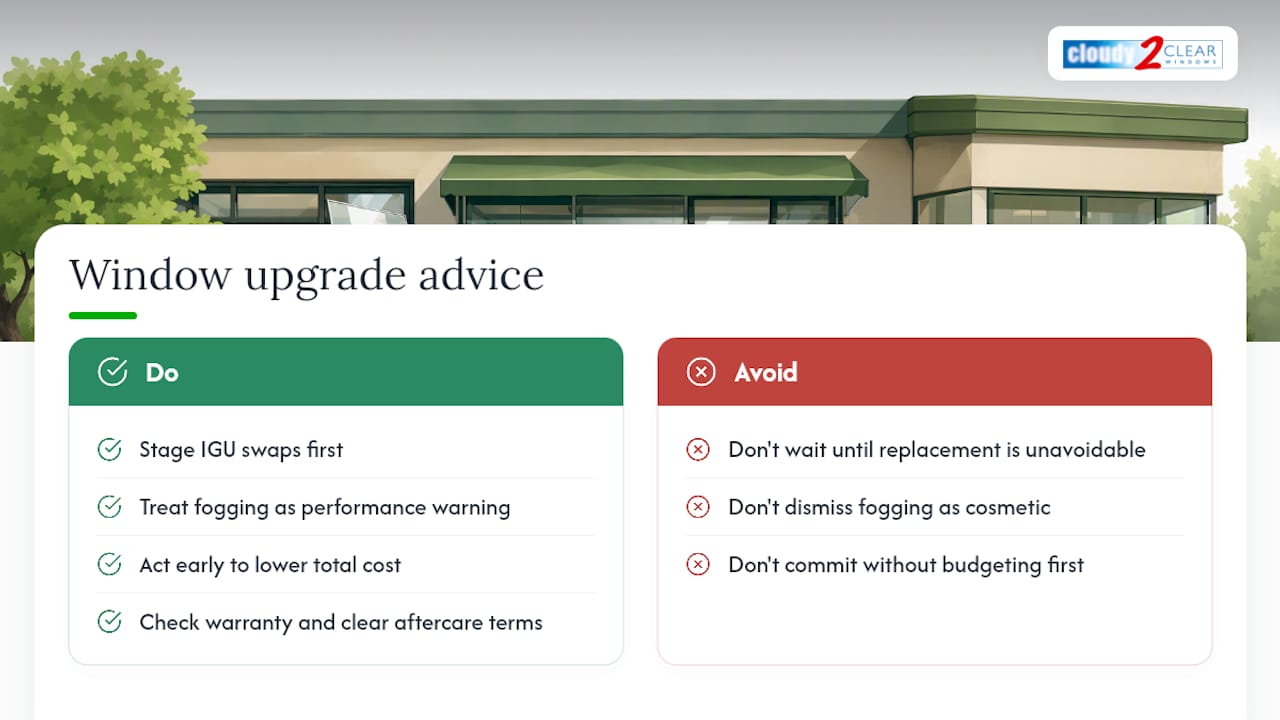
Staged IGU swaps are usually the smartest first move for small business premises, not because they’re cheaper (though they often are), but because they let you fix the worst-performing units now without committing to a full-scale project you haven’t budgeted for. Fogging should always be read as a performance warning rather than a cosmetic complaint. Cloudy2Clear Windows has worked across residential and commercial glazing since 2005, and the pattern holds across almost every job: the businesses that act early on seal failure spend less overall than those that wait for a full replacement to become unavoidable. A solid warranty and clear aftercare terms remain the simplest way to judge whether a supplier stands behind their work.
How Cloudy2Clear Windows can help with your upgrade
Cloudy2Clear Windows specialises in exactly the low-disruption route this article has described: glass-only IGU swaps, full glazing replacement, commercial window repair, and compliance checks that give you the U-value evidence a supplier should hand over unprompted. That’s the practical difference versus starting from scratch with a full-frame contractor. You get the thermal and acoustic upgrade without losing a working frame or closing for weeks.
Every job comes with warranty and aftercare support, so you’re not left chasing anyone if a seal fails again down the line. If you manage a shopfront, office, or commercial unit and want to know which of your windows genuinely need attention, book a free site check through our commercial window repair service or get a quote via double glazing replacement. Our team is available Monday to Friday, 8:30am to 6:30pm, to talk through your priorities and get a plan moving this week.
Where to check the detail yourself
- Approved Document L for the current energy efficiency limits on replacement windows
- BR 443 guidance within Approved Document L Vol 2 for whole-element U-value calculations
- Ask any supplier to show you their U-value evidence against these same documents before you sign
This article is general information, not a substitute for advice from a qualified lawyer. Consult a qualified legal professional about your own circumstances before acting on anything here.
Sources
- Conservation of fuel and power: Approved Document L
- Approved Document L volume 2 – consultation version – January 2021
- Pilkington: Existing non‑dwellings (conservation of fuel and power)
FAQ
Is it cheaper to replace glass or the whole window?
Replacing just the insulated glass unit is usually cheaper and faster than a full frame replacement, provided the existing frame is straight, secure, and free from corrosion.
Do small business window replacements need to meet Part L?
Yes. Replacement windows and doors in non-domestic buildings must meet the energy efficiency limits set out in Approved Document L, usually demonstrated through U-value evidence.
How do I know if my double glazing has failed?
Fogging or misting trapped between the panes that doesn’t clear on wiping is the clearest sign of seal failure, distinct from ordinary surface condensation.
What is a reasonable warranty on commercial glazing work?
Warranty length varies by supplier and unit type, so always get it in writing alongside details of what it covers. Cloudy2Clear Windows backs its installations with warranty and aftercare support as standard.
Can listed or character buildings still get energy-efficient glazing?
Yes. Approved Document L allows for relaxed standards or secondary glazing in character-sensitive buildings where the original frames must be retained.