A Kitemark on toughened glass tells you the pane has passed independent testing to BS EN 12150, with ongoing factory checks by the BSI rather than a one-off assessment. If your windows, doors, or rooflights need verified safety glass, ask your supplier for Kitemark-certified panes and the paperwork to prove it. Anything less leaves you guessing about what is actually in the frame.
What is the BSI Kitemark and how does it differ from CE or UKCA?
The Kitemark is a voluntary certification scheme run by the British Standards Institution, and it works quite differently from the marks you’re legally required to have. CE and UKCA markings confirm a product meets minimum requirements to be sold in the UK market. They’re largely self-declared, checked once at the point of manufacture or import.
The Kitemark goes further. It involves independent, third-party testing plus ongoing audits of the factory’s production process, so a manufacturer can’t simply pass a test once and coast. That ongoing scrutiny is why architects, developers, and building control officers treat it as a stronger form of assurance than a mandatory mark alone.
For toughened and laminated safety glass, the Kitemark scheme references a specific set of standards:
- BS EN 12150 – defines thermally toughened soda lime silicate safety glass, covering fragmentation behaviour and product tolerances.
- BS EN 12600 – the pendulum impact test used to classify how glass performs and breaks under impact.
- BS EN 14449 – covers laminated glass and laminated safety glass, relevant where toughened and laminated builds are combined.
Together, these standards give licensees the technical evidence needed to demonstrate compliance with construction regulations, rather than a bare assertion that “the glass is safe.” Our own guide to toughened safety glass covers how this standard applies specifically to UK windows and doors.
How do you identify a Kitemark toughened pane on site?
Verifying a pane isn’t guesswork if you know where to look and what counts as proof. Toughened glass carries its evidence on the glass itself, not on a paper trail alone.
- Look in the corner of the pane. A genuine mark is permanently etched or sandblasted into the glass, usually showing the manufacturer’s name, the relevant standard (such as BS EN 12150), and confirmation it’s toughened safety glass.
- Check that the mark is etched, not stuck on. Stickers are not acceptable proof of compliance, because they can be peeled off, swapped, or misapplied entirely — a sticker tells you nothing permanent about what’s actually in the frame.
- Ask for the Declaration of Performance. This document ties the physical pane to its tested performance data and should reference the exact standard used.
- Request traceable batch or certificate details. A reputable supplier can link a specific pane back to its test records, not just point to a general claim of “toughened glass.”
Pro Tip: Photograph the etched corner mark before installation and keep it with your paperwork. If a dispute ever arises with an insurer or building control, that image is often the fastest way to confirm what was actually fitted.
Why does the Kitemark matter for safety and compliance?
Independent testing combined with factory production control cuts the risk of a non-conforming pane reaching your property, because the manufacturer is audited continuously rather than trusted on a single certificate. That matters more than it sounds, given how often panes without permanent marking turn up on real jobs.
- Fewer compliance headaches. Building control officers and insurers accept Kitemark evidence far more readily than an unverifiable claim.
- Predictable breakage behaviour. Properly toughened glass to BS EN 12150 fractures into small, blunt fragments rather than long dangerous shards, which is the entire point of using safety glass near doors, low-level windows, and balustrades.
- Higher mechanical strength. Toughened panes withstand considerably greater impact and thermal stress than standard annealed glass of the same thickness, a benefit our piece on toughened glass advantages explores in more depth.
The BSI itself frames the Kitemark as the benchmark UK certification for demonstrating that a product has genuinely been through rigorous, independent scrutiny rather than a paperwork exercise.
When is Kitemark toughened glass necessary or insufficient?
Kitemark toughened glass is the right call for most domestic and commercial glazing: entrance doors, low-level windows, shower screens, balustrades, and many rooflights. In these applications, BS EN 12150 compliance combined with Kitemark evidence gives you a solid, checkable safety standard.
It doesn’t cover everything, though. BS EN 12150 defines the glass product itself; it doesn’t automatically qualify that glass for use in fire-rated assemblies, where the whole tested system, frame included, needs its own certification.
- Fire-rated glazing needs a specifically tested and certified assembly, not just toughened glass on its own.
- Large or overhead panes (rooflights, glass floors, some atria) often warrant heat soak testing, a separate process from EN 12150 that reduces the risk of spontaneous breakage caused by nickel sulphide inclusions.
- Mixed-standard marks are a red flag. A Kitemark referencing a standard that doesn’t apply to toughened glass isn’t relevant, regardless of how official it looks.
Our guide to different safety glass types sets out where laminated or fire-rated builds are the better fit.
What should you ask your supplier or installer?
A short checklist saves you from discovering problems after installation, when swapping the glass means disruption you could have avoided.
- Ask for the Declaration of Performance, and check it names the exact standard, such as BS EN 12150, rather than a vague reference to “safety glass.”
- Insist on seeing the permanent etched or sandblasted mark on each pane before it goes in, not a promise that it exists somewhere in a warehouse.
- Ask whether heat soak testing applies to your job, particularly for large panes, rooflights, or anything installed overhead.
- Keep certificates and product IDs on file. Insurers and building control officers may ask for them years after installation, not just on completion day.
Pro Tip: If a supplier can’t produce a Declaration of Performance on request, treat that as a warning sign rather than an oversight. Genuine Kitemark licensees keep this paperwork readily available because it’s part of their certification obligations.
Cloudy2Clear Windows perspective: what we see on real jobs
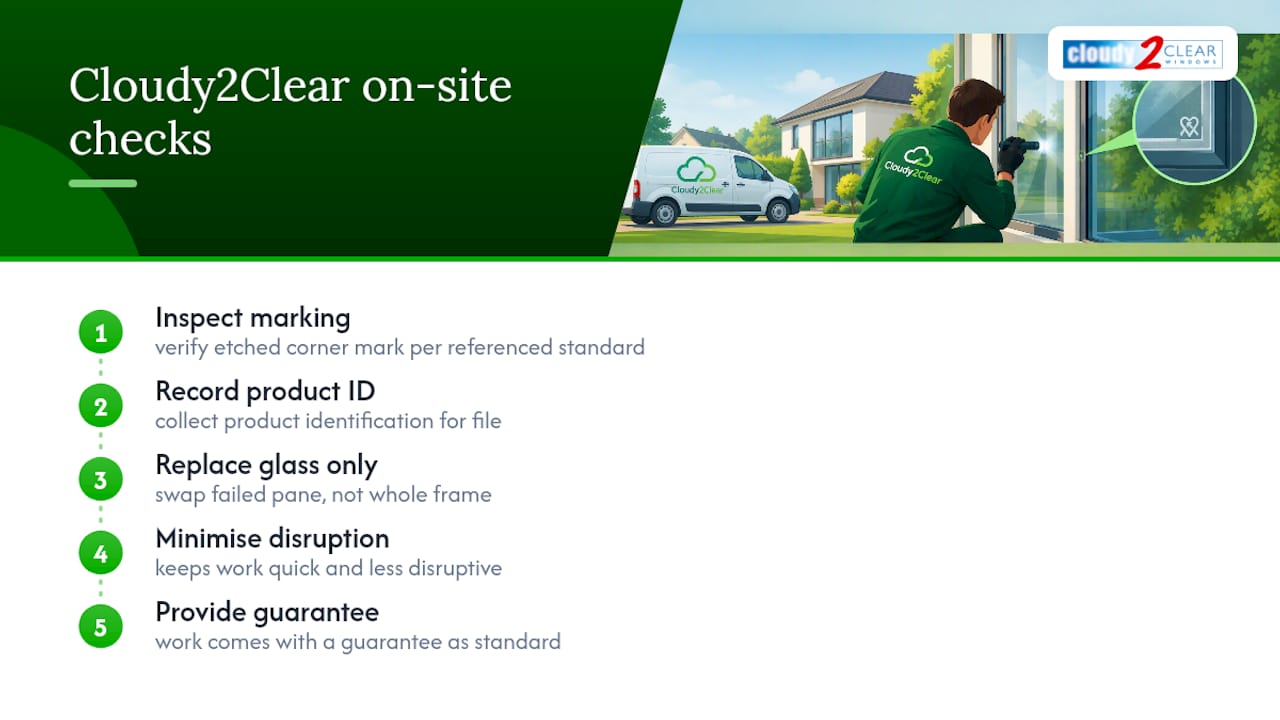
Working across homes and commercial premises throughout the UK, Cloudy2Clear Windows regularly finds panes with no permanent mark at all, or worse, a sticker standing in for genuine certification. Neither tells you anything reliable about what’s actually fitted.
When Cloudy2Clear Windows carries out a glass-only replacement, the team checks the etched corner mark against the standard referenced, and collects the product identification to keep on file. Because Cloudy2Clear Windows replaces only the failed glass rather than the whole frame, disruption stays minimal, and the work comes with a guarantee as standard.
Get Kitemark-verified glass fitted without replacing the whole window
Cloudy2Clear Windows is the practical alternative to a full window replacement when your glass needs Kitemark-verified toughened panes: you replace the glass, not the frame, which keeps costs down and disruption to a minimum compared with ripping out the whole unit.
Whether you need a single cracked pane sorted at home or a compliance check across a commercial site, the team verifies the etched corner mark, checks it against BS EN 12150 or the correct standard, and hands you the documentation to keep for building control or your insurer. Services cover double glazing replacement, door glass repairs, and commercial inspection support for landlords and housing associations managing multiple properties. If you’re unsure whether your current glass meets the standard, get in touch through the Cloudy2Clear Windows contact page and arrange an assessment.
Where to check the standards yourself
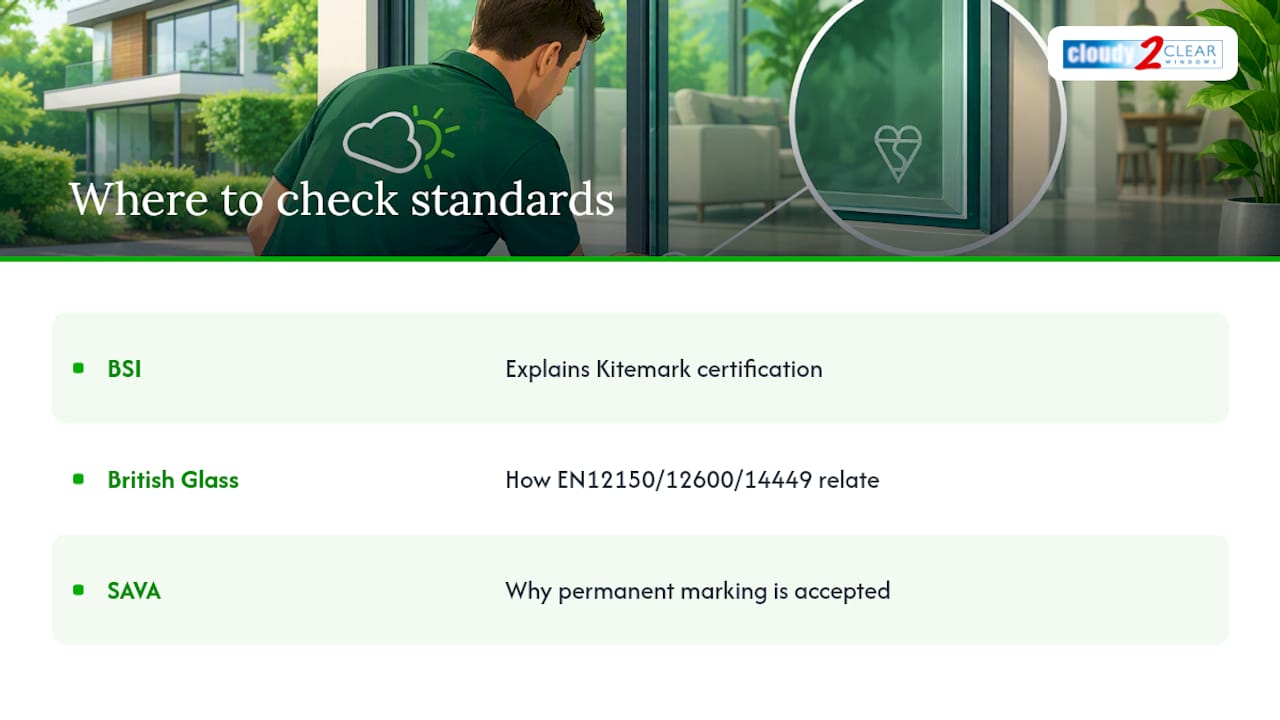
For readers who want to verify the technical detail directly, the BSI’s own explanation of the Kitemark scheme covers how certification works. British Glass sets out how EN 12150, EN 12600, and EN 14449 fit together for safety glass, and SAVA’s guidance explains why permanent marking is the accepted verification method.
Sources
- Aico: BSI Group Kitemark
- British Glass: The BSI Kitemark for safety glass
- SAVA: Safety glass types, standards and reporting
- FireResist: BS EN 12150 glass standard — are you compliant?
FAQ
How do you spot toughened glass on a window?
Look for a permanent etched or sandblasted mark in one corner of the pane, usually showing the manufacturer’s name and the relevant standard such as BS EN 12150. If there’s no mark at all, or only a sticker, you can’t confirm the glass is genuinely toughened without further testing.
Does a sticker count as proof of Kitemark certification?
No. Stickers aren’t accepted as compliance evidence because they can be removed, swapped, or applied incorrectly, unlike a permanent etched mark, which stays on the pane for its lifetime.
Is a Kitemark compulsory for toughened glass in the UK?
No, the Kitemark is voluntary rather than a legal requirement. CE or UKCA marking covers the mandatory minimum for market entry, but the Kitemark provides extra assurance through ongoing independent testing and factory audits that mandatory marks don’t include.
Does Cloudy2Clear Windows check for Kitemark marking during installation?
Yes, the supplier checks for the permanent etched corner mark and confirms it references the correct standard before fitting. Glass-only replacements come with a guarantee, and documentation is kept on file for building control or insurance purposes.
When do I need heat soak testing as well as a Kitemark?
Heat soak testing is worth requesting for large panes, rooflights, or overhead glazing, where it reduces the risk of spontaneous breakage from nickel sulphide inclusions. It’s a separate process from BS EN 12150 testing, so ask your supplier directly whether it applies to your job.