A trickle vent lets a small, controlled amount of air into a room, so a gentle flow of cool air near the top of the window is normal. You should keep trickle vents open in winter. GOV.UK’s ventilation guidance says to leave them open and unblocked, even in cold weather. A cold draught around your feet usually has another cause, such as a worn seal, a failed glass unit or a gap in the frame. At Cloudy2Clear Windows we repair and replace double glazing glass, so those faults are what we deal with.
This guide is for home and business owners in England and Scotland, and for housing associations. It explains what a trickle vent does, how to tell it from a real draught, and what to do about each.
What a trickle vent does
A trickle vent is a small, adjustable slot, usually in the top frame of a window. It gives background ventilation: a slow, constant supply of fresh air, even when the window is shut. Homebuilding’s expert Anthony Threlfall explains that this flow removes moisture and airborne pollutants. He adds that it matters as much in modern airtight houses as in older ones.
Cooking, showering, drying washing and breathing all add moisture to the air. Without a way out, that moisture settles as condensation on cold surfaces. Over time it can lead to mould.
Draught or ventilation: how to tell the difference
The two feel similar but behave differently. The Energy Saving Trust explains that draughts tend to bring cold air in at floor level, while ventilation brings air in higher up. That is why trickle vents sit at the top of the window. Keeping them open means a constant, controlled supply of fresh air without a cold draught around your feet.
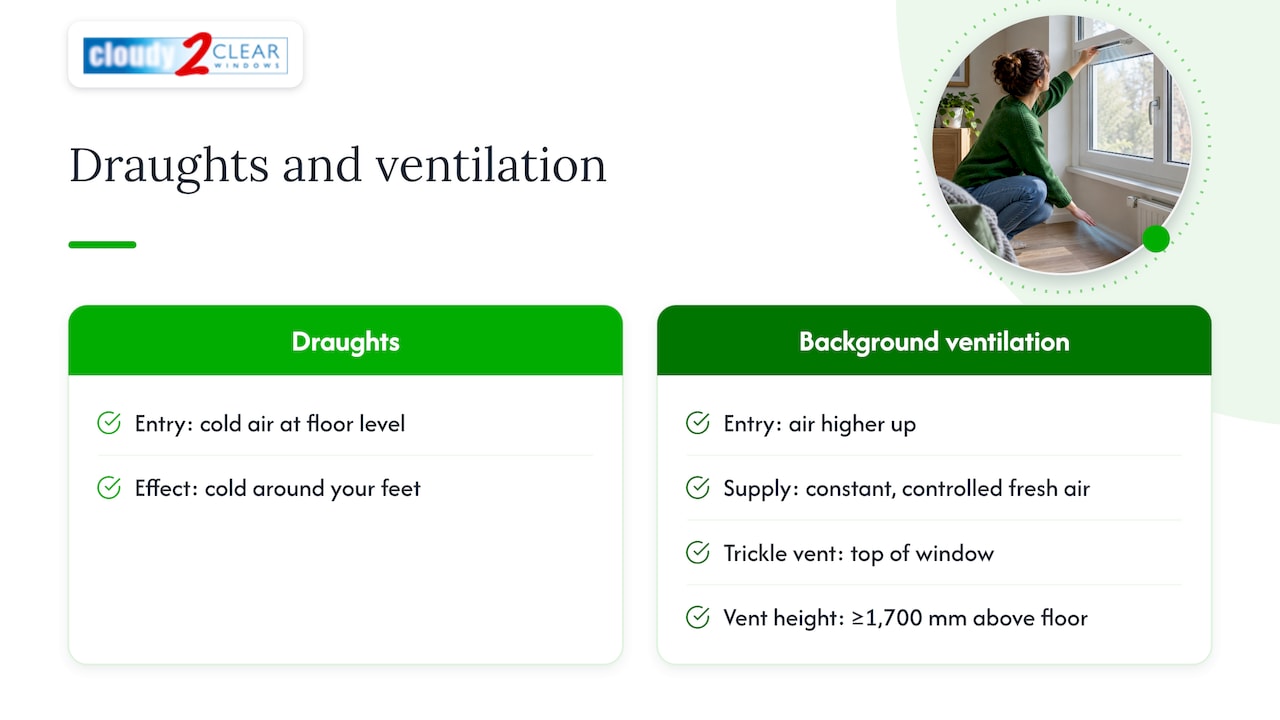
The Yale white paper on ventilation guidance says background ventilators should be at least 1,700 mm above floor level, to reduce cold draughts while staying within reach. The MDPI review of ventilator performance also notes that trickle vents are mostly placed about 1.7 m above the floor for the same reason.
Signs the airflow is normal
- A slight, steady movement of cool air at head height beside the vent.
- More noticeable airflow on windy or very cold days.
- No cold air at ankle level, around the sash, or along the frame edges.
Signs you have a fault or an unwanted leak
- Cold air at the bottom or sides of the window, or along the glazing bead.
- Perished, flattened or cracked rubber seals.
- Condensation or fogging between the panes, which means the sealed unit has failed.
- A sash that does not close tightly, or a handle or hinge that has worked loose.
- Draughts that continue with the trickle vent shut.
If closing the vent does not stop the cold air, the vent was never the problem.
Why a trickle vent can feel draughty
A vent can feel stronger than you expect. RetrofitIQ lists the main causes:
- High wind or large pressure differences between inside and outside.
- Cold surfaces nearby, which make the incoming air feel sharper.
- Uncontrolled leaks elsewhere in the home.
- The vents being the home’s main source of background ventilation.
The physics is straightforward. The MDPI review explains that the main driver of airflow through a vent is the pressure difference between indoors and outdoors, caused by wind and warm air rising. Pressure-controlled vents adjust their opening to reduce draught risk.
Should you close trickle vents in winter?
No. Keep them open. Three official or expert sources agree on this:
- GOV.UK says that leaving them open uses a little more energy to heat the home, but provides fresh air.
- Wolverhampton City Council’s damp and mould booklet says dry, cool air costs less to warm than warm, moist air. Letting moisture out is therefore not a waste.
- Homebuilding advises keeping them open in winter to prevent damp and condensation.
If you close them because of a cold draught, Homebuilding says to open the windows for short intervals so air still circulates. RetrofitIQ reports that closing vents commonly leads to condensation and stuffiness within days.
How to reduce cold air and keep the ventilation
The aim is to stop the leaks you do not want while keeping the vent you do. Work through these in order.
- Check the vent is the cause. Close it for an evening. If you still feel cold air, the leak is elsewhere. Reopen the vent afterwards.
- Look at the seals. Worn rubber seals around sashes and doors let in air all year. Our guide to stopping uPVC door draughts covers replacing seals while keeping trickle vents open.
- Check for failed glass. A misted or cracked sealed unit loses its insulation, so the glass surface turns cold and the air beside it feels harsher. RetrofitIQ notes that warmer internal surfaces reduce the contrast between incoming air and the room.
- Check handles, locks and hinges. If a sash does not pull in tight, the window leaks around the whole frame.
- Seal gaps, but not the vents. The Energy Saving Trust says to seal gaps around doors, windows and floors, but not to block extractor fans, airbricks, wall vents or trickle vents.
- Think about mechanical ventilation. Where trickle ventilation stays uncomfortable, RetrofitIQ says the right upgrade is mechanical ventilation with heat recovery. It supplies tempered fresh air continuously.
For more on causes, see our guide to what a window draught is and how to fix it and our draught proofing advice.
Where to take care when draught-proofing
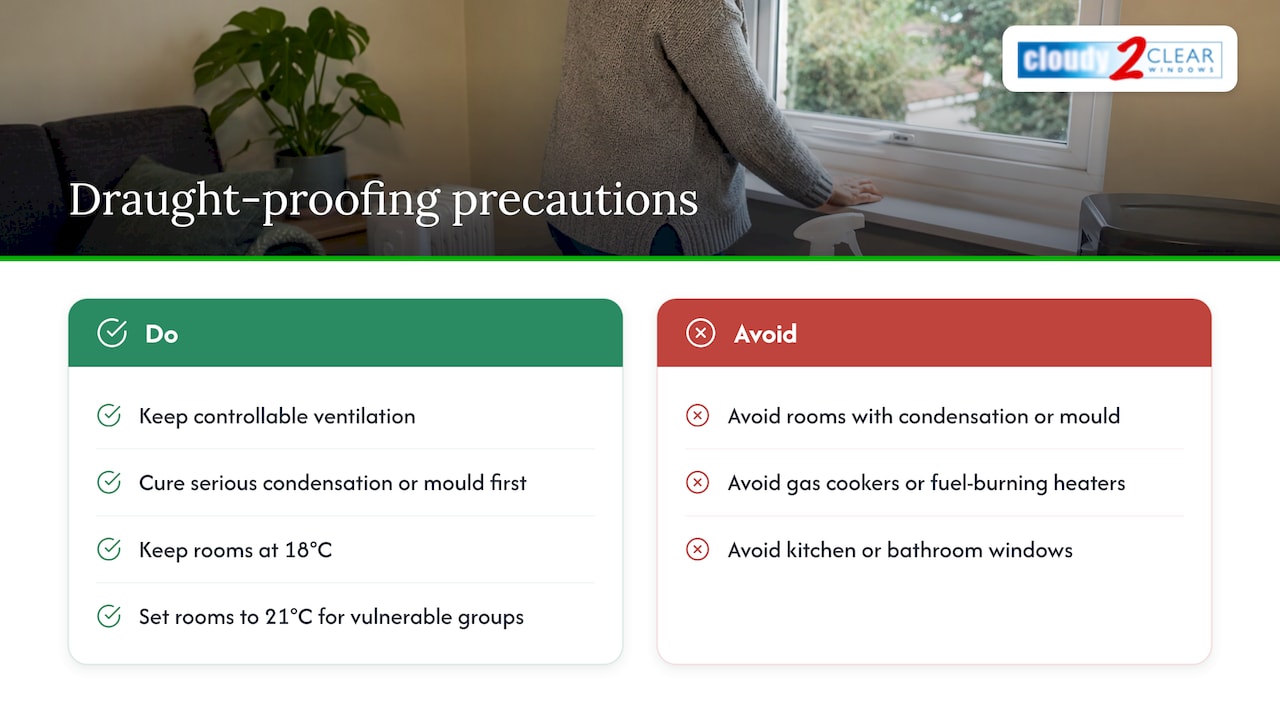
Do not draught-proof a room that already has condensation or mould, a room with a gas cooker or fuel-burning heater, or a kitchen or bathroom window. The NHS leaflet on damp and mould gives this advice. It also suggests keeping rooms at 18°C, or 21°C for older residents, households with under-fives and vulnerable people.
The Air Infiltration and Ventilation Centre adds that draughtproofing should never be done in isolation. Controllable ventilation must remain, and any serious condensation or mould must be cured first. Fuel-burning appliances also need their air supply.
If you have damp or mould that keeps returning, speak to your landlord, housing association or a surveyor about the cause.
Older and listed buildings
Historic England recommends about 0.4 air changes per hour in living and sleeping rooms, or 0.4 to 0.8 in older buildings in reasonable condition. It advises keeping some controllable ventilation that can be closed when a room is not in use. It also warns that condensation is a significant risk when altering older buildings, and can lead to mould and decay of the fabric.
Older buildings often leak more than that range, so draught-proofing is normally beneficial there. The ventilation still has to stay.
What the rules say about trickle vents
England
England’s Approved Document F (2026) was published on 24 March 2026. It says ventilation should, as far as reasonably practicable, protect from cold draughts.
When windows are replaced, GOV.UK guidance says a background ventilator or trickle vent should go in the new window. This replaces the ventilation lost from the old, leakier window, unless it can be shown that useful ventilation was not reduced. Homebuilding reports that since 15 June 2022 this has applied to replacement windows and doors in habitable rooms in England and Wales. Scotland had similar requirements before then.
One local authority building control guide says a night latch cannot replace a trickle vent.
Scotland
Ventilation falls under Standard 3.14 of the Scottish Building Standards Technical Handbook for domestic buildings, which applies to work from 1 January 2025. The 2022 handbook says uncontrollable ventilators are not recommended. Occupants like control, and uncontrollable vents tend to get sealed up to stop draughts.
Vent sizes
Vents are rated by equivalent area in mm², and the figure must be marked on the product where it is visible from inside after fitting. The table shows the figures in the guidance.
| Room | England (2026 guidance, replacement windows without existing vents) | Scotland (2022 handbook) |
|---|---|---|
| Habitable rooms and kitchens | 8,000 mm² | 12,000 mm² for apartments, 10,000 mm² for kitchens |
| Bathrooms | 4,000 mm² | 10,000 mm² for bathrooms and toilets |
The figures come from the Approved Document F Volume 1 text and the Scottish handbook above. Ducted vents need double the area to make up for friction losses. If you are replacing windows in a rented or managed building, check the rules with your building control body.
Our guide to building regulations for windows covers the wider compliance picture. Another article explains the role of vented windows in homes and businesses. For the wider question of fitting replacement windows with background ventilation, this overview of installation costs and requirements is a helpful read for Irish readers.
Noise from trickle vents
Vents let sound in as well as air. Homebuilding names noise as a downside. The Yale white paper recommends noise-attenuating vents on façades near sustained loud noise, such as main roads. We also fit soundproofing and noise reduction glass.
Our perspective
Most draught calls we take turn out to be about the glass, seals or hardware, not the trickle vent. Our approach is to replace only the glass, not the frame, so the work is quicker and causes less disruption than replacing the whole unit.
A failed sealed unit makes the whole window colder, and a cold pane makes any incoming air feel sharper. Fitting new insulated glass restores clarity and energy efficiency, and we back our work with a 25-year guarantee.
Keep the trickle vent open, fix what leaks, and you get warmth and fresh air together.
Get the glass and hardware fixed
If the cold air comes from misted or cracked panes, tired locks or loose hinges, we can help. We handle double glazing replacement, door glass, locks, handles and hinges, conservatory, Velux and commercial windows, and insulated glass units. Our local teams include Stockport, Coventry and Norwich.

Our lines are open 24 hours a day, 7 days a week to book a quote. Our operating hours are 8.30am to 6.30pm.
FAQ
Do trickle vents cause draughts?
They let in a small, controlled flow of air, which can feel cool in wind or cold weather. That is deliberate ventilation, not a fault. If you feel cold air at floor level or around the frame, look at the seals, glass and hardware instead.
Should I close trickle vents in winter?
No. GOV.UK advises leaving them open and unblocked, even in winter. Closing them commonly leads to condensation and stuffiness. If the draught bothers you, deal with the leaks and cold glass around it.
Are trickle vents required by law?
In England, replacement windows should have a background vent where the old window had one, or where useful ventilation would otherwise be lost. Scotland has its own standards under Standard 3.14. Listed buildings and homes with mechanical ventilation are treated differently, so check with your building control body.
How big does a trickle vent need to be?
Size is rated in equivalent area in mm². England’s 2026 guidance sets 8,000 mm² for habitable rooms and kitchens and 4,000 mm² for bathrooms on replacement windows without existing vents. Scotland’s 2022 handbook recommends 12,000 mm² for apartments and 10,000 mm² for wet rooms.
Sources
- Existing home ventilation guide, GOV.UK
- What are trickle vents? Homebuilding
- How to improve your home’s ventilation, Energy Saving Trust
- Draught proofing, Energy Saving Trust
- Do trickle vents cause draughts? RetrofitIQ
- A review of performance specifications and studies of trickle vents, MDPI
- Damp, condensation and mould booklet, Wolverhampton City Council
- Energy efficiency and historic buildings: draught-proofing, Historic England
- Managing damp and mould in the home, NHS leaflet
- Domestic draughtproofing: balancing ventilation needs, AIVC
- Approved Document F (2026), GOV.UK
- Approved Document F Volume 1, ventilation
- Approved Document F Volume 1, Welsh Government copy
- Extensions and alterations guidance booklet, building control
- Meeting the guidance on ventilation, Yale white paper
- Technical Handbook Domestic, January 2025, Scottish Government
- 3.14 Ventilation, Technical Handbook 2022 Domestic
- Double glazing installation requirements overview, TrustyTrades