• USP Logo Icon
    25 Year Guarantee
  • USP Leaf Icon
    Latest ECO Friendly Technology
  • USP Pointer Icon
    National Coverage
Get a FREE quote

Misty windows: how to diagnose and fix the problem

Many homeowners treat misty windows as an unavoidable side effect of British weather. A quick wipe and it is gone, right? Not always. What looks like everyday condensation can actually be a signal that your double glazing has failed internally, and no amount of wiping will fix it. Warm moist air meeting cold glass is what typically triggers condensation, especially in autumn and winter, but the cause determines everything about the right solution. This article walks you through exactly how to tell the difference and what to do next.

What causes misty windows and how to tell the difference

Understanding why your windows turn misty is the first step to solving the problem correctly. Condensation forms when warm moist air meets a cold surface, causing water droplets to appear. That much is well known. What trips people up is assuming all window misting is the same.

There are two distinct problems that look similar but require completely different responses:

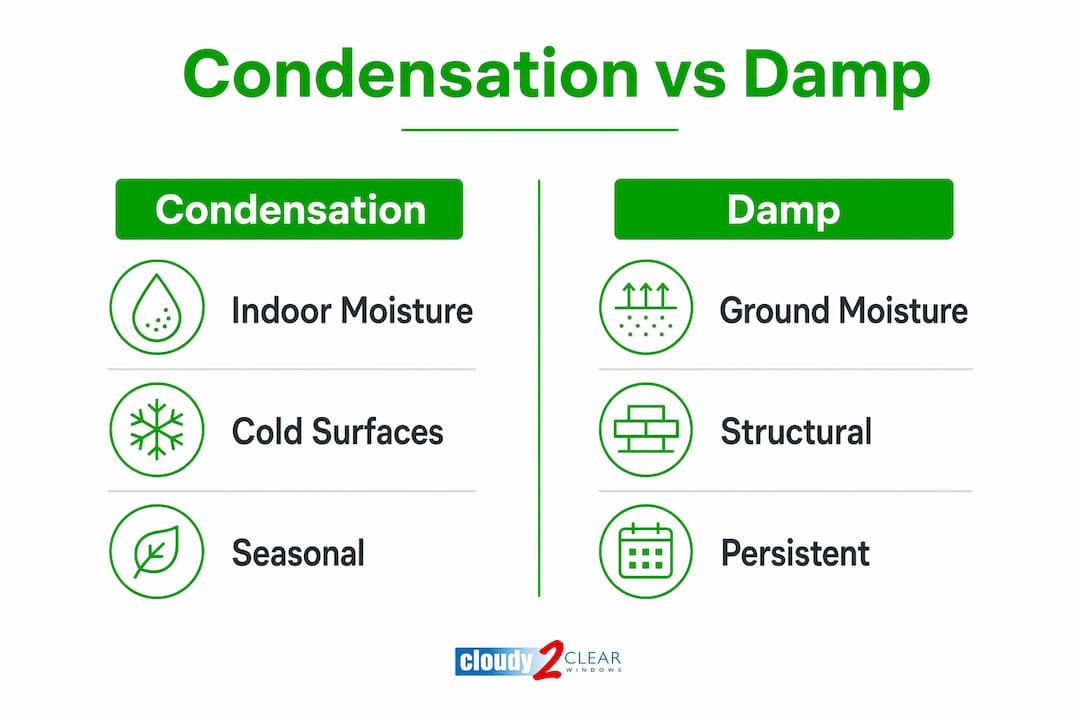
  • Surface condensation forms on the inside face of the glass. It is caused by high indoor humidity and cold glass. You can wipe it off with a cloth. It tends to appear in the morning, especially in winter, and often clears as the room warms up.
  • Sealed-unit failure (also called internal misting) is when moisture is trapped between the two panes of your double glazing. You cannot wipe it away because it is inside the unit. It may look hazy, streaky, or cloudy regardless of the weather outside.

The key diagnostic test is simple: run your finger across the glass. If the mist wipes clean, it is surface condensation. If the haziness is still there, the glazed unit has failed and moisture has entered the sealed cavity.

Feature Surface condensation Sealed-unit failure
Location On the glass surface Between the panes
Can be wiped away? Yes No
Cause High humidity, cold glass Failed hermetic seal
Seasonal pattern Mostly autumn and winter Year-round, persistent
Solution Ventilation and humidity control Sealed unit replacement


Man testing window condensation with finger


Surface condensation is seasonal and manageable. Internal misting is permanent until the unit is replaced. Knowing which one you are dealing with saves you time, money, and frustration.

Now that we understand the nature of misty windows, we can explore how to manage and prevent surface condensation effectively.

Managing and preventing surface condensation effectively

Surface condensation is common across homes and businesses in England and Scotland, particularly in winter when heating is running and windows stay closed. The good news is that most cases respond well to straightforward changes. Ventilation improvements such as daily airing and using extractor fans during cooking or showering are the most effective starting points.

Here is a practical sequence to follow:

  1. Open windows briefly each morning. Even five to ten minutes allows moist overnight air to escape. This single habit makes a noticeable difference in bedroom and bathroom windows.
  2. Use extractor fans in kitchens and bathrooms. These rooms generate the most moisture. Leave fans running for a few minutes after cooking or showering.
  3. Avoid drying clothes on indoor radiators. A single load of washing releases around two litres of moisture into the air as it dries. Use a tumble dryer or dry clothes outside where possible.
  4. Keep curtains open during the day. Closed curtains trap cold air against the glass and reduce airflow, making condensation worse.
  5. Maintain indoor humidity between 40% and 50%. This range is comfortable for occupants and low enough to prevent persistent condensation.

You can also take a few targeted steps to reduce moisture at the source:

  • Place moisture-absorbing products near particularly cold or north-facing windows
  • Ensure trickle vents in window frames are open and unblocked
  • Check that loft and wall insulation is adequate, as poorly insulated walls create cold spots that attract condensation
  • Learn more about long-term strategies with these condensation prevention tips for double glazing

For a more detailed guide on protecting your double glazed units from moisture damage, you can also read about how to prevent condensation in double glazed windows.

Pro Tip: Buy a hygrometer (a small device that measures indoor humidity) and place one in rooms where condensation is worst. They cost around £10 to £15 and take the guesswork out of whether your ventilation efforts are working.

Once surface condensation is controlled or ruled out, we turn to solutions for internal sealed-unit failure and misted double glazing.

Understanding and repairing misted double glazing units

A double glazed unit is made up of two panes of glass with a sealed cavity between them, usually filled with argon gas for insulation. When the hermetic seal (the airtight bond around the edge of the unit) fails, outside moisture enters that cavity. The result is permanent internal fogging that no amount of cleaning or ventilation will shift.

Seal failure typically happens due to age, heat exposure, or frame movement over time. Once it fails, your options are straightforward:

  • Sealed unit replacement: The failed glass unit is removed from the existing frame and replaced with a new one. The frame itself stays in place. This is the standard repair and is suitable for most windows.
  • Full window replacement: The frame and glass are both replaced. This is only necessary if the frame is damaged, warped, or structurally compromised.

The cost difference is significant. Sealed unit replacement typically costs £80 to £250 per pane including fitting, making it far more economical than full window replacement.

Repair type Typical cost (per window) When it is appropriate
Sealed unit replacement £80–£250 Seal failure, frame intact
Full window replacement £400–£900 Frame damaged or severely aged
DIY defogging kits £20–£60 Not recommended (temporary at best)


For a full breakdown of what to budget, the double glazing repair costs UK guide covers current pricing across different window types and regions.

The cost of replacing misted double glazed units is often far lower than people expect, which is why getting a quote before assuming you need full replacement is always worth doing.

Pro Tip: Get at least three written quotes from registered installers before committing to any repair. Prices vary considerably, and having multiple quotes helps you identify fair pricing and avoid unnecessary upselling.

With costs and repair options clear, let us review some practical tips homeowners can use while managing misty window issues.

Temporary fixes and expert tips for homeowners

Before your repair appointment, or while you are deciding on next steps, there are a few things you can try to manage the issue. These are not permanent solutions, but they are practical in the short term.

For surface condensation only, a small amount of washing-up liquid spread thinly across the glass can temporarily reduce misting by altering how water droplets form on the surface. It is not a fix, but it can reduce the visual impact while you put longer-term measures in place.

Here is what else you can do in the short term:

  • Keep radiators clear of furniture and curtains so warm air circulates freely
  • Open trickle vents on window frames to encourage airflow
  • Use a small dehumidifier in rooms with persistent condensation
  • Check window cleaning methods for keeping glass surfaces in the best condition during this period

What to avoid is equally important. DIY defogging kits sold online claim to inject solutions between the panes and clear the misting. Some produce short-term results, but they do not restore the seal or the insulation value of the unit. In some cases, they can introduce additional moisture or chemicals into the cavity.

‘Professional sealed unit replacement is the only permanent solution for misted double glazing.’ — Home Careness

The most useful step you can take is an accurate diagnosis. Understanding how to identify and solve types of window condensation helps you move forward with confidence rather than spending money on approaches that will not last.

Pro Tip: Keep radiators on a low, consistent setting rather than blasting heat on and off. Dramatic temperature swings accelerate seal degradation and contribute to surface condensation.

Understanding temporary fixes prepares homeowners to take informed next steps when addressing misty window problems.

Choosing and working with professionals for double glazing repairs

Finding the right glazier matters. Not just for the quality of the repair, but for avoiding unnecessary costs. Some installers will recommend full window replacement when only the sealed unit needs attention. Obtaining at least three quotes from registered installers ensures you have a fair basis for comparison.

When searching for a professional, keep the following checklist in mind:

  • Look for FENSA-registered glaziers. FENSA is the UK’s primary competent persons scheme for window installation and replacement. Registration means the installer meets industry standards and their work is automatically registered with the local authority.
  • Ask for itemised written quotes. A trustworthy installer will break down costs clearly, including call-out charges, glass unit costs, and fitting fees separately.
  • Confirm exactly what is being replaced. If your frame is sound, you should only be quoted for the sealed unit, not the full window.
  • Ask about guarantees. Reputable glaziers typically offer a guarantee on both the sealed unit and their workmanship, often for five to ten years.
  • Check reviews and regional availability. A local installer with strong reviews in your area is usually a safer choice than a national call centre with subcontracted labour.

Expect a single window sealed unit replacement to take between one and two hours from start to finish. The process is not particularly disruptive, and you should have a clear, properly sealed window by the time the job is done.

If you are based in Scotland, our team covering double glazing repairs in Glasgow and Ayr is available to assess and repair failed sealed units. Further south, our double glazing repairs in Oxford team covers the surrounding region too.

A fresh take on misty windows: balancing DIY and professional repairs

Here is something we have observed over nearly two decades of working with homeowners across England and Scotland: most people either do too little or too much.

They either ignore misted windows for years, assuming it is just cosmetic, or they panic and authorise full window replacements that were never necessary. Both responses are understandable. Neither is ideal.

The honest truth is that the majority of foggy window problems fall into one of two categories. Either it is surface condensation, which costs nothing to fix beyond some ventilation habit changes, or it is sealed-unit failure, which is almost always repairable without replacing the whole window. Mist between panes is caused by seal failure and cannot be resolved by household cleaning methods, but the sealed unit itself is a replaceable component.

What homeowners often overlook is frame condition. If you have an older property with original timber or uPVC frames that are warped, rotting, or poorly fitted, addressing only the glass unit may leave you with the same problem within a few years. A good glazier will flag this before starting work. One who does not mention the frame condition at all is worth being cautious about.

There is also a strong case for monitoring multiple windows at once. Seal failures rarely happen in isolation. If one unit has failed on a set of windows installed at the same time, others are likely not far behind. Grouping repairs in a single visit saves on call-out charges and fitting costs. Staying proactive about preventing condensation in double glazed windows extends the life of your units considerably.

Pro Tip: Walk around your property on a cold morning and check every window for persistent haze. Catching multiple failing units early and grouping the repairs is one of the most practical ways to keep costs down.

Professional double glazing repair services with Cloudy2Clear Windows

If you have worked through this guide and realised your windows need professional attention, we are here to help. At Cloudy2Clear Windows, we have been repairing and replacing failed sealed units across England and Scotland since 2005. Our focus has always been on replacing only what needs replacing, keeping your existing frames wherever possible and saving you money in the process.

https://www.cloudy2clearwindows.co.uk


We cover a wide range of locations, including double glazing repairs in Milton Keynes, repairs in Oxford, and many other areas across England and Scotland. Our glaziers use quality sealed units backed by manufacturer guarantees, and every quote we provide is transparent and itemised. There is no pressure to replace full windows when a sealed unit repair will do the job properly. If you are ready to clear up your misty windows for good, explore our double glazing glass replacement service and get in touch with your local branch today.

Frequently asked questions

What causes windows to become misty between the panes?

Misting between panes means the hermetic seal on your insulated glass unit has failed, allowing moisture to enter and condense inside the glass cavity where it cannot be wiped away.

Can I fix misty windows myself?

For surface condensation, improving ventilation can reduce the problem, but DIY defogging attempts are unreliable for sealed-unit failure. Professional sealed unit replacement is the only permanent solution for internal misting.

How much does it cost to replace a misted double glazed unit in the UK?

Sealed unit replacement typically costs between £80 and £250 per pane including fitting, which is usually considerably less expensive than full window replacement.

How can I prevent surface condensation on my windows?

Reduce indoor humidity and improve ventilation by briefly airing rooms each morning, using extractor fans during cooking and showering, and keeping air circulating freely near windows.

Should I replace the entire window if my double glazing is misty?

Not usually. The glass unit and frame are separate components, and replacing only the sealed unit is typically sufficient unless the frame itself is damaged or structurally compromised.

How windows impact insulation for UK homes and businesses

Most people assume window insulation simply means having glass in a frame. Replace single glazing with double glazing, and the job’s done. In reality, the picture is far more detailed than that. The full performance of any window depends on the whole assembly: the frame material, the edge spacers, the quality of installation, and how well the seals hold over time. For homeowners and businesses across England and Scotland, understanding these factors properly is the difference between windows that genuinely cut energy costs and ones that look modern but still let warmth drain away.

Understanding window insulation: beyond the glass

Having previewed why window insulation is pivotal, let’s break down the terminology and core ideas that drive effective upgrades.

Two measurements matter most when assessing a window’s insulating ability: the U-value and the Window Energy Rating (WER).

The U-value (measured in W/m²K) tells you how much heat passes through the window per square metre, per degree of temperature difference. The lower the number, the better the insulation. A single-glazed window typically has a U-value of around 5.0, while a well-specified double-glazed unit can achieve 1.2 or below. As the BWF Window Energy Performance Toolkit makes clear, insulation performance is primarily about the whole-window U-value and air leakage across the installed assembly, not just the glass in isolation.

The WER (Window Energy Rating) is a letter-based scale running from G (worst) through to A++ (best). It accounts for U-value, solar gain, and air leakage together, giving a more rounded picture of real-world performance. You can learn more about window energy ratings and how they affect your property’s overall efficiency.

Measurement What it tells you Ideal value
U-value (W/m²K) Heat loss per square metre As low as possible (below 1.4 for new installs)
WER (A++ to G) Combined energy performance A or above
Air permeability Air leakage through the assembly As low as possible


Why does this matter so much in practice? Because air leakage through gaps in frames, around beads, and through degraded seals can undermine even the most technically advanced glazing. A window rated to perform at 1.2 W/m²K in a laboratory can perform far worse once poorly installed or left with failing seals in the field. Ensuring your installation follows correct window installation standards is just as important as choosing the right product.

Key factors affecting whole-window insulation include:

  • Frame thermal performance: uPVC, timber, and aluminium frames all conduct heat differently
  • Edge spacer quality: warm-edge spacers at the perimeter of the glazed unit dramatically reduce heat loss at the edges
  • Seal integrity: degraded or poorly fitted seals allow air to bypass the glazing entirely
  • Installation airtightness: gaps between the frame and the reveal can be significant sources of draught

A window is only as good as its weakest point. Focusing purely on the centre-pane glass value ignores the edges, frames, and seals where real-world performance often falls short.

Double vs. triple glazing: insulation explained

With a foundation in how whole-window performance is measured, let’s examine practical glazing solutions and their impact.

Infographic comparing double and triple glazing features

The core principle behind double and triple glazing is straightforward: sealed gaps between panes, usually filled with an inert gas like argon or krypton, slow down the transfer of heat. As the Energy Saving Trust explains, upgrading to double or triple glazing improves insulation by adding a sealed insulating gas layer between panes, reducing heat loss, minimising draughts and cold spots, and lowering the risk of condensation forming on the interior glass surface.

Here is how the two main options compare in everyday terms:

Feature Double glazing Triple glazing
Typical U-value 1.0 to 1.6 W/m²K 0.6 to 0.8 W/m²K
Insulating gas layers 1 2
Noise reduction Good Very good
Weight Standard Heavier (structural check advised)
Cost Moderate Higher upfront
Best suited for Most UK homes and businesses Colder regions, high-exposure sites


Double glazing remains the most practical and cost-effective insulation solution for the majority of properties in England and Scotland. The science behind why it works so well is explored in detail in our article on double glazing science.

Triple glazing takes this further by introducing a second insulating gas layer between three panes. The result is a measurably lower U-value and improved performance in very cold or exposed conditions. If you are weighing up whether the upgrade is right for your property, read our overview of triple glazing pros and when it makes financial sense.

Benefits of upgrading glazing for insulation:

  • Reduced heat loss through the glass surface itself
  • Lower energy bills over the long term
  • Greater thermal comfort, with fewer cold spots near windows
  • Reduced condensation on interior glass surfaces
  • Quieter interior environment, particularly near busy roads

Pro Tip: When comparing quotes for new insulated glass windows, always ask for the whole-window U-value, not just the centre-pane figure. The centre-pane value is consistently lower than the whole-window figure, and the whole-window value is what matters for your actual energy performance.

A useful benchmark: UK Building Regulations currently require a whole-window U-value of 1.4 W/m²K or better for replacement windows in England. Many modern double-glazed units comfortably exceed this requirement.

Frames, edges, and seals: the hidden factors

After choosing optimal glazing, it’s crucial to recognise the importance of frames, edges, and seals that form the insulation boundary.

Closeup of window frame and weather seals


As the Energy Saving Trust confirms, window insulation is strongly affected by performance at the frame, edges, and seals, not just the centre-pane glass. Thermal bridging (where heat bypasses insulation by travelling through a conductive material such as an aluminium frame or a metal edge spacer) can account for a significant share of total window heat loss, even in otherwise well-specified units.

Here is a practical checklist to address the hidden weak points:

  1. Inspect seals annually: Run your hand around the edge of the closed frame in cold weather. Any detectable draught indicates seal degradation that is costing you energy.
  2. Ask about warm-edge spacers: When specifying a new unit, insist on a warm-edge spacer bar rather than a standard aluminium bar. This reduces edge-of-glass heat loss noticeably.
  3. Choose frames wisely: Thermally broken aluminium or good-quality uPVC frames outperform standard aluminium significantly in terms of heat conduction.
  4. Check the installation perimeter: The gap between frame and reveal should be filled with low-expansion foam and finished with an airtight sealant. This step is often rushed on cheaper installations.
  5. Address draughts proactively: Temporary draught-proofing measures can supplement window performance while a full upgrade is planned. Detailed guidance on draught proofing tips covers the most effective approaches.

Thermal bridging at window edges accounts for a disproportionate share of heat loss in many properties. Addressing the edge spacer and frame specification alone can improve whole-window U-values by 10 to 20 percent compared to using standard components.

If seals have already deteriorated, the fix is often simpler than people expect. Our article on sealing drafty windows covers the most practical options, and if you suspect water ingress alongside air leakage, our guide on fixing window leaks walks you through diagnosis and solutions.

Pro Tip: Even new windows can have poor airtightness if installation quality is low. After any new installation, test all opening lights with a piece of thin tissue paper held at the edge. Movement in still indoor air indicates a seal that needs attention before the first cold spell.

Moisture, condensation, and ventilation: balancing insulation

Strengthening insulation raises new questions about moisture control. Let’s review how to balance insulation and air quality.

One of the most overlooked consequences of improving window insulation is the effect it has on moisture behaviour inside your property. When you seal draughts and upgrade glazing, you reduce the accidental ventilation that previously helped to carry humid air out of the building. The result can be increased condensation, particularly on cold wall surfaces near windows.

It is important to distinguish between two very different types of condensation at windows:

Type Location Likely cause Action needed
Surface condensation Inside the glass Humidity too high / poor ventilation Improve ventilation; check heating
Interstitial condensation Inside the sealed unit (misting) Failed seal / unit breakdown Replace the sealed unit
External condensation Outside the glass High-performance glazing (normal) No action needed


As Barry Turner & Son notes, improving insulation and airtightness can make condensation-related damp issues more noticeable if ventilation is not addressed alongside the upgrade. This is not a reason to avoid improving your windows. It is a reason to manage the change thoughtfully.

Practical steps to balance insulation and moisture control:

  • Maintain background ventilation: trickle vents built into window frames provide low-level ventilation without negating draught-proofing gains
  • Use extractor fans in kitchens and bathrooms: these are the primary sources of moisture in most properties
  • Monitor humidity levels: a simple digital hygrometer (available for a few pounds) tells you whether indoor humidity is reaching the risk zone above 70 percent
  • Consider MVHR in new builds or major refurbishments: Mechanical Ventilation with Heat Recovery captures warmth from outgoing stale air and uses it to pre-heat incoming fresh air

For a detailed breakdown of how to identify which type of condensation you are dealing with and how to resolve it, our guide on solving condensation is an excellent starting point.

Upgrading windows: UK ratings, compliance, and heritage considerations

To ensure your insulation project delivers lasting value and meets standards, it’s essential to understand UK energy ratings and compliance matters.

When buying replacement windows in England and Scotland, look for products independently rated through the BFRC (British Fenestration Rating Council). The BFRC scheme verifies WER labels so that the performance you see on paper reflects real-world testing. As the BWF Window Energy Performance Toolkit advises, look for independently rated window performance via BFRC rather than unverified manufacturer claims. The rating incorporates insulation (U-value), air leakage, and solar gain together.

Key points when choosing and specifying compliant windows:

  • Always ask for the BFRC-rated WER label, not just a U-value figure from a brochure
  • Replacement windows must meet Building Regulations: currently a minimum of 1.4 W/m²K whole-window U-value in England
  • FENSA or CERTASS registration: any installer fitting replacement windows must be registered with a competent persons scheme or submit a Building Regulations application on your behalf
  • Commercial properties: may face different compliance requirements; speak to a specialist with commercial installation experience

Heritage and listed building owners face additional considerations. Historic England is clear that retrofit measures for historic buildings should include good detailing and workmanship, balancing thermal performance with heritage constraints and moisture risks. In practice, this often means using secondary glazing rather than replacing original frames, or specifying slim-profile double glazing designed to match the proportions of period windows.

Pro Tip: If your property is listed or in a conservation area, always consult your local planning authority before specifying replacement windows. Some councils have pre-approved product lists for common window types in their area, which can speed the approval process considerably.

Why most people underestimate window insulation — and what actually works

Beyond compliance and technical ratings, it is worth reflecting on what truly leads to insulation success in real homes and businesses.

The standard advice in most guides focuses almost entirely on glazing specification: switch from single to double, upgrade to triple if you can afford it. While glazing matters, this advice systematically undervalues the contribution of everything else.

In our experience working across England and Scotland since 2005, the properties that benefit most from window upgrades are rarely those that simply swap glass. They are the ones where the whole window assembly is addressed: frames, edge spacers, seals, installation quality, and ventilation strategy considered together. The Energy Saving Trust puts it clearly: windows work as part of the building’s overall energy strategy, and the best results come from coordinating window upgrades with the broader insulation and airtightness plan.

What does this mean in practice? It means that a property where seals are failing, where the installation perimeter has never been checked, and where ventilation is either excessive or absent, will not achieve meaningful gains from glazing upgrades alone. Conversely, a property with thoughtfully detailed frames, well-fitted seals, and controlled ventilation can deliver genuinely impressive insulation performance even with standard double glazing.

The other underappreciated factor is installation quality. The same window unit, fitted by two different installers, can perform very differently in the real world. Corners cut on foam filling, rushed seal application, or poorly trimmed frames create air pathways that defeat the entire purpose of the upgrade. Exploring fenestration strategies that take the whole building envelope into account is the approach that consistently delivers results.

Our honest advice: treat your window upgrade as a building fabric project, not a product purchase. The glass matters. Everything around it matters just as much.

Upgrade your windows for lasting insulation and energy savings

If this guide has given you a clearer picture of how window insulation actually works, the next step is finding the right team to help you act on it. Whether you are a homeowner wanting warmer rooms and lower bills, or a business looking to improve the efficiency and comfort of your premises, professional advice and quality installation make all the difference.

https://www.cloudy2clearwindows.co.uk


At Cloudy2Clear Windows, we have been installing, repairing, and replacing double-glazed windows for homeowners and businesses across England and Scotland since 2005. We understand that every property is different, and we approach each project with the whole-window performance picture in mind, not just the glass. From sealed unit replacements to full window upgrades for domestic or commercial properties, our experienced team is ready to help. Get in touch today to find out how we can improve your windows and your comfort this year.

Frequently asked questions

What is a U-value and why does it matter for window insulation?

A U-value measures how much heat passes through your window per square metre; a lower figure means better insulation and, in practice, greater comfort and lower energy bills. The BWF toolkit confirms that U-value is the core measure of thermal transmittance for window assemblies.

Do I need ventilation if I upgrade to airtight windows?

Yes, absolutely. Improved airtightness reduces draughts but can increase indoor humidity if ventilation is not managed, and controlled ventilation under Approved Document F in England is still required to prevent damp and maintain air quality.

How do double and triple glazing differ in insulating ability?

Double glazing creates one insulating gas-filled gap between two panes, while triple glazing adds a second gap and third pane, lowering heat loss further. The Energy Saving Trust notes that triple glazing extends insulation performance with the additional panes and insulating gaps.

Is it possible to improve insulation in historic buildings without damaging the character?

Yes, with careful design, sympathetic materials, and skilled workmanship, meaningful insulation improvements are achievable. Historic England advises that good detailing and workmanship are the key to balancing thermal performance with heritage preservation.

The best home security window features for safer properties

Windows are one of the most commonly exploited entry points in residential and commercial break-ins across England and Scotland. Yet many homeowners and business owners spend thousands on alarm systems and reinforced doors while leaving their windows with outdated locks and standard glazing. The right security window features do not just deter opportunist intruders — they can physically delay forced entry long enough to make an attempt not worth the effort. This guide walks you through the key criteria, certified standards, and practical features that genuinely make a difference.

How to evaluate home security window features

Now that you understand why secure windows are vital, it is important to know what sets apart a truly robust security feature from superficial add-ons. Not all security windows are created equal, and marketing language can make it hard to separate genuine protection from products that simply look the part.

The most important principle is to treat your window as a complete system. A weak point anywhere in that system — whether it is the frame, the glazing, the hardware, or the installation — can undermine the entire assembly. Here is what to assess:

  • Frame integrity: Frames made from reinforced uPVC, thermally broken aluminium, or treated timber should resist twisting, prying, and impact without deforming.
  • Glazing specification: Best security glass choices include laminated, toughened, or combined units that resist both manual attacks and thermal shock.
  • Hardware quality: Locks, hinges, and restrictors must all meet recognised standards and work together as a unit.
  • Attack delay time: How long does the window resist a forced-entry attempt? Even a delay of one to three minutes significantly reduces the chance of a successful break-in.
  • Ventilation security: A window that is secure when shut but insecure in the night-vent position offers only partial protection. Look for locking restrictors that hold the window open at a limited position without being easily defeated.
  • Certification: As a baseline, look for compliance standards for windows that confirm the entire system has been tested, not just individual components. PAS 24 is the mandatory minimum; SBD is a higher police-preferred standard.

Pro Tip: Always ask for full system certification documents rather than accepting assurances about individual parts. A certified frame with uncertified locks is not a certified window.

Certified security: PAS 24 and Secured by Design

Once you have identified the main evaluation criteria, the next logical step is to understand the differences between recognised security ratings and what they guarantee. Two standards dominate the UK market: PAS 24 and Secured by Design (SBD).

PAS 24 (Publicly Available Specification 24) is a British Standard that tests window and door sets against a defined series of forced-entry attacks. These include physical assaults using tools, manipulation of hardware, and attempts to defeat glazing. Any window sold for use in a new build or replacement in England and Wales must meet PAS 24 as a minimum under Building Regulations Part Q.

Secured by Design goes considerably further. This police-backed initiative, run by the UK Police Service, specifies enhanced performance levels that exceed the PAS 24 baseline. SBD-certified products undergo additional testing and must also meet aesthetic and functional requirements that make them suitable for real-world, long-term use. The standard is particularly relevant for ground-floor windows, commercial premises, and any property in a higher-crime area.

“Compliance with Secured by Design is regarded by police as best practice, particularly for ground-floor windows and high-risk premises, offering a level of assurance that goes beyond the legal minimum.”

The table below summarises the key differences:

Feature PAS 24 Secured by Design
Legal requirement Yes (Building Regs Part Q) No (voluntary, but recommended)
Forced-entry testing Standard suite of attacks Extended and more rigorous suite
Police endorsement No Yes
Suitable for high-risk settings Adequate Preferred
Whole-system assessment Required Required and more detailed
Additional performance criteria Basic Enhanced (hardware, glazing, install)


If you are renovating a home, fitting new commercial windows, or upgrading a property in a high-footfall area, SBD certification is worth the investment. Read the full window regulations guide to understand how these standards interact with broader building compliance.

Top physical window features for real-world security

With your understanding of rating systems established, it is time to consider which physical components of a window most contribute to true break-in resistance. Certification tells you a product has been tested; the features below tell you what does the actual work.

Homeowner checking window lock in kitchen


Multi-point locking mechanisms are one of the most impactful upgrades you can make. Traditional single-point locks leave most of the window frame unsecured and can be levered open with relatively little force. Multi-point locks engage at several points along the frame simultaneously, distributing resistance across the whole unit. For all accessible windows, police advice is to fit key-operated locks to every ground-floor and accessible window, including those on upper floors reachable via a drainpipe or flat roof.

Reinforced frames and reveals prevent attackers from exploiting the gap between the window and the wall. Steel reinforcement within uPVC profiles, or solid hardwood cores in timber frames, makes it far harder to spread or collapse the frame under pressure.

Laminated glazing (two or more glass panes bonded with a plastic interlayer) holds together when struck rather than shattering into fragments. This means a smash-and-grab attempt takes far longer and makes considerably more noise. Toughened glass breaks into small, rounded pieces but does not hold together the way laminated glass does, making laminated the better option for security purposes.

Here is a quick summary of physical security features worth prioritising:

  • Multi-point, key-operated locks on all accessible windows
  • Steel-reinforced uPVC or solid aluminium frames
  • Laminated or laminated-toughened glazing units
  • Shoot-bolt hinges that prevent the window being lifted off
  • Locking night-vent restrictors for safe ventilation
  • Security film applied internally for older single-glazed windows in lower-risk settings
  • Internal security bars or grilles for very high-risk commercial premises

For modern secure window styles that combine all these features with contemporary aesthetics, there are options across every frame material and opening type.

Pro Tip: Even a high-specification window is only as secure as its installation. If the frame is not correctly anchored to the reveal or the sealant is poorly applied, the structural integrity is compromised regardless of the product’s certification.

See our dedicated window lock advice for detailed guidance on upgrading existing hardware.

Smart and sensor technologies: electronic window enhancements

Physical upgrades form the backbone of window security, but adding smart sensors can significantly boost both detection and deterrence. Electronic window security has become increasingly accessible and reliable in recent years, making it a practical addition for homes and businesses alike.

Glass-break sensors are among the most useful electronic tools available. They detect the specific acoustic signature produced when glass fractures, triggering an alert or alarm within milliseconds. This gives you early warning even if an intruder does not fully breach the window. Modern sensors like Honeywell’s FG1625, which uses multi-signal analysis and adjustable sensitivity, significantly reduce false alarms while maintaining reliable response. Getting this balance right is critical, as overly sensitive sensors quickly become ignored.

How and where to install sensors correctly:

  1. Mount glass-break sensors on the ceiling or wall opposite the window, within the manufacturer’s specified detection range (typically four to six metres).
  2. Avoid placing sensors in areas with high background noise such as kitchens near appliances or rooms with heavy traffic.
  3. Test each sensor after installation using the manufacturer’s test tool, not by actually breaking glass.
  4. Integrate sensors with your main alarm panel so that activation triggers both a local siren and a remote notification.
  5. Review sensor placement if you add new windows or change the room’s layout.

The table below outlines the main types of smart window sensors and what they offer:

Sensor type How it works Key advantage
Glass-break detector Detects acoustic frequency of glass fracturing Early alert before full breach
Magnetic contact sensor Detects when window opens unexpectedly Simple, reliable, low cost
Vibration sensor Detects impact or tampering on frame or glass Catches early attempts before breakage
PIR window sensor Detects movement close to a window Useful for monitoring unoccupied spaces
Smart window sensor Combines contact detection with app notification Real-time alerts on your phone


It is worth being clear that sensors do not physically stop an intruder. They work best as a second layer of defence behind strong physical features, not as a replacement for them.

Retrofit versus replacement: choosing the right security upgrade

After considering your options for new features, the choice between retrofitting and full replacement depends on the age and vulnerability of your existing window systems.

Retrofitting means adding security enhancements to windows you already have. This is a cost-effective approach when the core frame and glazing are in reasonable condition and the main weakness is outdated hardware or missing sensors. Retrofit options include:

  • Upgrading to multi-point locks
  • Adding locking restrictors for night-vent security
  • Applying internal security film to existing glazing
  • Installing glass-break and magnetic contact sensors
  • Fitting external window bars or grilles to high-risk openings

Full replacement is necessary when the existing frame is structurally weak, the design is non-compliant with current standards, or the glazing is single-pane or badly degraded. Replacing old windows with units certified to PAS 24 or SBD not only improves security but also brings thermal performance and Building Regulations compliance up to modern requirements.

As NPSA guidance advises, where possible use products that have achieved LPS 1673, and if retrofitting is not sufficient, consider fitting new windows designed and installed to meet an appropriate forced-entry standard. The goal of any certified window is to delay or deter rather than offer an absolute guarantee. A window meeting forced-entry standards can buy you the vital minutes needed for an alarm to be raised or for an intruder to abandon the attempt.

Use this quick guide to decide which approach suits your situation:

  • Choose retrofit if: Your frames are structurally sound, the window is less than fifteen years old, and the primary gaps are in hardware or sensors.
  • Choose replacement if: Frames are warped, cracked, or single-glazed, the window fails current Building Regulations, or you need SBD certification for insurance or planning purposes.

For properties considering sustainable window upgrades, full replacement often delivers combined security and energy efficiency benefits that far outweigh the initial cost.

A security expert’s take: don’t underestimate ‘everyday’ vulnerabilities

Here is something that rarely appears in product brochures or certification documents: the majority of residential break-ins in the UK do not involve smashing glass or defeating sophisticated locks. They involve windows that were simply left unlocked, propped open in an insecure position, or fitted with locks that were never actually used. Advanced hardware is genuinely valuable, but its value is zero if the window is not engaged properly.

We have seen properties with SBD-certified windows, laminated glazing, and multi-point locks that were nonetheless vulnerable because the occupant routinely left the night-vent position unsecured. As highlighted in police guidance on window operating states, burglary may occur without any glass breakage at all because the real vulnerability is the window’s operating state, not its specification.

The practical message is this: your security is only as strong as your least consistent habit. A window that is sometimes locked is an unlocked window from a risk perspective.

Pro Tip: Do a window audit of your property. Walk around every room, check every window, and note which ones have functioning locks that are actually used. You may be surprised by what you find, and the fixes are often very simple.

Attention to the ordinary details, such as using locking restrictors every time you open a window for ventilation, checking older fixing window locks before relying on them, and replacing any hardware that feels loose or difficult to operate, consistently delivers more real-world security value than any single product upgrade. Awareness and consistency are security features too.

Enhance your property’s window security with professional solutions

If you are ready to upgrade your physical and practical security, tailored professional services can help you find the right solution for your specific property.

https://www.cloudy2clearwindows.co.uk


At Cloudy2Clear Windows, we have been helping homeowners and businesses across England and Scotland improve their glazing since 2005. Whether you need to repair broken windows to restore security functionality, explore replacement glazing options that bring your windows up to current standards, or arrange commercial security window repairs for your business premises, our experienced team is ready to help. We ensure every installation and repair meets the security, compliance, and performance standards your property deserves.

Frequently asked questions

What is the difference between PAS 24 and Secured by Design for windows?

PAS 24 is the mandatory minimum required by UK Building Regulations, while Secured by Design is a higher police-preferred standard with more rigorous forced-entry testing and police endorsement, making it the better choice for higher-risk properties.

How effective are glass-break sensors as window security features?

Modern sensors such as the Honeywell FG1625, which uses multi-signal analysis and adjustable sensitivity, provide reliable early alerts and are most effective when used as a second layer of protection alongside strong physical window security.

UK police recommend key-operated locks on all ground-floor and accessible windows, as these significantly increase resistance to both opportunist and planned break-in attempts.

Should I retrofit or replace old windows to improve home security?

If existing frames are structurally sound and hardware is the main weakness, targeted retrofits can boost security cost-effectively. However, NPSA guidance advises replacing windows entirely when the core design is weak or non-compliant with current forced-entry standards.

Why use laminated glass: the UK homeowner’s guide

Most people assume all glass is broadly the same. It lets light in, keeps the weather out, and breaks when something hits it hard enough. But if you are a homeowner or business owner weighing up glazing options, that assumption could cost you in safety, comfort, and compliance. Understanding why use laminated glass matters is not just a technical exercise. It is a practical decision that affects how secure your property is, how quiet it feels inside, and whether your installation meets UK building regulations.

What is laminated glass and how is it made

To fully appreciate why laminated glass is favoured, it helps to understand how it is made and what makes it structurally different from a standard pane.

Laminated glass is made from two or more sheets of glass bonded together with a polymer interlayer, most commonly PVB (polyvinyl butyral). That thin layer sits between the glass plies and does something ordinary glass simply cannot. As laminated glass is constructed, the interlayer transfers forces between the plies and keeps fragments adhered after fracture, rather than allowing shards to scatter freely.

Close-up edge of laminated glass on workbench


This construction changes how the glass behaves under stress. Instead of shattering into dangerous pieces, it holds together in a web pattern. The result is a product that is meaningfully stronger and safer than single-pane glass.

Key structural properties of laminated glass include:

  • Fragment retention: Broken pieces stay bonded to the interlayer, not the floor or a person nearby.
  • Impact resistance: The bonded construction resists penetration better than a single pane of equivalent thickness.
  • Structural integrity: Even after breakage, the panel often stays in place, maintaining a barrier.
  • Versatility: Interlayer type, thickness, and glass combinations can be adjusted for specific performance needs.

How laminated glass improves safety and security in UK properties

Now that we know its structure, let us explore how laminated glass delivers superior safety and meets UK legal requirements.

Infographic comparing laminated glass benefits in strength, noise, and safety


The most important safety feature is straightforward. When the interlayer holds fragments together instead of letting shards fall away, the risk of laceration injuries drops significantly. This matters most in locations where people are close to glass, such as doors, low-level windows, staircases, and overhead glazing.

UK building regulations, specifically Part K, take this seriously. Laminated glass is required in critical locations where falling or impact could cause injury. These include:

  • Overhead glazing where breakage could drop glass onto people below.
  • Doors and side panels within 300mm of a door edge.
  • Low-level glazing below 800mm from floor level.
  • Balustrades and guarding where falls are a risk.

For security purposes, laminated glass also outperforms standard glazing. It resists forced entry more effectively because breaking through it takes significantly more effort and time. Even if the outer pane cracks, the interlayer holds everything together, buying time and often deterring intruders entirely.

Laminated glass is not just a safety upgrade. For businesses handling cash, sensitive stock, or operating in high-footfall areas, it is a practical security measure that standard glass cannot replicate.

For a broader look at your options, our types of safety glass guide covers how laminated glass compares with toughened and other safety glazing products.

Acoustic insulation benefits of laminated glass for homes and businesses

Beyond safety, laminated glass also plays a key role in enhancing acoustic comfort for property owners.

Sound travels through glass by vibrating the pane. The polymer interlayer in laminated glass dampens those vibrations, interrupting the path sound takes through the glass. The result is noticeably less noise reaching the inside of your property. Purpose-designed acoustic laminates with appropriate pane thicknesses and asymmetric constructions can significantly reduce sound transmission, often outperforming standard double glazing.

This is worth unpacking. Many people assume double glazing automatically provides strong noise reduction. It does help, but a standard double-glazed unit with two equal-thickness panes can actually create a resonance effect at certain frequencies. Acoustic laminated glass, especially when used with panes of different thicknesses, avoids this by breaking up the resonance pattern.

The benefits are most pronounced in:

  • Urban homes near busy roads, rail lines, or flight paths.
  • Commercial properties in town centres or near industrial areas.
  • Home offices where concentration and quiet are essential.
  • Hotels and hospitality venues where guest comfort depends on low ambient noise.

Proper frame installation matters too. Even the best acoustic glass underperforms if the frames are draughty or poorly sealed. You can read more about reducing noise with double glazing and explore our dedicated soundproofing services for a complete picture.

Pro Tip: If noise reduction is your primary goal, ask your glazing specialist specifically about acoustic laminated glass rather than standard laminated glass. The interlayer formulation makes a real difference to performance. Our acoustic glazing guide explains what to look for.

Regulatory considerations and limitations for laminated glass in the UK

While laminated glass offers many advantages, it is important to consider UK-specific regulatory constraints before installation.

Not every application is straightforward. UK regulations have limited the use of laminated glass for certain balcony balustrades, particularly where fire spread risk is a concern. This is a nuance many property owners miss until they are mid-project.

Here is a practical checklist to work through before specifying laminated glass:

  1. Identify the application. Is it a window, door, balustrade, overhead panel, or spandrel? Each carries different regulatory requirements.
  2. Check Part K compliance. Confirm whether your location qualifies as a critical location under UK building regulations.
  3. Assess fire safety implications. For balconies and external applications, review Regulation 7(3) exemptions and fire spread guidance.
  4. Confirm energy efficiency compliance. Laminated glass must still meet thermal performance requirements under Part L of building regulations.
  5. Consult a qualified installer. Regulatory requirements change, and a specialist will flag issues before they become problems.

Specification should always be driven by the application, not a generic benefit list. Getting this wrong can mean costly retrofitting or planning delays.

Pro Tip: Review our building regulations guide and window installation standards before committing to any laminated glass project. Understanding the regulatory landscape early saves time and money.

Choosing laminated glass for your property: practical applications and aesthetics

Understanding regulations and technical performance helps you make informed choices to match your property’s needs and style.

Laminated glass is not a single product. It comes in a wide range of constructions, thicknesses, and finishes. Choosing the right type depends on what you need it to do and where it will be installed.


Application Recommended type Key benefit
Ground-floor windows Standard laminated or acoustic laminated Safety and noise reduction
Front doors and side panels Laminated safety glass Fragment retention, security
Overhead glazing / rooflights Laminated (mandatory in many cases) Prevents falling shards
Balustrades (internal) Laminated toughened combination Strength and safety
Commercial shopfronts Thicker laminated or laminated toughened Security and impact resistance
Acoustic priority areas Acoustic laminated with asymmetric panes Maximum noise reduction


Beyond performance, laminated glass also offers genuine design flexibility. Tinted interlayers can reduce glare and solar gain. Patterned or frosted options provide privacy without sacrificing light. Coloured interlayers are popular in commercial settings for branding or aesthetic reasons.

Key considerations when choosing laminated glass:

  • Location and exposure: Properties near busy roads, airports, or high-crime areas benefit most from acoustic and security-rated laminated glass.
  • Regulatory triggers: Always confirm which regulations apply to your specific installation location.
  • Frame compatibility: Your existing frames may need upgrading to accommodate thicker laminated units.
  • Budget vs. long-term value: Laminated glass costs more upfront than standard glass, but the combined safety, acoustic, and security benefits often make it the more cost-effective choice over time.

Pro Tip: Do not choose glass type in isolation. Our guide on upgrading security with the right glass and our safety glass guide can help you compare options side by side before speaking to an installer.

Why laminated glass is an overlooked solution for modern UK properties

Having covered the practical and regulatory landscape, it is worth asking a more direct question: why do so many UK property owners still default to standard or toughened glass when laminated glass offers so much more?

In our experience, the answer comes down to three things: misconception, habit, and incomplete advice.

The misconception is that laminated glass is fragile or unnecessarily expensive. Neither is accurate. It is actually more resistant to penetration than toughened glass of the same thickness, and while it costs more than single-pane glass, it replaces the need for separate acoustic treatment, additional security measures, and in some cases, planning complications that arise from using the wrong product.

The habit problem is subtler. Many builders and developers specify toughened glass because it is familiar and straightforward to source. Laminated glass requires a more considered specification process, so it gets passed over even when it is clearly the better choice.

The incomplete advice issue is perhaps the most important. If you are not told early in a project that your balcony, rooflight, or ground-floor window might legally require laminated glass, you may find out only when a surveyor or building inspector raises it. That is an expensive moment to learn.

Our types of safety glass guide is a good starting point for understanding the full picture. But the real lesson is this: always assess your property’s specific needs rather than defaulting to whatever is most common. Laminated glass is not a premium add-on. For many applications, it is simply the right tool for the job.

Discover laminated glass solutions with Cloudy2Clear Windows

If you are weighing up your glazing options, getting the right advice early makes all the difference. At Cloudy2Clear Windows, we have been helping homeowners and businesses across the UK make informed glazing decisions since 2005.

https://www.cloudy2clearwindows.co.uk


We offer a wide range of laminated glass options suited to homes, commercial properties, and specialist applications. Whether you need double glazing replacement that meets current safety standards, expert commercial fenestration services, or local repairs and installations through our Milton Keynes branch and beyond, our team will guide you through the options and ensure full compliance with UK regulations. Speak to us before you specify, not after.

Frequently asked questions

What makes laminated glass safer than regular glass?

Laminated glass includes a polymer interlayer that keeps broken shards adhered, preventing dangerous falling fragments and significantly reducing the risk of injury compared to standard glass.

Can laminated glass help reduce noise in my home or business?

Yes. Laminated glass with acoustic interlayers reduces sound transmission effectively, particularly when combined with asymmetric pane thicknesses and properly sealed frames.

Are there any restrictions for using laminated glass in balconies in the UK?

UK regulations have limited laminated glass use in certain balcony balustrades due to fire safety concerns, so checking specific rules before installation is essential.

How do I ensure my laminated glass installation complies with UK building regulations?

Consult a qualified installer and reference Part K critical location requirements alongside fire safety guidance, confirming your glass type and installation location meet all applicable rules. For balcony applications, also check fire safety balcony regulations before proceeding.

Is laminated glass more expensive than other types of safety glass?

Laminated glass typically costs more upfront than single-pane glass, but its combined safety, acoustic, and security benefits often deliver better long-term value than purchasing separate solutions for each need.

What affects window efficiency? Your guide to saving energy

Window efficiency is one of those topics where it’s easy to think you understand it until you actually try to make sense of the choices. Most people assume it’s simply about how well a window keeps heat in. In reality, window efficiency depends on the balance between heat loss and solar gain, expressed through ratings like the Window Energy Ratings scheme used across the UK. Get just one of these factors wrong and you could end up spending more on heating and cooling than you did before upgrading. This guide explains exactly what drives performance, in plain language you can actually use.

Understanding window efficiency: The basics every homeowner should know

With misconceptions addressed, let’s demystify what actually goes into measuring window efficiency.

There are two core numbers you need to understand before you do anything else. The first is the U-value, which measures how much heat escapes through a window. Lower is better. A U-value of 1.0 W/m²K is more efficient than a U-value of 2.0 W/m²K. The second is the G-value, which measures how much solar energy passes through the glass. A higher G-value means more solar heat enters your room, which can warm your home in winter but may cause overheating in summer.

Neither number works in isolation. This is why the UK uses a combined scoring system called the Window Energy Rating (WER), which runs from band A (most efficient) to band G (least efficient). The WER accounts for both heat loss and solar gain together, giving you a single, easy-to-read label when you’re shopping for new windows. You can start assessing window efficiency for your own property by looking at the WER band on any window you’re considering.

Here is a quick comparison of WER bands and what they typically mean in practice:


WER band Typical U-value (W/m²K) Typical G-value Practical meaning
A+ Below 0.8 0.5 or above Outstanding efficiency, lowest energy bills
A 0.8 to 1.2 0.4 to 0.5 Excellent, recommended for most UK homes
B 1.2 to 1.4 0.3 to 0.4 Good, meets current UK regulations
C 1.4 to 1.6 0.2 to 0.3 Average, may fall below current standards
D to G 1.6 and above Below 0.2 Poor, likely to increase energy bills


Key facts to keep in mind when reading these ratings:

  • A lower U-value always means better heat retention
  • A higher G-value brings in more solar warmth, useful in cooler months
  • WER band B is the current minimum standard for replacement windows in England
  • Focusing only on U-value can mislead you if G-value and air leakage are ignored

When you look at double glazing efficiency in more detail, you will see just how much variance exists between products that might look identical on the shelf.

Pro Tip: Always ask your supplier for both the U-value and G-value data, not just the WER band. Two windows with the same WER band can have very different performance profiles depending on how they balance heat loss and solar gain.

The science behind U-value, G-value and air leakage

Now that you know what each metric means, let’s see how they interact in practice, because not every home or business is the same.

U-value is measured by calculating how much heat flows through one square metre of the window for every degree of temperature difference between inside and outside. In simple terms, a cold Scottish winter night with a 10°C difference between inside and outside will drive more heat out through a poor-performing window than through a well-insulated one. Reducing your U-value from 2.8 (old single glazing) to 1.2 (modern double glazing) can cut the heat loss through that window dramatically.

G-value tells a slightly different story. A south-facing window with a high G-value (say 0.6) will allow significant solar heat into your living room on a sunny February day, effectively acting like passive solar heating and reducing the load on your boiler. The same window in a west-facing office, however, might create uncomfortable overheating on summer afternoons. This is why the solar gains G-value definition matters when you are selecting glazing for different rooms or orientations.

Air leakage is the third factor that many guides simply skip over. It refers to the uncontrolled flow of air through gaps in the window frame, seals, or opening mechanisms. Even a window with an excellent U-value and a well-chosen G-value will underperform if cold air is seeping in around the edges. Air leakage is measured in cubic metres of air per hour per square metre of window area (m³/h.m²). The lower the figure, the better.

Here is how the three factors work together across different property situations:

  1. North-facing windows in Scotland: Prioritise a low U-value and moderate G-value to retain heat. Air leakage is critical here as cold winds are common.
  2. South-facing conservatories in England: A lower G-value helps prevent summer overheating, even if it slightly reduces winter solar gain.
  3. Commercial office buildings: Both U-value and air leakage matter for consistent internal temperatures and lower HVAC costs.
  4. Older Victorian terraces: Focus first on air leakage by sealing frames before investing in full replacement.
  5. New build properties: Must comply with regulated performance benchmarks, currently a maximum U-value of 1.4 W/m²K or the specified WER band under Building Regulations introduced in England in June 2023.

“Even if you improve insulation by lowering your U-value, you may not achieve the expected savings if solar gain and air leakage are not aligned with your property’s orientation, heating strategy, and summer overheating risk.” This is the single most important nuance that homeowners in the UK need to understand before committing to an upgrade.

Your choice of window frame material also plays a role in air leakage performance, as different materials expand and contract at different rates, affecting how well seals hold over time. When selecting glazing options, consider all three metrics together rather than treating them as separate decisions. It is also worth noting that window locking mechanisms and frame integrity go hand in hand, as explored in this UPVC vs wooden windows comparison from a security perspective.

Window design, material, and installation: Do they really matter?

Technical numbers only tell part of the story. Discover how design and build choices affect window efficiency in real homes and offices.

The short answer is yes, they matter enormously. A window with excellent ratings on paper can still fail to deliver if the frame material is poorly suited to your property, or if the installation is rushed or imprecise.

Here is a straightforward comparison of common frame materials used in UK properties:


Frame material Typical U-value contribution Maintenance needs Expected lifespan
uPVC Low (good insulation) Minimal 20 to 35 years
Timber Moderate (varies by treatment) Moderate to high 30 to 60 years with care
Aluminium Higher (can cause thermal bridging) Low 30 to 45 years
Composite Low to moderate Low 25 to 40 years


Thermal bridging is a term worth understanding. It refers to areas where heat bypasses the insulation because the frame conducts it directly from inside to outside. Aluminium frames are particularly prone to this unless they include a thermal break, which is an insulating barrier built into the frame profile. Without it, even the best glazing unit loses efficiency at the edges.

Key factors in glazing type and specification:

  • Single glazing: U-value typically around 5.0 W/m²K, far below current standards
  • Standard double glazing: U-value typically 2.8 W/m²K, acceptable for older properties but not compliant for replacement today
  • Double glazing with low-emissivity (low-E) coating and argon gas fill: U-value typically 1.0 to 1.4 W/m²K, meets current regulations
  • Triple glazing: U-value can reach below 0.8 W/m²K, but higher cost and weight must be justified by your property’s needs

Low-E coatings are thin metallic layers applied to the glass surface. They reflect heat back into the room rather than letting it escape, which significantly improves the U-value without affecting visible light transmission. Argon gas is used between the panes because it conducts heat less readily than air, further reducing heat loss.

Installation quality is where many otherwise good products fail in the real world. Poor sealing around the frame, inadequate fixings, or frames that are not perfectly level will create air leakage points that undermine everything else. Always check that your installer holds relevant credentials and carries out a post-installation inspection. Compliance with Building Regulations for replacement windows must be notified to your local authority or handled through a registered competent person scheme.

The importance of frame material and fenestration design (fenestration simply means the arrangement and sizing of windows in a building) can make a significant difference to both the look and efficiency of your property.

Pro Tip: Always require your installer to show their relevant certification and ask for a written confirmation that the installation meets Building Regulations. A reputable installer will have no hesitation providing this.

Maximising efficiency: Practical tips for the UK climate

Once you grasp what is driving efficiency, you can take concrete steps to optimise your property for the local climate.

Infographic comparing insulation and solar gain factors


The UK climate varies considerably from the south of England to the north of Scotland. Coastal areas bring persistent damp and wind exposure. Urban areas trap heat. Rural Scottish properties can experience temperatures well below freezing for extended periods. A one-size-fits-all approach to window efficiency simply does not work across this range of conditions.

Practical steps you can take right now:

  • Check orientation before choosing G-value: North-facing windows benefit from higher G-values to maximise whatever solar gain is available. South-facing windows, especially in England, may need a lower G-value to prevent summer overheating.
  • Target U-value of 1.4 W/m²K or better for any replacement window to meet current Building Regulations and avoid future compliance issues when selling your property.
  • Inspect seals annually: Run your hand around window frames on a cold, windy day. If you feel cold air, your seals need attention. This is one of the most cost-effective maintenance checks you can carry out.
  • Look for condensation between panes: This is a sign that the sealed unit has failed and the gas fill has been compromised. The insulating properties of the unit will have deteriorated significantly.
  • Use thermal curtains or blinds: These add a secondary layer of insulation during cold nights and can reduce heat loss through even moderately efficient windows.
  • Check for draught gaps around frames: Expanding foam or flexible sealant can address minor gaps without requiring full replacement.

A step-by-step approach to improving efficiency without full replacement:

  1. Identify problem windows using a thermal imaging check or a simple hand test on cold days
  2. Seal any gaps around frames with appropriate weather-stripping or sealant
  3. Add secondary glazing film as a budget retrofit option for single-glazed windows
  4. Install thermal blinds or heavy curtains to supplement existing glazing performance
  5. Schedule a professional inspection if fogging, draughts, or condensation between panes are present

For more detailed guidance, our energy saving tips cover a wide range of practical approaches, and our energy-efficient upgrade guide walks you through the full replacement process step by step. For wider home protection, it is also worth reviewing these window security tips alongside your efficiency improvements.

As a reminder, improving solar gain alignment alongside U-value improvements delivers genuinely better results than chasing either metric alone.

Pro Tip: When shopping for replacement windows, use the WER label as your quick-reference guide. A band A or A+ label tells you instantly that the product has been independently assessed as meeting a strong combined standard for both insulation and solar gain.

Why most window efficiency advice oversimplifies the problem

We have spent nearly two decades at Cloudy2Clear helping homeowners and businesses across England and Scotland make better decisions about their windows. And in that time, one pattern keeps repeating itself: people come to us having read advice that told them simply to “get the best U-value you can afford.” They have done exactly that and still find their energy bills are stubbornly high, or that certain rooms are uncomfortable year-round.

The reason is almost always the same. Good advice on window efficiency cannot ignore G-value, air leakage, or property orientation. It is not enough to fit a window with a U-value of 0.8 W/m²K if the installation is poorly sealed, or if the G-value is mismatched to the room’s exposure. A north-facing bedroom with a low-G glazing unit will feel cold and dim all winter. A south-facing kitchen with a high-G unit will be unbearable in July.

What genuinely works is treating your property as a system. Which direction does each window face? What is your primary concern, keeping heat in during winter or preventing overheating in summer? Do you rely heavily on solar gain as passive heating, or do you have a well-insulated building that does not need it? These are the questions that determine the right specification.

The building regulations guide provides the regulatory framework, but compliance should be your floor, not your ceiling. The best results come from understanding your specific property and making informed choices based on real data, not just the minimum required standard. That combination of regulatory knowledge, climate awareness, and tailored specification is what separates a genuinely efficient window from one that simply ticks a box.

Find the right window upgrade for your property

Making the right choice for your property becomes far easier when you have experienced professionals guiding you through the options.

https://www.cloudy2clearwindows.co.uk


At Cloudy2Clear Windows, we have been helping homeowners and businesses across England and Scotland since 2005. Whether you need a straightforward double glazing replacement or a more complex commercial window repair, our team will assess your property’s specific needs and recommend the right specification for your orientation, climate, and budget. We cover a wide range of locations, including our team in Milton Keynes and many other branches across the country. Get in touch with us today to arrange an assessment and start making your property genuinely more efficient.

Frequently asked questions

What is the most important factor affecting window efficiency?

Both the U-value and G-value together determine overall window efficiency, as the Window Energy Ratings scheme combines both metrics into a single band to reflect real-world performance.

Do triple glazed windows always mean the best energy savings?

Not always. Orientation, G-value, frame type, and installation quality must all suit your climate and property, as improving insulation alone will not deliver expected savings if solar gain and air leakage are not aligned.

What do U-value and G-value actually mean?

U-value shows how much heat escapes through the window, while G-value tells you how much solar energy passes through. The Window Energy Ratings scheme uses both figures together to produce a single efficiency rating.

How do I know if my current windows meet UK regulations?

Most replacement windows must achieve a U-value of 1.4 W/m²K or lower, or reach the necessary WER band under Building Regulations. The regulated performance benchmark is the practical compliance standard for any replacement window installed in England today.