Windows are the single most performance-critical component in any passive house, responsible for 25–40% of heat loss or gain in a typical home. The term “passive house” refers to the internationally recognised Passivhaus standard, a rigorous energy performance framework developed by the Passive House Institute. Windows in passive houses are not simply openings in a wall. They are active thermal components that must balance insulation, solar gain, and airtightness simultaneously. Get them right, and your heating system shrinks. Get them wrong, and no amount of insulation elsewhere will compensate.
What is the role of windows in passive houses?
Windows in passive houses serve three functions at once: they insulate against heat loss, admit controlled solar gain, and maintain airtightness across the building envelope. Each function must be managed in parallel, not in isolation. A window that admits plenty of winter sun but leaks warm air at its frame edges fails the standard regardless of its glass specification.

The Passive House Institute sets a clear benchmark: whole-window U-values must reach 0.80 W/m²K or better in temperate climates, with interior glazing surface temperatures deviating no more than 4.2 K from a 22°C room temperature. That requirement exists to prevent cold radiant discomfort near windows, which is one of the most common complaints in otherwise well-insulated homes. Meeting it demands far more than standard double glazing.
High-performance windows also reduce energy bills in measurable terms. Upgrading from a U-Factor of 0.50 to 0.25 across a home with 20 windows cuts heating demand by 12% and cooling energy use by up to 28%. Those savings compound over decades, making window quality one of the highest-return investments in the building envelope.
What are the key performance metrics for passive house windows?
Four metrics define whether a window qualifies for passive house use. Understanding each one helps you specify correctly from the outset.
| Metric | What it measures | Passive house target |
|---|---|---|
| U-Factor (W/m²K) | Rate of heat loss through the whole window | 0.80 or lower (temperate); ~0.14 in severe climates |
| SHGC | Fraction of solar radiation admitted | 0.30–0.40 (cold, south-facing); 0.20–0.25 (hot climates) |
| Visible transmittance | Amount of daylight admitted | Higher values preferred for occupied spaces |
| Sound transmission class | Acoustic insulation performance | Relevant for urban or noisy sites |
U-Factor is the most cited metric in passive house specifications. Lower values mean less heat escapes through the window. Baseline ENERGY STAR windows target a U-Factor of 0.22, while passive house windows in severe climates require approximately 0.14. That gap is significant and cannot be closed by frame design alone.
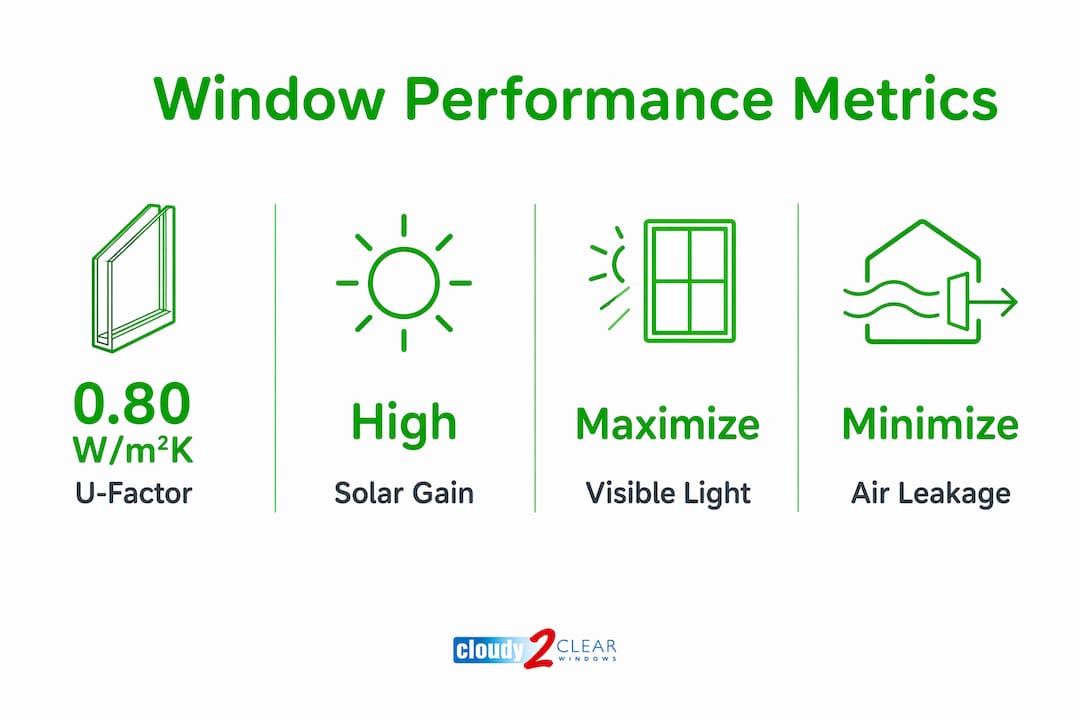
Solar Heat Gain Coefficient (SHGC) measures how much solar radiation passes through the glass into the room. Cold climate zones prioritise SHGC 0.30–0.40 on south-facing windows to capture free winter heat. Hot or mixed climates require SHGC 0.20–0.25 to limit unwanted heat gain and reduce cooling loads. Specifying the wrong SHGC for your climate is one of the most common and costly errors in passive house window selection.
Visible transmittance determines how much daylight enters the space. High-performance coatings that improve U-Factor can reduce visible transmittance if not specified carefully. Always check both values together.
Pro Tip: Ask your supplier for the whole-window U-value, not just the centre-of-glass value. The frame and edge spacer can account for a significant portion of total heat loss, and centre-of-glass figures alone will give you an overly optimistic picture.
How does window placement affect passive house performance?
Window orientation is as important as window specification. Placing the right window in the wrong location undermines the entire energy strategy.
- South-facing windows are the primary solar collectors in UK passive houses. They should carry a higher SHGC to admit winter sun and be sized generously relative to other orientations.
- North-facing windows contribute little solar gain and should be minimised in area. Where they are needed for daylight or ventilation, specify the lowest U-Factor available.
- East and west-facing windows admit low-angle morning and evening sun, which is difficult to shade with fixed overhangs. Limit their area or specify external shading devices.
- Shading design must account for summer overheating. Large south-facing windows suit cold climates but require carefully calculated overhangs or external blinds to prevent summer overheating in mixed climates.
- Thermal mass works alongside glazing. Concrete floors or masonry walls behind south-facing windows absorb daytime solar heat and release it slowly overnight, smoothing temperature swings.
The principle of strategic sizing and placement over uniform large glazing is well established in passive solar design. More glass does not automatically mean more comfort or lower energy use. It means more variables to manage.
Pro Tip: Use the Passive House Planning Package (PHPP) to model each window’s contribution to annual heating demand before finalising sizes. Changing a window from 1.2 m² to 1.8 m² on the south elevation can shift your annual heating demand by several kWh/m² per year.
Architects working on passive house projects should treat window placement as a structural decision, not a finishing detail. Homeowners commissioning new builds should ask their designer to show PHPP outputs for each orientation before planning permission is sought.
What types of windows are used in passive houses?
Triple-pane glazing is the standard construction for passive house windows, not an optional upgrade. Triple-pane adoption is rising to meet U-Factor requirements of 0.22 or lower, with the median cost of such upgrades around £16,000 for a full house. That figure is significant, but it must be weighed against reduced mechanical system costs and long-term energy savings.
The four components that determine passive house window performance are:
- Glazing unit. Three panes of glass with two gas-filled cavities. Argon or krypton fill reduces conductive heat transfer between panes. Low-emissivity (low-e) coatings on inner surfaces reflect heat back into the room. Sunlight control coatings and gas fills critically impact performance beyond the number of panes alone.
- Frame material. Timber, uPVC, fibreglass, and aluminium with thermal breaks are all used. Timber and fibreglass frames offer the lowest thermal conductivity. Aluminium frames require a continuous thermal break to avoid becoming a cold bridge at the frame edge.
- Spacer bar. The spacer separating the panes at the glass edge must be a “warm edge” type. Steel spacers conduct heat rapidly and cause condensation at the glass edge. Foam or composite warm-edge spacers reduce this significantly.
- Installation and sealing. Installation errors at junctions are the most common failure point, even with high-specification windows. The window must be set within the insulation layer, not in front of it, to avoid thermal bridging at the reveal. All joints must be sealed with airtight tapes on the interior and vapour-open membranes on the exterior.
Fixed glazing consistently outperforms operable windows on U-Factor because there are no moving seals to degrade over time. Where ventilation is needed, tilt-and-turn windows with multi-point locking mechanisms provide the best airtightness among operable types. You can read more about selecting glazing options for energy performance on the Cloudy2Clear Windows website.
How do windows influence other passive house systems?
Windows affect every other system in a passive house. Their performance determines how large your heating system needs to be, how your ventilation strategy is designed, and whether your airtightness target is achievable.
- Mechanical system sizing. High-performance window investments allow downsizing mechanical heating and cooling systems, offsetting the initial window premium. A passive house with correctly specified windows may need only a small heat recovery ventilation unit rather than a full central heating system.
- Airtightness. Windows are one of the highest-risk points for air leakage in the building envelope. Poor installation creates gaps that undermine the whole-house airtightness target of 0.6 air changes per hour at 50 pascals, which is the Passivhaus standard.
- Condensation risk. High-performance windows keep interior glass surfaces warmer, reducing condensation. Energy Star certified windows improve efficiency by around 20% over standard windows and reduce condensation and draughts significantly in cold weather.
- Ventilation integration. Passive houses rely on mechanical ventilation with heat recovery (MVHR) rather than opening windows for fresh air. Window specification should account for this: operable windows are used for summer cooling and emergency ventilation, not as the primary fresh air source.
- Energy modelling. Windows integrated early in PHPP modelling ensure accurate energy performance expectations and avoid costly redesigns. Windows must be modelled based on their actual installed position to reflect precise thermal bridging and insulation continuity.
Selecting windows late in design causes performance mismatches and forces expensive changes to mechanical systems. Specify windows at the same stage as structural elements, not as a finishing decision.
What we have learned from two decades of window installations
After more than 20 years fitting and replacing windows across the UK, the pattern we see most often is this: homeowners and architects treat windows as a product decision rather than a system decision. They select a glazing unit with impressive U-Factor figures and assume the job is done. The installation detail is where passive house performance is won or lost.
The most expensive mistake we encounter is a high-specification triple-glazed unit installed in the outer leaf of a cavity wall, bridging the insulation layer entirely. The glass performs to specification. The reveal does not. The result is condensation, cold spots, and a heating demand that never matches the design prediction.
Fewer, better-placed windows consistently outperform a wall of glass in both energy terms and occupant comfort. A modest south-facing window in a well-insulated room feels warmer than a large glazed wall with a cold radiant surface at night. That is a physical reality, not a design preference.
The other lesson is that window quality and installation are inseparable. A £3,000 window fitted poorly will underperform a £1,200 window fitted correctly. Specify the installation standard with the same rigour you apply to the product specification. Ask for airtight tape details, thermal bridge calculations at the reveal, and a blower door test after installation to verify performance.
How Cloudy2Clear Windows can help with your passive house project
Choosing the right windows for an energy-efficient home is a significant decision, and getting the installation right matters just as much as the product itself.

Cloudy2Clear Windows has been installing and replacing double and triple glazed windows across the UK since 2005. Our teams understand the thermal performance requirements that passive house and energy-efficient design demands, from correct frame placement within the insulation layer to airtight junction sealing. Whether you are in Milton Keynes, Watford, or elsewhere across our local service areas, our experienced installers can help you achieve the performance your project requires. For double glazing replacement or a full window upgrade, contact Cloudy2Clear Windows to discuss your requirements.
FAQ
What U-value do passive house windows need?
Passive house windows require a whole-window U-value of 0.80 W/m²K or better in temperate climates. In severe cold climates, the target drops to approximately 0.14 W/m²K.
Are triple-glazed windows necessary for a passive house?
Triple-pane glazing is the standard for passive house certification, not an optional upgrade. Double glazing cannot reliably meet the U-Factor and interior surface temperature requirements set by the Passive House Institute.
What is SHGC and why does it matter in passive house design?
SHGC, or Solar Heat Gain Coefficient, measures how much solar radiation a window admits. Cold climates need higher SHGC values (0.30–0.40) on south-facing windows to capture free heat, while hot climates need lower values (0.20–0.25) to reduce cooling loads.
Does window placement really affect energy performance?
Window orientation directly affects heating and cooling demand. South-facing windows with appropriate SHGC values reduce heating loads in winter, while poorly placed east or west-facing windows can cause overheating without adequate shading.
Can I upgrade existing windows to meet passive house standards?
Replacing existing windows with triple-glazed units improves performance significantly, but full passive house compliance also requires correct installation within the insulation layer and airtight sealing at all junctions. A product upgrade alone is rarely sufficient without attention to the installation detail.