Window efficiency is one of those topics where it’s easy to think you understand it until you actually try to make sense of the choices. Most people assume it’s simply about how well a window keeps heat in. In reality, window efficiency depends on the balance between heat loss and solar gain, expressed through ratings like the Window Energy Ratings scheme used across the UK. Get just one of these factors wrong and you could end up spending more on heating and cooling than you did before upgrading. This guide explains exactly what drives performance, in plain language you can actually use.
Understanding window efficiency: The basics every homeowner should know
With misconceptions addressed, let’s demystify what actually goes into measuring window efficiency.
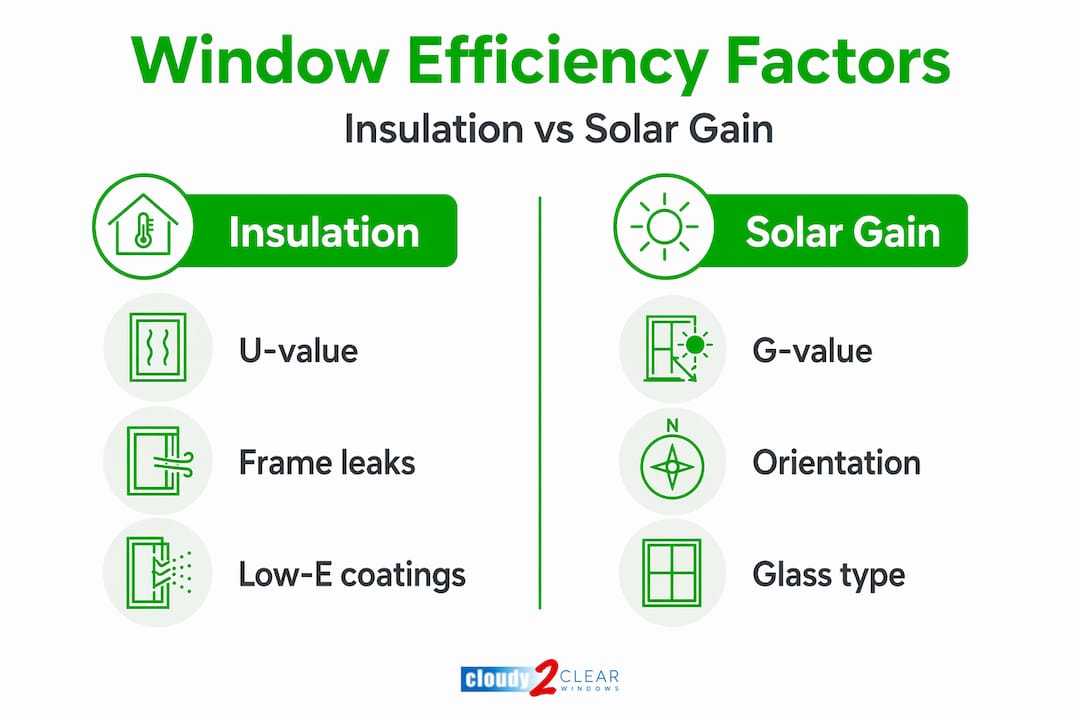
There are two core numbers you need to understand before you do anything else. The first is the U-value, which measures how much heat escapes through a window. Lower is better. A U-value of 1.0 W/m²K is more efficient than a U-value of 2.0 W/m²K. The second is the G-value, which measures how much solar energy passes through the glass. A higher G-value means more solar heat enters your room, which can warm your home in winter but may cause overheating in summer.
Neither number works in isolation. This is why the UK uses a combined scoring system called the Window Energy Rating (WER), which runs from band A (most efficient) to band G (least efficient). The WER accounts for both heat loss and solar gain together, giving you a single, easy-to-read label when you’re shopping for new windows. You can start assessing window efficiency for your own property by looking at the WER band on any window you’re considering.
Here is a quick comparison of WER bands and what they typically mean in practice:
| WER band | Typical U-value (W/m²K) | Typical G-value | Practical meaning |
|---|---|---|---|
| A+ | Below 0.8 | 0.5 or above | Outstanding efficiency, lowest energy bills |
| A | 0.8 to 1.2 | 0.4 to 0.5 | Excellent, recommended for most UK homes |
| B | 1.2 to 1.4 | 0.3 to 0.4 | Good, meets current UK regulations |
| C | 1.4 to 1.6 | 0.2 to 0.3 | Average, may fall below current standards |
| D to G | 1.6 and above | Below 0.2 | Poor, likely to increase energy bills |
Key facts to keep in mind when reading these ratings:
- A lower U-value always means better heat retention
- A higher G-value brings in more solar warmth, useful in cooler months
- WER band B is the current minimum standard for replacement windows in England
- Focusing only on U-value can mislead you if G-value and air leakage are ignored
When you look at double glazing efficiency in more detail, you will see just how much variance exists between products that might look identical on the shelf.
Pro Tip: Always ask your supplier for both the U-value and G-value data, not just the WER band. Two windows with the same WER band can have very different performance profiles depending on how they balance heat loss and solar gain.
The science behind U-value, G-value and air leakage
Now that you know what each metric means, let’s see how they interact in practice, because not every home or business is the same.
U-value is measured by calculating how much heat flows through one square metre of the window for every degree of temperature difference between inside and outside. In simple terms, a cold Scottish winter night with a 10°C difference between inside and outside will drive more heat out through a poor-performing window than through a well-insulated one. Reducing your U-value from 2.8 (old single glazing) to 1.2 (modern double glazing) can cut the heat loss through that window dramatically.
G-value tells a slightly different story. A south-facing window with a high G-value (say 0.6) will allow significant solar heat into your living room on a sunny February day, effectively acting like passive solar heating and reducing the load on your boiler. The same window in a west-facing office, however, might create uncomfortable overheating on summer afternoons. This is why the solar gains G-value definition matters when you are selecting glazing for different rooms or orientations.
Air leakage is the third factor that many guides simply skip over. It refers to the uncontrolled flow of air through gaps in the window frame, seals, or opening mechanisms. Even a window with an excellent U-value and a well-chosen G-value will underperform if cold air is seeping in around the edges. Air leakage is measured in cubic metres of air per hour per square metre of window area (m³/h.m²). The lower the figure, the better.
Here is how the three factors work together across different property situations:
- North-facing windows in Scotland: Prioritise a low U-value and moderate G-value to retain heat. Air leakage is critical here as cold winds are common.
- South-facing conservatories in England: A lower G-value helps prevent summer overheating, even if it slightly reduces winter solar gain.
- Commercial office buildings: Both U-value and air leakage matter for consistent internal temperatures and lower HVAC costs.
- Older Victorian terraces: Focus first on air leakage by sealing frames before investing in full replacement.
- New build properties: Must comply with regulated performance benchmarks, currently a maximum U-value of 1.4 W/m²K or the specified WER band under Building Regulations introduced in England in June 2023.
“Even if you improve insulation by lowering your U-value, you may not achieve the expected savings if solar gain and air leakage are not aligned with your property’s orientation, heating strategy, and summer overheating risk.” This is the single most important nuance that homeowners in the UK need to understand before committing to an upgrade.
Your choice of window frame material also plays a role in air leakage performance, as different materials expand and contract at different rates, affecting how well seals hold over time. When selecting glazing options, consider all three metrics together rather than treating them as separate decisions. It is also worth noting that window locking mechanisms and frame integrity go hand in hand, as explored in this UPVC vs wooden windows comparison from a security perspective.
Window design, material, and installation: Do they really matter?
Technical numbers only tell part of the story. Discover how design and build choices affect window efficiency in real homes and offices.
The short answer is yes, they matter enormously. A window with excellent ratings on paper can still fail to deliver if the frame material is poorly suited to your property, or if the installation is rushed or imprecise.
Here is a straightforward comparison of common frame materials used in UK properties:
| Frame material | Typical U-value contribution | Maintenance needs | Expected lifespan |
|---|---|---|---|
| uPVC | Low (good insulation) | Minimal | 20 to 35 years |
| Timber | Moderate (varies by treatment) | Moderate to high | 30 to 60 years with care |
| Aluminium | Higher (can cause thermal bridging) | Low | 30 to 45 years |
| Composite | Low to moderate | Low | 25 to 40 years |
Thermal bridging is a term worth understanding. It refers to areas where heat bypasses the insulation because the frame conducts it directly from inside to outside. Aluminium frames are particularly prone to this unless they include a thermal break, which is an insulating barrier built into the frame profile. Without it, even the best glazing unit loses efficiency at the edges.
Key factors in glazing type and specification:
- Single glazing: U-value typically around 5.0 W/m²K, far below current standards
- Standard double glazing: U-value typically 2.8 W/m²K, acceptable for older properties but not compliant for replacement today
- Double glazing with low-emissivity (low-E) coating and argon gas fill: U-value typically 1.0 to 1.4 W/m²K, meets current regulations
- Triple glazing: U-value can reach below 0.8 W/m²K, but higher cost and weight must be justified by your property’s needs
Low-E coatings are thin metallic layers applied to the glass surface. They reflect heat back into the room rather than letting it escape, which significantly improves the U-value without affecting visible light transmission. Argon gas is used between the panes because it conducts heat less readily than air, further reducing heat loss.
Installation quality is where many otherwise good products fail in the real world. Poor sealing around the frame, inadequate fixings, or frames that are not perfectly level will create air leakage points that undermine everything else. Always check that your installer holds relevant credentials and carries out a post-installation inspection. Compliance with Building Regulations for replacement windows must be notified to your local authority or handled through a registered competent person scheme.
The importance of frame material and fenestration design (fenestration simply means the arrangement and sizing of windows in a building) can make a significant difference to both the look and efficiency of your property.
Pro Tip: Always require your installer to show their relevant certification and ask for a written confirmation that the installation meets Building Regulations. A reputable installer will have no hesitation providing this.
Maximising efficiency: Practical tips for the UK climate
Once you grasp what is driving efficiency, you can take concrete steps to optimise your property for the local climate.
The UK climate varies considerably from the south of England to the north of Scotland. Coastal areas bring persistent damp and wind exposure. Urban areas trap heat. Rural Scottish properties can experience temperatures well below freezing for extended periods. A one-size-fits-all approach to window efficiency simply does not work across this range of conditions.
Practical steps you can take right now:
- Check orientation before choosing G-value: North-facing windows benefit from higher G-values to maximise whatever solar gain is available. South-facing windows, especially in England, may need a lower G-value to prevent summer overheating.
- Target U-value of 1.4 W/m²K or better for any replacement window to meet current Building Regulations and avoid future compliance issues when selling your property.
- Inspect seals annually: Run your hand around window frames on a cold, windy day. If you feel cold air, your seals need attention. This is one of the most cost-effective maintenance checks you can carry out.
- Look for condensation between panes: This is a sign that the sealed unit has failed and the gas fill has been compromised. The insulating properties of the unit will have deteriorated significantly.
- Use thermal curtains or blinds: These add a secondary layer of insulation during cold nights and can reduce heat loss through even moderately efficient windows.
- Check for draught gaps around frames: Expanding foam or flexible sealant can address minor gaps without requiring full replacement.
A step-by-step approach to improving efficiency without full replacement:
- Identify problem windows using a thermal imaging check or a simple hand test on cold days
- Seal any gaps around frames with appropriate weather-stripping or sealant
- Add secondary glazing film as a budget retrofit option for single-glazed windows
- Install thermal blinds or heavy curtains to supplement existing glazing performance
- Schedule a professional inspection if fogging, draughts, or condensation between panes are present
For more detailed guidance, our energy saving tips cover a wide range of practical approaches, and our energy-efficient upgrade guide walks you through the full replacement process step by step. For wider home protection, it is also worth reviewing these window security tips alongside your efficiency improvements.
As a reminder, improving solar gain alignment alongside U-value improvements delivers genuinely better results than chasing either metric alone.
Pro Tip: When shopping for replacement windows, use the WER label as your quick-reference guide. A band A or A+ label tells you instantly that the product has been independently assessed as meeting a strong combined standard for both insulation and solar gain.
Why most window efficiency advice oversimplifies the problem
We have spent nearly two decades at Cloudy2Clear helping homeowners and businesses across England and Scotland make better decisions about their windows. And in that time, one pattern keeps repeating itself: people come to us having read advice that told them simply to “get the best U-value you can afford.” They have done exactly that and still find their energy bills are stubbornly high, or that certain rooms are uncomfortable year-round.
The reason is almost always the same. Good advice on window efficiency cannot ignore G-value, air leakage, or property orientation. It is not enough to fit a window with a U-value of 0.8 W/m²K if the installation is poorly sealed, or if the G-value is mismatched to the room’s exposure. A north-facing bedroom with a low-G glazing unit will feel cold and dim all winter. A south-facing kitchen with a high-G unit will be unbearable in July.
What genuinely works is treating your property as a system. Which direction does each window face? What is your primary concern, keeping heat in during winter or preventing overheating in summer? Do you rely heavily on solar gain as passive heating, or do you have a well-insulated building that does not need it? These are the questions that determine the right specification.
The building regulations guide provides the regulatory framework, but compliance should be your floor, not your ceiling. The best results come from understanding your specific property and making informed choices based on real data, not just the minimum required standard. That combination of regulatory knowledge, climate awareness, and tailored specification is what separates a genuinely efficient window from one that simply ticks a box.
Find the right window upgrade for your property
Making the right choice for your property becomes far easier when you have experienced professionals guiding you through the options.

At Cloudy2Clear Windows, we have been helping homeowners and businesses across England and Scotland since 2005. Whether you need a straightforward double glazing replacement or a more complex commercial window repair, our team will assess your property’s specific needs and recommend the right specification for your orientation, climate, and budget. We cover a wide range of locations, including our team in Milton Keynes and many other branches across the country. Get in touch with us today to arrange an assessment and start making your property genuinely more efficient.
Frequently asked questions
What is the most important factor affecting window efficiency?
Both the U-value and G-value together determine overall window efficiency, as the Window Energy Ratings scheme combines both metrics into a single band to reflect real-world performance.
Do triple glazed windows always mean the best energy savings?
Not always. Orientation, G-value, frame type, and installation quality must all suit your climate and property, as improving insulation alone will not deliver expected savings if solar gain and air leakage are not aligned.
What do U-value and G-value actually mean?
U-value shows how much heat escapes through the window, while G-value tells you how much solar energy passes through. The Window Energy Ratings scheme uses both figures together to produce a single efficiency rating.
How do I know if my current windows meet UK regulations?
Most replacement windows must achieve a U-value of 1.4 W/m²K or lower, or reach the necessary WER band under Building Regulations. The regulated performance benchmark is the practical compliance standard for any replacement window installed in England today.